REVIEW: Emma.

Autumn de Wilde’s Emma. offers a refreshingly whimsical and defiant, pastel-colored adaptation of Jane Austen’s classic romance-comedy novel. The quirky addition of punctuating the title itself complements the film’s mood and aesthetics perfectly, and reflects the protagonist’s emphatic and self-assured mannerisms. The film opens with an elegant quote and homage to Austen’s 1815 novel,

“Emma Woodhouse, handsome, clever, and rich… had lived nearly twenty-one years in the world with very little to distress or vex her.” – Jane Austen, 1815

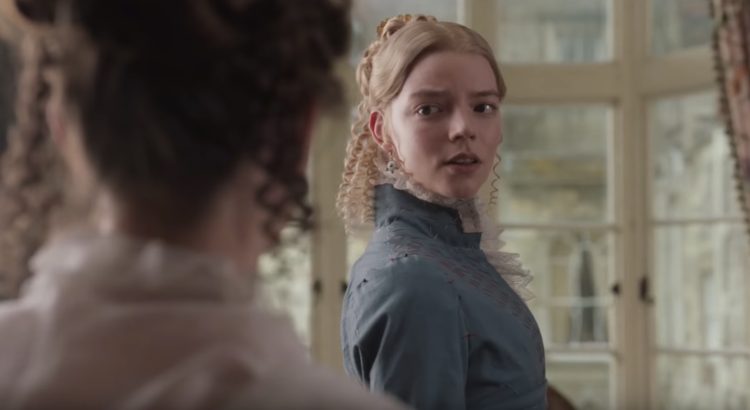
Indeed, actress Anya Taylor-Joy portrays the titular character Emma Woodhouse every bit as ‘handsome, clever, and rich’ as she perceives herself to be. Taylor-Joy has perfected the detached and rational, yet keenly observant composure unique to Emma and other queen-bee characters, which she punctuates with a penetrating and cool stare that the viewer learns to associate with the plot’s twists, turns, and grievous misunderstandings. Unabashedly headstrong as Emma may be, the character has historically carried certain unlikeable qualities that set Emma apart from Austen’s other famous female protagonists – Emma is spoiled rich and prideful, and with that pride wholly conforms to her period’s class and status norms. Additionally, her stubborn convictions as a self-proclaimed neighborhood matchmaker are almost manipulative, especially when examined alongside the friendship she forms with the less-sophisticated, bumbling Harriet Smith. However, de Wilde’s adaptation and Taylor-Joy’s performance not only allow but also highlight these traditionally unfavorable traits, which is precisely what I find most charming about this film. Unlike its predecessors, Emma. does not attempt as much to reconcile Emma’s haughty, self-satisfied nature with ‘good-girl’ behavior; to the end, Emma’s pride remains undiluted, even as she receives her happy ending with Mr. Knightley. Taylor-Joy with Johnny Flynn, who plays Knightley in the movie.

Though de Wilde’s interpretation of Emma. is slightly modernized in terms of its unapologetic treatment of Emma, the storyline and costume elements remain true to the original narrative while introducing color and whimsy. The cinematography and visual aesthetics of Emma. are every bit as vivid and spirited as the female lead herself, and can be likened to a sugary and symmetrical Parisian macaron. De Wilde’s use of visual symmetry is consistent and strategic, most evidently when interweaving type into lush backgrounds and more subtly to emphasize Emma’s careful hold on her town’s social hierarchy. In later scenes, the visual symmetry is pushed to represent symmetries between characters such as Emma and Jane Fairfax, a multitalented, elegant woman of Emma’s same age. The dreamy and ornate filming locations, shot around England, further emphasize the lavish lives of the characters in Emma. and the comedic frivolity of their distresses.

If you’re seeking a wonderfully lighthearted, visually pleasing period film – I would highly recommend heading over to the Michigan Theater to watch Emma. You can find tickets here.

PREVIEW: Talisk at the Ark

This next Tuesday, March 10th, Talisk is coming to Ann Arbor! This performance will mark the second time that this world-renowned Celtic/Folk band has played at the Ark! Within only four years since their formation, Talisk has already raked in several major awards, including Folk Band of the Year 2017 at the BBC Alba Scots Trad Music Music Awards.

With tickets priced at $20, the doors open at 7:30PM and the show starts promptly at 8:00PM.

Be sure not to miss out on this terrific trio!

REVIEW: Mary Poppins

It’s a real tall order to ask a live performance to be able to make magic in front of their audience’s eyes, and you can bet none of these 100+ Burns Parks Elementary students are much over 4’10”.

Somehow, the group of kids, with the help of a few adult actors, crew, and directors, did just that. From the wondrous costume design to the joyful choreography, this production succeeded in every meaning of the word.

While I might usually stick to metrics of artistry and professionalism to review a performance, this production of Mary Poppins is impossible to judge that way. It was just too darn adorable. Exhibit A is to your right. Image may contain: 4 people, people sitting, hat, child, stripes, outdoor and closeup

Emily Betz is the magician behind the costume design, which really brought the show together. The way she balances bold, whimsical colors without it being too brash or distracting is amazing. It’s no wonder she specializes in all things Disney. It takes a special, rare kind of person to so perfectly embody childishness as art in the way she does. The fact that just about everything was handmade was shocking, and I’m sure a great joy to the financial aspect of the project.Image may contain: 1 person, indoor

The show also featured a Queen Victoria cameo by community theatre devotee Fredda Clisham, a centennial and all-around fabulous lady. She has been in Burns Park Players shows for the past 15 years, and is known for a move where she coyly pushes up her breasts, a tradition with origins in a previous play’s improvised scene.

Several other Burns Park Players veterans were also involved in the production. The director, Rachel Carpman, has been coming to see the group’s plays since 1994. Omkar Karthikeyan, is a parent of one of the young actors, but rather than simply driving his second-grader to play practice, he got fully involved. He played the chimney sweep Bert in the production, and was totally, completely his character. As energetic as the children both on stage and in rehearsals, he is surely a permanent member of the Players family.

All of this hard work coming from a crew of around 200 children and adults is lovely to see. Local theatre groups are a gift to a community, truly. The pressure is low, but the belief in the art is great. The art of pretending, of community-building, of creating something so earnestly certainly is a magic of its own, perhaps even rivaling our favorite nanny. You can take a child’s enthusiasm for granted maybe, but the adults are also so clearly passionate about the troupe. So much joy is lost in the transition from childhood to adulthood, but some things have the power to save us. The creativity involved in a story like Mary Poppins is strong, between the costumes and the flying away via umbrella and the floating quality of the songs. It brings the performers, crew, and audience together with a present-tense nostalgia unlike anything else.

Note: As my pictures were of bad quality, taken far from the stage, I borrowed a few from what was posted on the Burns Park Players Facebook page. Photo credit to Kara Cuoio.

REVIEW: Hometown Hero (Chink): An American Interior

As I stepped with socked feet onto the fabric-covered flooring of installation piece Hometown Hero (Chink), I was struck with an eerie and unshakable sense of familiarity. No, not from the hand-upholstered, Confederate flag recliner, or the country karaoke sounding from the plush TV – save for the artist’s face in the video recording, the 3-part installation itself was essentially free of any immediately recognizable, East-Asian motifs. So why did my experience feel closer to a revisit rather than a shocking introduction? I told myself that it must have been the culturally ingrained, practiced motion of taking one’s shoes off before entering a living space, or maybe the intimately homey experience of padding around a carpeted floor with the TV streaming white noise.  

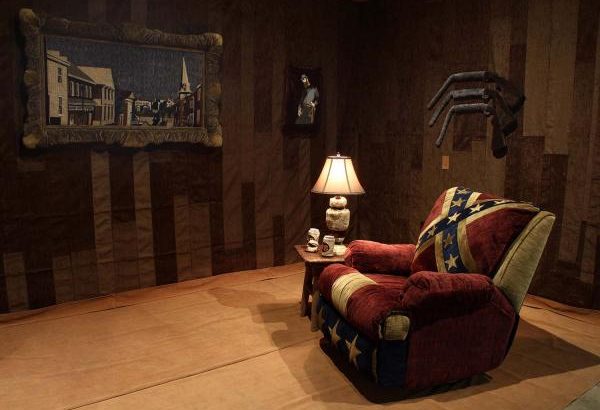
The fact that the entire space is hand-sewn jumps out at me; under artist Valery Jung Estabrook’s skillful hands, everyday “soft” objects turn steely, while “hard” objects are revealed to have soft and sagging underbellies. The “lazy boy” recliner decorated with the image of a Confederate flag displays these juxtapositions most prominently; though the surface is composed of velvety chenille, soft-to-touch and associated with comfort, the repellent flag imagery strongly dissuades the viewer from touching the furniture.

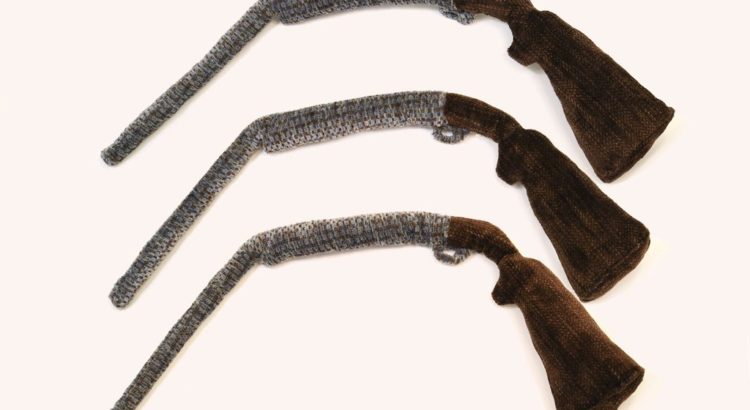
Even so, the recliner dominates the space, sending chilly tones throughout the warmly lit interior. Other striking plush components include the ‘pillow guns’, a set of three flaccid rifles mounted to the wall, and the ‘Born & Bred Beer’ beer cans casually littered on the recliner’s side-table. Chenille fabric, what the majority of the installation consists of, is immediately distinguishable through its tufted, caterpillar-like texture and iridescent appearance. These characteristics make the textile a popular choice for sofas, baby blankets, and other items that make direct contact with the skin. Needless to say, I was fascinated with the artist’s approach to materiality and her manipulation of sensory elements with chenille that served to contradict and even amplify the viewer’s psychological responses to derogatory imagery.
In a reflection about the title, Hometown Hero (Chink), Estabrook refers to the painful addition of the racial slur as a necessary component “… in order to have an honest discussion about the America that I know.” Her statement propelled me towards a question that I, and likely many others, have faced constantly while navigating ‘the Asian-American experience’: why the America that we know appears so dependent on the home that we say we know. I do not share Estabrook’s experience growing up in rural southwestern Virginia; what I do share are similar feelings of alienation upon being subjected to the white gaze – even at home, we are foreign spectacles singing along to the jaunty tunes of assimilation, while America reclines in a chenille chair, crushing ‘Born & Bred Beer’ beer cans in silent assent.


REVIEW: Mike Marshall & Darol Anger with opener Westbound Situation

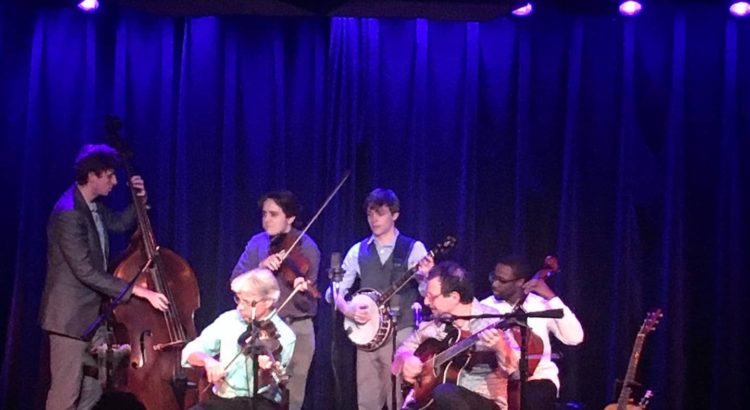
Mike Marshall and Darol Anger, a duo that has been playing together for over forty years, brought back their mix off bluegrass, jazz, and chamberfolk music to the stage of the Ark. The two continue to push boundaries in the genre of American acoustic music for stringed instruments and erase the barriers that separate bluegrass and traditional American string music from jazz, world music, and the avant garde. They spanned multiple genres over the course of the night, seamlessly taking the audience on a tour of the music world they have experienced.

Before the duo, Westbound Situation, a group that formed at Marshall’s camp: the Savannah Music Festival, played a set of their own. Made up of umich alumni and current students, the Ark was excited to welcome back Westbound to the stage for the second time this season. The group played tunes off their first record titled “pilot,” as well as some new tunes written and arranged by members of the group. Westbound had a really dynamic energy that pulled in the crowd, and was the perfect way to usher in Marshall and Anger.

With Anger on fiddle and Marshall switching back and forth between guitar and mandolin, the two reminisced about old tours and tunes they had shared over the years. The night was filled with fantastic improv and even better dad jokes shared between two very good friends. They played tunes that spanned the past 4 decades, many written by the two themselves. They had a very distinct style of playing with rhythm and tripping up the audience member. I heard lots of twisty tunes that night that made me want to rewind and listen again.

For the second half, Westbound joined the duo to play some of their tunes off of their record ” Chiaroscuro.” It was fun to see this next generation of musicians play with their mentors and and personal inspiration. Mike Marshall commented that “the future of this music is in good hands,” and how excited he was that this group of musicians was able to meet and continue to make music together. Mike Marshall and Darol Anger continue to be some of the most prominent musicians in this mixed genre scene, and I am so glad I got to see them play at the Ark:)

Every time I go to the Ark I am always in awe of how good the acoustics are. The space is inviting and intimate, and the popcorn is really good (fun fact!!!). It is a very student friendly venue and I am sure I will find myself back there within the next month!

REVIEW: Hometown Hero

If you took a moment to step out of the abrasive Michigan cold and into 202 South Thayer, you might also get the feeling you were stepping into the living room of any family in America. This is the first impression that the Institute for the Humanities’ latest exhibit provides. The space of the interior is small, homey, and inviting: a worn armchair slumps before a flickering TV, nestled atop a plush rug. The area is peaceful and dim, inviting you to sit down, take a load off, relax. However, just one more look may put you on edge; something sinister swirls around the sleepy scene, something not quite right. In an instant it hits, the glaringly obvious: the well worn chair is not upholstered with plaid, or gingham, or any fabric you’d expect, but instead, horrifyingly, with a Confederate Flag.

As I came to this realization, a strange feeling settled into my stomach. The space is a portrait of middle class America gone eerily wrong, while remaining hauntingly familiar. I believe this difficult truth is exactly what artist Valery Jung Estabrook aims to capture in her installation, titled “Hometown Hero (Chink): An American Interior.” Growing up an Asian American in Virginia, Estabrook’s work seems to reflect her desire to maintain a Southern identity while acknowledging that her home state is not a universally accepting place.

Upon closer inspection, the room only becomes more unsettling. It is beautifully crafted, hand sewn by Estabrook in chenille. Everything is plush, down to the crumpled beer cans, and the rifles limply mounted to the wall. This choice in medium suggests the space as something tied down, as if the room had grown roots. Its refusal to budge seems to reflect the nature of the traditional, antiquated Old South that Estabrook hoped to portray. Sewn portraits of Confederate soldiers dot the walls, only strengthening this message. Like everything else in the room, they are slightly fantastical: General Jackson’s head floats inches above his shoulders, and Lee is adorned with a faint halo. A southern cityscape hangs as well, its innocuous presence contrasting with the eerie romanticization of the Confederacy.

While the entire room suggests nostalgia for antebellum America, scenes on the television reflect how this longing for the past affects Estabrook. Clips on the TV depict the difficult relationship Estabrook has with her race and her Southern identity; one such video is a Twinkie commercial, “Twinkie” being a derogatory nickname for Asian Americans. Perhaps the video that captures Estabrook’s question of identity best is one of the artist herself lip syncing Tammy Wynette’s famous southern ballad, “Stand by Your Man.” In a blond wig with dark roots, singing an iconic country song, Estabrook embodies the struggle of balancing her Southern identity with her Asian heritage. Haunting and hypnotizing, this performance tied together the message of the entire installation.

Even after two viewings, I don’t feel I’ve picked up on every meaningful detail that the installation includes. Although the effect of the chenille coating the room is interesting in itself, the piece only becomes more moving with Estabrook’s history and story. I highly recommend viewing this homage to an America that we wish to forget, but one that is still instrumental to our history. “Hometown Hero (Chink): An American Interior” will be on display through March 12th. A visit can save you from the chill outside while still sending a chill down your spine.