PREVIEW: Oscar Nominated Shorts: Documentary

Billy Porter wearing Christian Siriano at the Academy Awards, 2019.

The Oscars are an event in many realms: fashion, celebrity gossip, film. Here is decided the best in that dress, the least-promising Hollywood marriages, and the most powerful audiovisual works of the year. While I love all sorts of movies, I have always been partial to short films. They have so much to accomplish in a fraction of the time feature-length films have; it’s thus a unique medium that results in stories with an odd edge to them. Often you’re left with surreal feelings after being thrown into and out of another world. I’m much more poignantly affected in this way.

For the 15th year, Oscar-nominated shorts are being shown in theaters all over. Determine your favorites and see if the Academy agrees on February 9th.

The documentary category will surely be a treat this year, with five selections from around the world featuring the heavy-hitting work of journalistic artists. Choose from a variety of showtimes through February 13th!

Tickets: https://www.michtheater.org/show/2020-oscar-shorts-documentary/

PREVIEW: The Song of Names

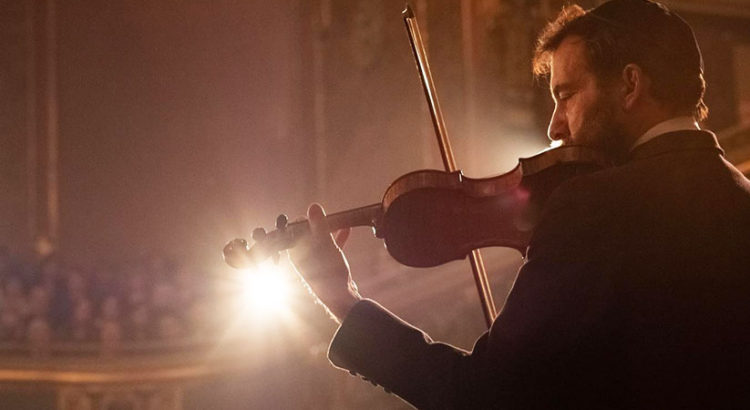
The film The Song of Names, which is based off of Norman Lebrecht’s novel of the same name, is currently showing at the Michigan Theater. It is about the search for a lost brother and lives altered, for better or for worse, by music. I am excited to see this movie because I recently finished the novel, and I’m interested to see how the story is told on the big screen (I’m stubborn and refuse to see movies based on books before reading the book).

For showtimes and ticket information, visit the Michigan Theater website.

REVIEW: 2020 Oscar Nominated Shorts – Animation.

List:
Hair Love – Matthew A. Cherry and Karen Rupert Toliver
Dcera (Daughter) – Daria Kashcheeva
Memorable – Bruno Collet and Jean-François Le Corre
Sister – Siqi Song
Kitbull – Rosana Sullivan and Kathryn Hendrickson

The Bird and the Whale (Highly Commended)
Henrietta Bulkowski (Highly Commended)
Hors Piste (Highly Commended)
Maestro (Highly Commended)

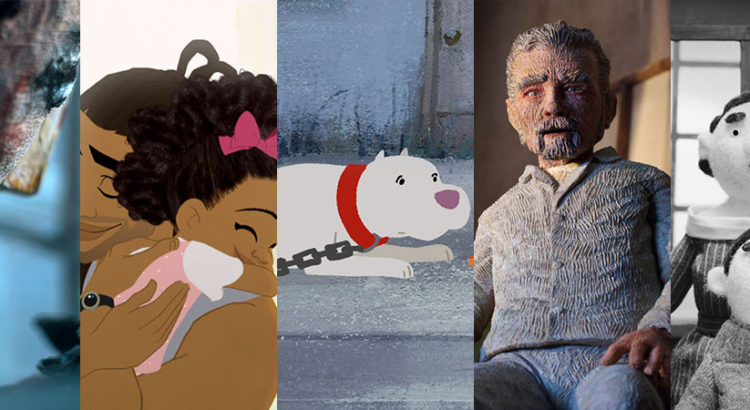
Hair Love, Dcera, Memorable, Sister, and Kitbull are contenders for this year’s Oscar nominated shorts in animation, and The Bird and the Whale, Henrietta Bulkowski, Hors Piste, and Maestro are highly commended films also playing at Michigan Theater. Like every year, the style and media of the films differ tremendously, each with its own merits that make it an interesting watch.

The series opens up with Hair Love, a film that’s full of pastels and backgrounds that look like it’s been coloured in with pencil crayons. It’s heartwarming and sweet, and although it’s not as visually rich as some of the other shorts, the pacing in its storytelling is perfect. A father does his daughter’s hair for the first time with a little encouragement – an interaction that develops their relationship in the absence of her mother.

Although Hair Love was produced by entertainment giant Sony Pictures, it feels pretty organic. People need people, and the film does a good job capturing that spirit when the father and daughter bond and rely on each other when their family fabric is pulled and twisted by the lack of her mother’s presence.

Daughter (Dcera) has the momentum and framing of motion picture cinematography. The characters look imperfect, textured puppets with painterly faces, an expressiveness teased out with an unflinching gaze. The camerawork, jarring and claustrophobic, frames the tenuous relationship between father and daughter. Despite the closeness of the camera, there is an endless distance between the two, and the short film takes us to a quiet hospital room to reflect on the course of their relationship and the moments lost so long ago.
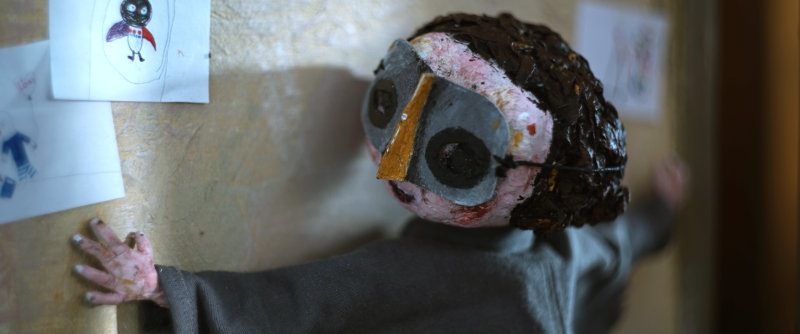
Daughter is beautiful and sad. The yearning for love and comfort is pinned delicately in scenes like butterfly taxidermy. There is no dialogue, but Daughter doesn’t need any to convey the emotions told through space and time, through elegantly laid out shots and a silence that stretches between father and daughter until a bird flies into the hospital window.

Memorable follows in the same vein using puppets full of post-impressionistic strokes. Louis, a painter, watches the world around him become strange, surreal, and unfamiliar. The film is imbued with the style of van Gogh in many scenes. It turns his perspective into works of art – a cellphone puddles into moving shades of gray, his family members’ faces become molded and abstract, and his wife becomes nothing more than a few brushes of paint. Life around him falls apart until he is left in an empty world with only himself in it.
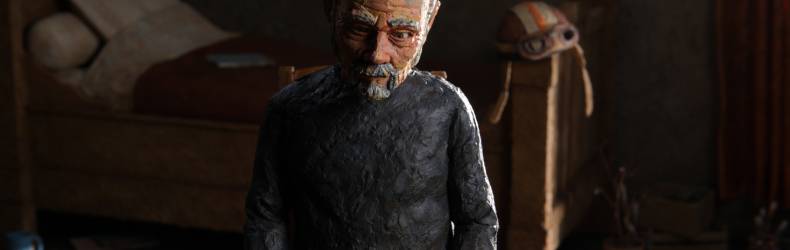
The soundtrack is also stunning, just as vivid and as bright as the visuals. When the world around Louis disintegrates and the music fades, the sense of loss feels personal and profound. Memorable does a good job building up this moment. First, the details are lost, turning people and objects into broad strokes. Then the meaning is lost, the paint pooling and disappearing.

We see a different kind of loss in the short film Sister, an exploration of things that could’ve been. The film is very tactile; the textures used lends itself to the distinctiveness of the animation. In a scene, the brother pulls on his giant sister’s belly button, the cottony material used to make the puppets twisting like an umbilical cord out of her until he lets go and she deflates like a balloon. Everything looks very soft and sweet, finished with a muted colour palette of black and white and a faded red.
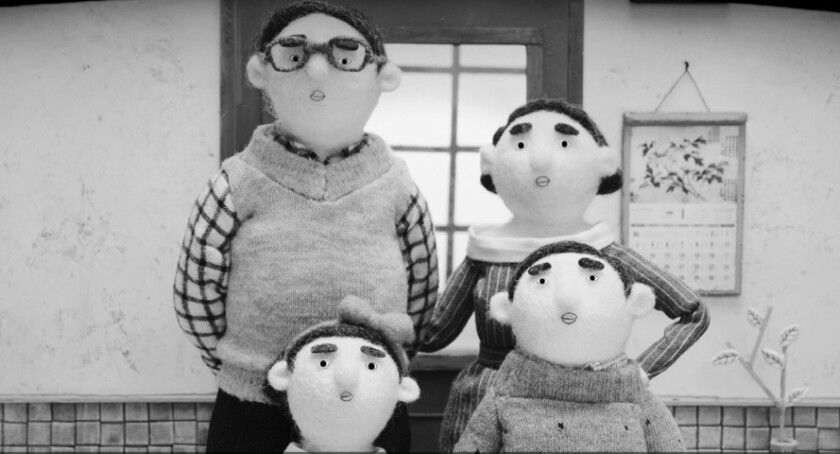
Despite its subject matter, Sister touches very lightly on the political aspect of China’s one child policy, alluding to it in post-film dedication. Instead, it focuses on the emotions of the narrator, the feeling of loss of not just a person, but an entire life missed because of it. Shots of mundane, every-day life are intertwined with surreal imagery to tell the story of Sister.

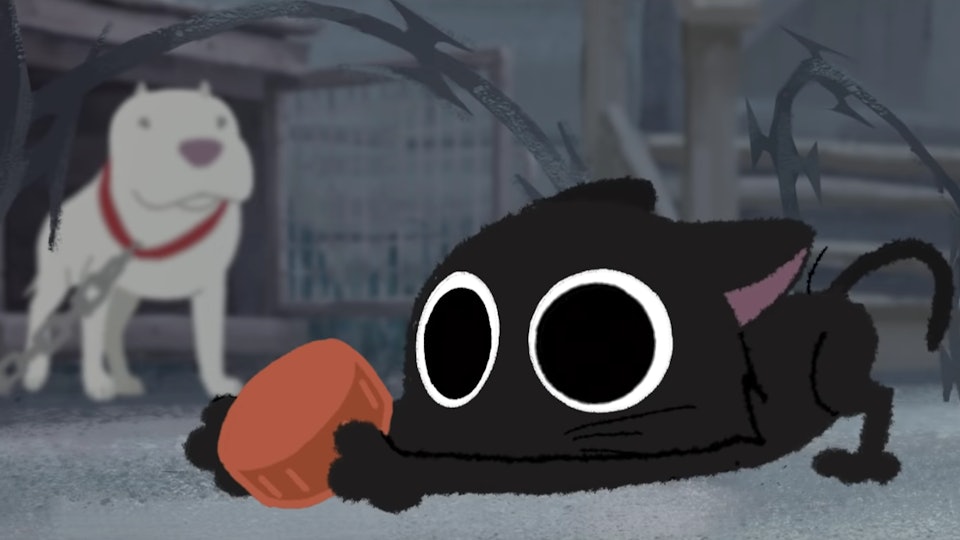
Kitbull is very cute, cushioning some of the gloomy undertones. It’s not as emotionally heavy-handed as a few of the other shorts nominated, but there’s a sweetness that prevails. The animation is descriptive; each expression and emotion is detailed through the movements of the stray kitten and the pitbull, even though their art is relatively simplistic. The two characters slowly grow closer together, helping each other get by in daily life, whether it’s from boredom or from hurt. It’s not ground-breaking or riveting, but Kitbull is still a solid film with a happy ending. It’s endearing and hopeful – a good note to end on.
Catch the Academy nods before February 9th.


REVIEW: 8th Annual Yule Ball

What a fantastic night!

University of Michigan’s quidditch team surely put on a show. The Rogel ballroom looked positively gorgeous in it’s Harry Potter attire, transforming into something almost as magical as the great hall itself. Quidditch hoops lined each opposing end of the room, decorated in twinkling lights, serving as a popular spot to to take pictures. A banquet table full of appetizing delights, tempted witches as wizards alike with different cheeses, fruits, cakes, and bread, as well as water and lemonade. A playlist of catchy dance music was constantly playing throughout the night encouraging guests to strut their stuff out on the dance floor, and of course being the enthusiastic dancer that I am, I complied, much to the despair of the dancers around me. I’ll tell you, dancing in full robes and high heels is harder than I thought it would be.

Although I enjoyed the Yule Ball very much, it did have it’s shortcomings. One of which is that the entertainment that was provided was a bit of a hit or miss. Of course, I have to take into consideration that this is an event put on by a student organization, hence budgets are always limited. However, when you see a sorting hat hanging from a string off a sagging wall-like structure that is  falling over at times…you start to wonder how much was left until the last minute. Of course, I would never claim that that was the case and I’m sure they worked hard on all their props, but if a prop is every failing, it’s better to just cut it out entirely. Another problem with the sorting hat was the performance itself. As my friend sat down to be sorted, it seemed as though the quidditch team had a series of sorting questions that were printed out a sheet of paper. However, the person in charge of the sorting hat only asked my friend two of them before abruptly sorting her into Gryffindor, a rather disappointing turn of events. As well as the sorting hat, there was also a divination booth which produced a better experience overall. The person in charge seemed very willing to put on the best performance possible and gave both my friend and I a very enthusiastic prediction of our futures.

Overall, I’d say it was a successful night in the long run. It was fun to see fellow fans of the wizarding world of Harry Potter enjoying time together under the same roof. No duels broke out and no one got turned into a ferret. I would have liked Dumbledore to make an appearance, but I guess that was too much to hope for.

Oh well, there’s always next year!

REVIEW: Yayoi Kusama’s Fireflies on the Water

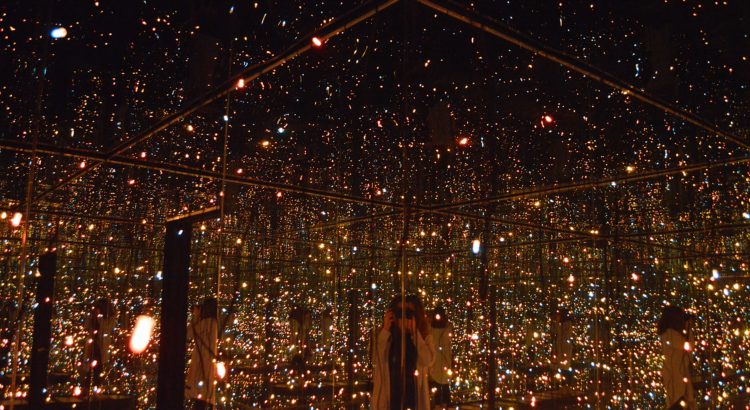
A 9 x 12 x 12 room. The walls and ceiling are mirrors, the ground water. You, the subject, are reflected over and over again against a backdrop of hanging lights: blues, reds, oranges. You are allotted 60 seconds in the room. Yayoi Kusama’s Fireflies on the Water transports you to another reality where it feels like you are at the center of that surreal universe.

Yayoi Kusama is a Japanese artist. When she was ten years old, Kusama began to experience vivid hallucinations in which she saw bright lights and endless fields of spots, which has heavily influenced her artwork throughout her life. She first became known to the public sphere as an active member of the hippie counterculture movement in the late sixties. She staged several performances, or “happenings,” in which naked participants were covered in polka dots.

I had previously seen another one of Kusama’s installations at The Broad in Los Angeles. The room was structured in a similar fashion, thought the lights were larger and more spherical. Infinity Mirrored Room – The Souls of Millions of Light Years Away had a more blue-green hue, whereas Fireflies on the Water had a warmer tone. Although both rooms are very similar, I found the two experiences to be independent of each other. The room in LA was exciting; I felt like a child, giddy, desperately taking photos in an attempt to capture the experience. This time around the experience felt more self-reflective. I was more aware of the tranquility of the scene, which was largely attributed to the fact the museum workers ask those waiting outside the room to remain silent. Inside the room, it feels like you are alone in this alternate dimension, but the experience is more soothing than frightening.

Naturally, I took an abundance of photos, but I almost felt that shattered the illusion. I wish I could return to the room and just sit on the platform surrounded by water for as long as I wanted. The logistics of allowing each visitor to stay in the room for 60 seconds makes sense, but it leaves the viewer yearning for more. Right when you enter a daze of seeing an endless number of lights and your reflection again and again, the door swings open, distorting your vision, and you find yourself back in the dingy lighting of the museum.

Still, Kusama’s installations are a very unique and unforgettable experience that I highly recommend seeing. Fireflies on the Water is currently on display at the Toledo Museum of Art and will be open until April 26.

REVIEW: Color Out of Space

SPOILER WARNING- you have been made aware.

This movie was much scarier than I expected it to be! A heads-up- there is blood and gore, scary creatures, lots of jump scares, and Nicholas Cage. However, the movie’s gorgeous colors and scenery almost made up for the fact that I was covering my eyes in fear and wincing at gross things for half of the second hour of the movie.

The movie is set in a gorgeous forest, in an old house, and at the beginning of the movie, we got to see the landscape, as well as the large, charming old house they live in. One thing I think was missing from the movie was that they did not do enough set-up of the family dynamic. I felt like the people were just actors living in the same house, rather than a family that cared for each other. This often made the stakes not feel as high for me when someone was in danger, or hurt, etc. I think if the family’s bonds had been established more at the beginning, I would have been more invested in the characters’ relationships and their interactions.

I like how the meteorite affected each person/animal in the family differently, but I also thought that made some of its effects somewhat confusing. For example, the first time the dad switches into the angrier version of himself, I was unsure of whether he was just having an outburst, or if he really was being possessed. But I did really like that none of them believed each other that something was going on because they all had different experiences of strange-ness.

My favorite part for sure was the usage of colors, which was the indicator that the meteorite’s evil was present. I like how it was used both very brazenly, like when the colors came shooting out of the well, but I also liked how it could be very subtle too, like when you saw little shards of it in the ice of a drink. I also liked how the color was limited to very bright blues, purples and pinks, because I think it made it look much more cohesive. It was cool how at the end everything was white, as though the evil from the meteorite had pulled all the color out of the world. It was also impactful at the very end, when the hydrologist, Ward, was standing on the dam. The colors were much more dark and sort of orangey-red, which was a huge contrast to the colors that had been all over the farm only 5 minutes earlier in the movie.

I noticed a couple of inconsistencies with the movie, or things that I think should have been better explained or elaborated. One of the big ones was the significance of the bug that came out of the meteorite. I never saw it touch anyone, or anything, it just flew around in a couple of scenes. However if it was supposed to be the catalyst of all of the destruction, I didn’t quite get that, because a bunch of the mishaps happened before we even saw it hatch. I also was confused a bit on the role of the old man in the woods. I understand that he was listening to the aliens in the ground, but his role seemed like it was added just for that, and he seemed so 2-D as a character. Also, when they went to find him and heard the tapes rolling, it was somewhat indiscernible what was being said, so that did not have as much as an impact as I think it should have.

Overall I thought it was a good movie for its genre. I wonder if the things that were kind of left hanging were because of H.P. Lovecraft’s original story that this was based on, or if it was the fault of the movie producers. Either way, I understand that a horror movie is more focused on the horror part than the storyline, and they definitely got the horrifying part right. There were many scenes where I needed to look away because the deformities that the meteorite caused were absolutely just plain gross, or something was very bloody. I did not expect this movie to be as scary as it was, so I don’t have much to comment on in that respect, as I have little experience with horror movies. Plus I was mostly covering my eyes during those parts. However, I did enjoy the mystery and the build-up, and even though I do not like horror, I could definitely appreciate some of the more artistic elements of the movie.