PREVIEW: Artist Spotlight: Nadim Azzam

This Tuesday, November 26th, be sure to attend the Ark’s latest Artist Spotlight featuring Nadim Azzam, a 24 year-old Ann Arborite who fuses hip-hop, alt-rock, and jazz for a heartfelt and layered musical expression! Nadim is currently working on his first full-length album, which is expected in 2020. Opening for this eye-catching ensemble is singer-songwriter Althea Grace, indie blues musician.

The doors of the Ark open at 7:30, and the show starts at 8:00; while this event is free to the public, it will accept non-perishable food items to go towards Food Gatherers!


REVIEW: Parasite

It would be too easy to say that Parasite gets under your skin. That turn of phrase feels light and obvious. Parasite doesn’t just lie underneath the surface, it digs deeper. Like a crawling feeling that turns into a stabbing pain, this film begins as a superficial sensation and ends leaving an indelible impression. It shifts and transforms, becoming something else before your very eyes. Or rather, the pleasure and terror is that you don’t see the transformations occurring before they are irreversible. There is something light and obvious about Parasite. Yet, the lightness and laughter don’t detract from the film’s obvious interest in heavier topics. It is a remarkable balance that the film maintains over a spectacular two hours.

Image result for parasite movie

The members of the Kim family are used to precarious balances. Jobs in the city, when they can be found, barely pay the rent for their semi-subterranean apartment as it is. Prospects are scarce, especially for those who don’t have college degrees. The children of the family, Ki-woo and Ki-jeong, are reaching the prime of their lives, young-adulthood. Yet, it seems as if their lives have stalled exactly when they should be speeding up. Youth means nothing with the pressure of financial troubles relentlessly bearing down on them. Ki-taek (Song Kang-ho), the patriarch of the family, is similarly helpless in the face of these circumstances. Emblematic of this powerlessness, he can only watch from the window as drunkards pee on their very doorstep. These daily humiliations are to be endured by the poor, not overcome. For, it doesn’t seem to matter what the Kim family does. Their efforts are insignificant, weak battering at a system with an entrenched hierarchy of wealth. The Kim family are part of the ignored thousands. Part of those who live below others, forever ignored, forever treated as lesser. They become indistinguishable bodies to be crushed slowly under gleaming skyscrapers of the rich. Yet, in a most humiliating and ironic turn, the rich are absolutely dependent on those they would ignore completely. They need the masses to be their smiling housekeepers, their stoic chauffeurs. Every aspect of their lives is handled by dozens of faceless servants. It is this reliance that finally gives the Kim family an opportunity to climb out of poverty. Ki-Woo’s friend, Min-hyuk, asks him to become a tutor in the wealthy Park family household. When Ki-Woo protests that he doesn’t have the credentials for such a job, Min-hyuk with a lighthearted air, tells him to fake it. And it seems like a small enough lie for such a great reward. For, once Ki-Woo gets the first foot in the door, the rest of the family is eager and ready to follow into the cavernous Park compound.

Image result for parasite movie park family

At first, it seems as if the Parks with their obliviousness and piles of money, are the perfect marks for the Kims. While the Kims work in perfect unison to enact their plan, the Parks are dysfunctional and distant with each other. Yeon-gyo is a naïve housewife who invests all her extra time and care in her children. Da-hye is the envious older sister, jealous of all the attention her younger brother, Da-song receives from her parents. Even Dong-ik, the otherwise competent head of an IT company, pays only the required, cursory attention to his family. The Parks are a family because they are expected to be. The Kims are a family because none of them would survive on their own. Out of necessity, there is love. The interactions between the two families are the most intricate of the film. Each character is full of a brilliant inner life. Their history is expressed in action, not needless exposition. Their behaviors are consistent, as all well-rounded humans are, but that consistency doesn’t lead to boredom. Instead, the predictability is part of the delight of watching the film, seeing how familiar characters react to unfamiliar situations. Sometimes, these confrontations are hilarious. Sometimes, they become deadly serious. Director Bong Joon-ho varies these beats according to his own rhythm resulting in a film where the jolts form a sort of thrilling harmony.

Besides the inventive plot and characters, Parasite also benefits from a cohesive design. The Park mansion is beautifully filmed. Its design is all smooth concrete and glass expanses. It is in this space where the battle of the wills take place between the Kims and the Parks. For, in this space, it is impossible to ignore the differences in status and situation. Everything the Kims have ever strived for is here, in easy reach. In this space, it is easy to dream of the possible life where wealth falls into their lap as inevitably as it has fallen for the Parks. Ultimately though, this house, this life, belongs to other people. The house, then, becomes a symbol for all that is unattainable. All that should be theirs but isn’t. It is a cruel taunt in a film that never shies away from how arbitrary and unkind the world can be. Some people get deliriously lucky. And some get crushed.


REVIEW: CSEAS Film Screening–Thai Movie Night. How to Win at Checkers (Every Time) / ‘พี่ชาย My Hero’

I used to pride myself in my cold-heartedness while watching emotional movies. While others wept over Les Mis I did not shed a single tear, and in this astonished both my peers and myself. 

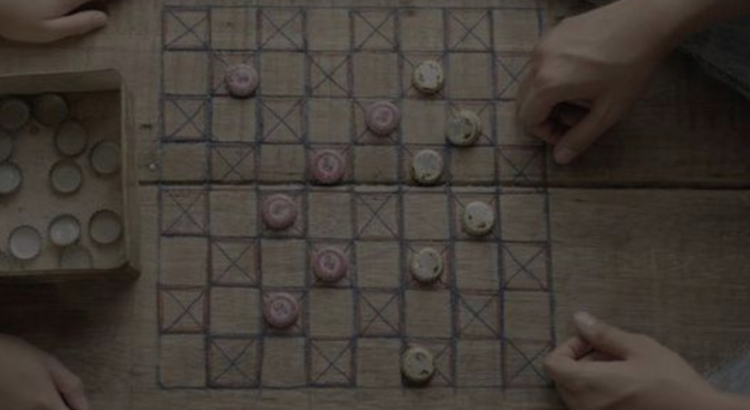
These days, this old pride is abandoned totally. Now I use how much I cry as a measure of how good the movie is. So, by the Sorrow Scale, How To Win At Checkers (Every Time) was fabulous. The purity of the brothers’ relationship is tragic in the face of government corruption and rapidly-moving sadnesses. Despite how inevitable the turning of events were, I’d still catch myself hoping along with the characters. 

The bond between Oat and Ek is realistic–not too sitcom-family well-behaved, but teasing and jeering and ultimately loving. It informs the questionable decisions Ek can make concerning his kid brother, like letting him come to the club with him. They both need another, less alien parental figure than their aunt, after the death of their parents, especially Oat. Ek is not a perfect father figure, which is quite the accurate representation, as he is so young himself, and could use someone guiding him as well.

Small things held significance in this film, working with subtlety that enhanced its themes of injustice, which is similarly slyly hidden to all those not looking for it. Take the draft lottery scene; while the crowd was singing the national anthem, Jai and Junior are one of the few pointedly not participating. It’s unclear whether they do so as they contemplate their part in the bribing, or the fact that the government accepts bribes to escape the draft at all. Perhaps they feel less connected to their country as a result. But hasn’t Ek earned the right to antipatriotism? He is stuck in the nerve-frying situation of facing possible death and leaving his young brother behind. Still he sings the song of the country that has none of his interests in mind. 


The color palettes are similarly subtle, simple combinations of muted earth and jewel tones that drag at the feeling of bleakness the later parts of the movie hold. Even the Cafe Lovely has a limited scheme, a little monochromatic neon against dark grays and browns in its rooms. Upstairs, that sinister place, is even flatter, an apartment building hallway of beige. In such environments I can feel the barrenness of the situation, in contrast with the joyous times of childhood. We see here that evil works in a lurking way, striking without ceremony. 

And although I have mostly positive views on Checkers, there were several instances of triteness that shocked me. Worst of all was the very ending, where an adult Oat rides out into the sunset, which turns to white as he gets to the horizon. I wanted to gag at this foolishly, blindly at-peace, going into the light ending. To me, it ruined much of the unique qualities the movie did contain. Instead of Ek’s painfully unceremonious killing, I was thinking about how much this reminded me of The Ghost Whisperer. At that point, I seriously considered labeling this a feel-good movie instead of the deeper drama it tries to be. I wondered how it could be nominated for an Oscar when they couldn’t think of a less superficial way of ending it.

But what matters most is one’s overall feeling walking out of the movie. At that time I was still crying, so by my measure of choice, it was still a powerful film.

This is director Josh Kim’s first full length film. He has also made several other short films to check out: Draft Day, The Postcard, and The Police Box. This was the last Thai Movie Night of the semester, but they will be starting up again at the beginning of the year.

REVIEW: 2019 Stamps Undergraduate Juried Exhibition

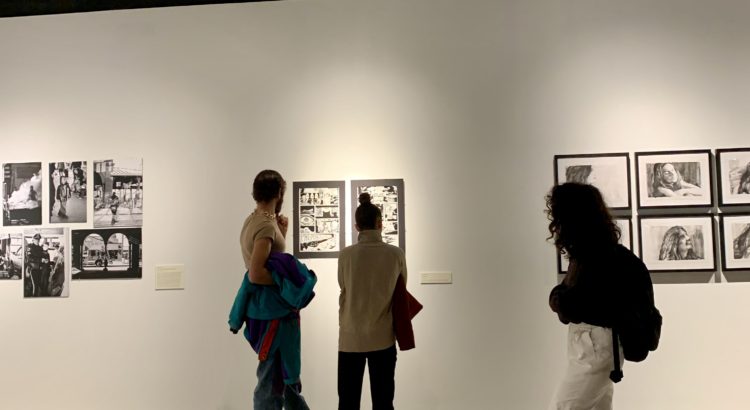
The 2019 Stamps Undergraduate Juried Exhibition opened amidst great excitement and contemplation on Friday, November 22nd, as most gallery receptions do. The exhibition consisted of over 50 Stamps undergraduate pieces, including both personal and course-related work, spread relatively evenly among each graduating class. I was pleasantly surprised with the diversity of subject matter, artistry, style, and media – which ranged from two-dimensional mediums like printmaking and collage work to three-dimensional and even four-dimensional mediums like embroidery, upcycled materials, and animation. Not only is the this annual Stamps Gallery tradition an excellent opportunity for students to showcase their work, but it additionally bridges the Stamps undergraduate community to Stamps alumni. All three of the visiting jurors, Parisa Ghaderi, Cynthia Greig, and Cosmo Whyte, are Stamps MFA graduates, as well as nationally and internationally recognized creatives.


Beyond the award-winning pieces, a couple of other works piqued my interest after after catching my eye for their emotionality and aesthetic appeal. Anna Cao’s Flowing Water and Falling Spring immediately stuck out for its vivacity, in both its rich imagery and allusions to Japanese aesthetics. From a distance, the serene scenery seems to surrealistically flow together in a seamless fashion, as if painted on one canvas. Yet as the viewer closes that distance, the rippling waters, snowy mountains, and familiar figures setting down water lanterns reveal to be collaged paper elements from different contexts – each vivid in their individuality yet still cohesively merged in dialogue with one another.


Gray Snyder’s Abstract Self Portrait, a monochrome, triptych timeline of the artist’s emotional growth and development, evoked within me a sense of peace yet empty solitude. I thought Snyder’s universally interpretable linear forms, spiraling shapes, splatters, and shadows that seemed to fall across the tapestry were ingeniously effective in portraying emotional transformation and the various stages of grief.


Another tapestry work imbued with the artist’s emotional histories, this one of embroidered, dyed, and woven cotton, was Brook Eisenbise’s Carrying All of This. Each aesthetic aspect of this work was carefully chosen by the artist to communicate her grandmother’s complex experience with her husband’s Hodgkin’s lymphoma diagnosis. Even without reading the accompanying information about the piece, the tension created from Eisenbise’s graphic color scheme, typographic elements, and jostling French knots was highly evocative of stress and human experiences of pain.


This exhibition will be on view until December 15, 2019 at the Stamps Gallery on S Division – I highly recommend making a trip down to experience the diverse, exceptional talent and hard work concentrated in the Stamps student body!

PREVIEW: A Midsummer Night’s Dream

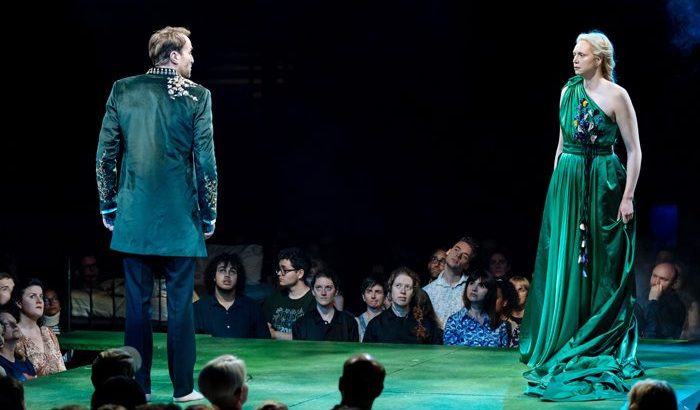
Midsummer Night’s Dream is a classic Shakespeare comedy following the king and queen of the forest, four runaway lovers, and a troupe of actors as they cross paths in a forest full of comedy, confusion, and some dark consequences.

This showing of the play is a National Theater Live broadcast, being screened at the Michigan Theater. This means that it is being performed live at the Royal National Theater in London, and we will be watching it being filmed on screen.

I am very excited to see this show, as it is one that I have only read and never seen. The show is playing Sunday evening, November 24 at 7 pm in the Michigan Theater Auditorium.

Link to info/tickets: https://www.michtheater.org/show/nt-live-a-midsummer-nights-dream/

PREVIEW: Stew & The Negro Problem

In case you missed Tony Award-winning playwright and singer Stew last night, you have another chance tonight! Don’t miss out on a homage to the art and activism of James Baldwin in a music and theater experience through a contemporary commentary on Baldwin’s 1955 collection of essays on being Black in America. Notes of a Native Song is an irreverent and spirited rock ‘n’ roll song cycle that uses Baldwin’s work to explore race, love, class division, and politics through an exciting mix of rock, jazz, and soul. Catch Stew & The Negro Problem at the Lydia Mendelssohn Theatre tonight at 8!