
REVIEW: Ad Astra

The final frontier. Glittering, sharp edged galaxies and exploding supernovas. Voids without end swallowing light and time. Majesty beyond measure, splendor beyond comprehension. Ad Astra imagines a time in the not too distant future, when the extraordinary becomes ordinary, when all the glimmering space becomes just another excuse for mankind to ignore its problems. It is a slightly gloomy proposition; yet, it is also one that seems, in all probability, the most realistic outcome. For as easy as it is to imagine the limitless possibilities of the cosmos, it is even easier to imagine humankind finding a way to corrupt the untouched unknowns. For, even as we travel further into the galaxies beyond, we cannot travel beyond ourselves.

Roy McBride (Brad Pitt) is a man who knows his limitations more than most. We hear his voice first. Calm and measured, he completes the mandatory psychological test, authorizing him as fit to perform a spacewalk. Composed and deliberate, he walks through a corridor, filled with cheerful colleagues. They greet him with enthusiastic smiles and a respectful, “Major”. He nods in return. Every word so considered, every action so purposeful. And perhaps, Roy is right to do so. As an astronaut, life is a delicate thing, easily destroyed by the slightest step outside of regulation. Surviving in space means dedicating every possible scrap of mental and physical energy to enduring. It is a harsh life, one that has helped alienate Roy from any semblance of a personal life. We are granted only glimpses of a previous relationship with Eve (Liv Tyler) before Roy compartmentalizes, shutting out pain. Acknowledging pain is a distraction after all, and Roy is far too practiced at drifting from his emotions instead. And so he does, until Roy is called on upon to find the man who caused him to fence off the world in the first place: his father.

Image result for ad astra
Like its main character, Ad Astra is lonely. Much of its run time is devoted to contemplation of beauty, of emptiness. It is the beauty and the emptiness, after all, that define mankind’s expansion into the solar system. As Roy notes in one of his many (only sometimes tedious) asides, the development of viable space travel has not substantially changed human nature. Even the rocket trip to the moon is dispiritingly familiar. The same cramped seating with limited leg room. The same wrinkled in-flight magazine. The human race may have figured out a path to the stars, but it still can’t outgrow its ceaseless need to demand payment for flight upgrades. The contrast between the extraordinary and the mundane is what differentiates the film from its more wide-eyed counterparts. Despite its lunar landscapes and its Martian set pieces, what is most stunning about the film is how it makes this fantastical future seem all too possible. This probable tomorrow must have seemed all too tempting to Roy’s father, H. Clifford McBride (Tommy Lee Jones). A vision that must have been even more tantalizing than staying home to take care of his young son. It is that tender pain consistently jabbing into Roy’s heart and wounding Brad Pitt’s composure throughout the movie. A pain that tells him that he wasn’t worth enough to his father. It is that pain is what carries the film most realistically through its travails through space. Like all space films, Ad Astra risks drifting beyond its Earthly ties and disengaging from audience interest. But it remains committed to the story of Roy above all, never losing focus among the stars.

Ad Astra is a film as interested in the vastness of one man’s psyche as it is in the immensity of outer space. And perhaps, this limits the scope of the film as it tunnels deeper and deeper into Roy’s mind. But perhaps, the limits are precisely the point. We are not unrestrained beings. We are held back by all our human humdrum, all our pleasantries used to cover up unpleasant realities. We get lost because we want to lose ourselves, for a little while anyway. There is no more beautiful place to get lost than outer space.

PREVIEW: Joker

Joker is a movie that everybody seemingly already has an opinion about. Having won the Golden Lion award, the top prize at the Venice Film Festival in September, the film has only gained momentum since. It is the result of an unstoppable combination of scintillating controversy, an iconic villain, and a movie-watching public hungry for both of the above. Starring Joaquin Phoenix,  Joker is about a man gone mad and the society that has ignored him for far too long. The premise is a familiar one, of course, well tread by innumerable movies before it, but never in quite so much clown make-up. You too can form an opinion about this contentious film; Joker is currently showing at the State Theater. Tickets can be bought online or at the box office ($8.50 with a student ID).

REVIEW: CCPS Exhibition. Stasys Eidrigevičius: Collages

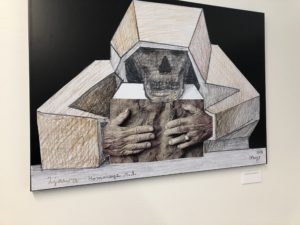
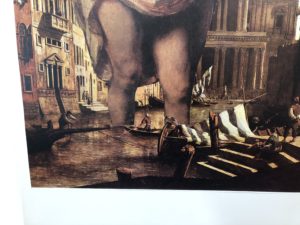
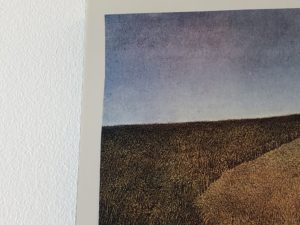
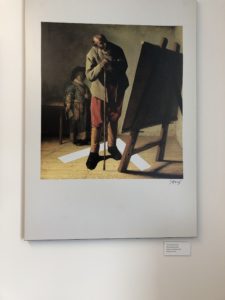
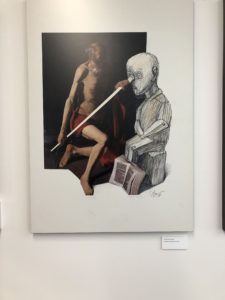
Before you read on, take a close look at Stasys Eidrigevičius’ pieces. Notice what you will about his placement of objects in relation to one another, the emphasis on odd shadows, all the shapes and angles involved. Regard each separately, trying not to immediately put any of the images together:

What can I say about these works? I was so befuddled by each one, torn by the wanting to fixate on the alarming details and the knowing that taking it as a conglomeration is the meaning of collage.

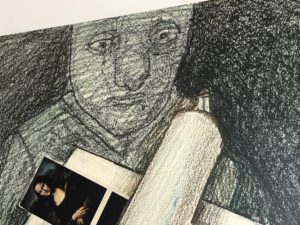
All I could do was be overwhelmed by slight curves in the edges of the pieces and the uncomfortably forced eye contact between figures. The expressions on characters’ faces ranged from haunting to somber to desperate to dazzled to sadistic to sly. I wasn’t sure what to make of the positions Eidrigevičius puts these persons into. It feels like each piece has an element of force that I find unsettling. Hands grip, eyes pierce, feet trample. Everything seemed too jarring to work together as cohesively as I expected it should.

Eidrigevičius further adds chaos to his work through additions made by his own hand. He deals in scribbled shading and blocky figures, asymmetrical faces and indiscernible expressions. I was so distraught by the time I’d spent ten minutes in the room with the artwork that I could hardly see straight. An unfortunately poetic, single tear rolled down my flustered cheek. Seconds after the only other people entered, I had to hightail it out of there, but not before I heard their first impressions (“Very symbolic,” says the man with an angular European accent. “Hm,” replies the woman, curtly. “I’ve been trying to figure out what the symbolism is,” he continues, illuminating nothing).

I don’t know that I could pick out any one symbol that persists throughout the pieces, or even a general grouping of motifs. Everything seems literal to a point of discomfort (mine), but I suppose there was a similar line of thinking throughout the collection. Something in each piece is being trapped, maybe not by the specific creature in the image, but by something. Entrapment could be a metaphor for something else, or it could represent nothing else but itself. Perhaps the artist is feeling constricted by the world’s narrow view of what art should be. Maybe he is reflecting on a home country whose practices of censorship are too harsh for goodness to grow.

Or maybe, as I always prefer to believe, Eidrigevičius strives only to challenge the limits of his viewers’ and his own thinking by combining unrelated objects and ideas. His mind knows few borders between things, preferring to string a doodle onto the end of everything. He sees shadows that might not be there, connections bridged between the physical and the emotional. There may or may not be anything much deeper than artwork that wishes to be fully open to interpretation.

If you’re interested in seeing Eidrigevičius’ work in the flesh, I urge you to visit Weiser Hall’s International Institute Gallery, room 547. The exhibit will be up until the end of November.


REVIEW: Brittany Runs a Marathon

While Brittany Runs a Marathon was a movie with an interesting storyline, some good messages, and a few comedic moments, I must admit that for me, it missed the mark. The film watched like it wanted to be a feel-good story, except that I felt exhausted when it was over. It was almost as if I had run the marathon, except I didn’t have any feeling of accomplishment at the end.

For one thing, it seemed that the characters lacked real development, leaving audiences with inauthentic caricatures that only played into the stereotypes the film was trying to break. Brittany’s (Jillian Bell) character enjoyed some personal growth that gave her character more depth, but many of the supporting characters seemed to be left as superficial, half-finished sketches (such as Gretchen, Brittany’s Instagram-perfect influencer roommate, who is played by Alice Lee and tells Brittany that she’ll always be fat). It is not that the acting was bad. Quite the contrary, actually – I think that the acting was very good, especially Jillian Bell’s work, but the script and disjointed plot did not provide sufficient material for the cast’s talents to shine. On a similar front, Brittany’s get-healthy storyline was, in my opinion, handled in an overall clunky and insensitive manner, providing an inspirational moment at the end when she actually ran the marathon, but in a lot of places failing to deliver the nuances needed to make her character authentic and relatable. Weight and body image are serious issues, and a delicate touch is needed to turn that into comedy while still being real.

However, despite the film’s shortcomings, it managed to deliver a few very relatable scenes. Brittany is crushed when she ends up with a stress fracture just weeks before the New York City Marathon, and although the lead-up to this was rather confusing to me, the aftermath of it will resonate with anyone who has ever been sidelined from an activity due to injury. After moving into her sister and brother-in-law’s basement and lashing out inappropriately at a guest at a birthday party, Brittany realizes that she needs to accept help and support when people offer it, instead of shutting out the world. At the movie’s end, as Brittany finally runs the marathon, it’s hard not cheer for her as she crosses the timing mat after 26.2 miles.

That said, the better scenes of Brittany Runs a Marathon did not, at least for me, outweigh the less-than-great ones, and it won’t be added to my list of favorites.

REVIEW: NT Live: Fleabag

Having never seen the show before, I walked into the Michigan Theater with only the high praise of my friends who have seen Fleabag. However, I liked what I’ve heard and NT Live never disappoints, and they certainly didn’t this time. 

Phoebe Waller-Bridge manages to insert her humor into the serious, her jokes masking her depression, her sex covering her deeper, underlying problems, seamlessly weaving all of these factors together in her one-woman play. The show starts with Fleabag going into a job interview. Waller-Bridge navigates time in a manner that may be confusing to begin with, especially with it being a one-person show, but she effectively uses flashbacks to provide context for why she did something or how she met someone or why she had a certain type of relationship with someone. In the end, the last scene is her back in the job interview, and Waller-Bridge does such an amazing job captivating the audience into her story and each scene that you forget the entire narrative was to explain why she needed a job so badly.  

She manages to jump from persona to persona with ease, each character with their own distinctive facial expressions, mannerisms, and voice. The guy with a small mouth, kindly referred to as Bus Rodent rodent, elicited much laughter every time she managed to transform her face. She also portrayed her relationship with her sister well, capturing the reserved and uptight personality that contrasts her own free spirit. 

The main tension in this show, aside from her own internal struggles and insecurities,  surrounds her best friend Boo, who recently passed away. Waller-Bridge balances the emotions Fleabag feels as she starts to spiral with humor and levity, much of which involves her sexual coping mechanisms. As she deals with her demons, Fleabag reveals much about human pain and how you can find light even in the darkest times.

If you missed NT Live: Fleabag last week, don’t worry—there’s a special encore performance at the Michigan Theater tonight! 

REVIEW: Downton Abbey

Having watched all six seasons of the British drama Downton Abbey, which aired in the United States on PBS, I was intrigued by the prospect of a big-screen sequel. It would mean a chance to revisit familiar characters, once again appreciate the sumptuous period costumes, and hear the show’s distinct theme music.

Elaborately beautiful costumes are one of the film’s strengths.

In these areas, the film certainly delivered – in many ways, it was (somewhat predictably) a 122-minute festival of fan gratification. One only needs to see Lady Mary’s (Michelle Dockery) sapphire blue gown made of a fabric with countless tiny pleats, or her elaborate beaded ballgown with its dramatic back detail, to see that the film’s costume designer, Anna Robbins, did her job and did it well. The Dowager Countess of Grantham (Dame Maggie Smith) returns with an ample supply of wry zingers, generally hilarious because of their disconnect from everyday life. The camera work is done in sweeping shots that showcase the grandness of the Crawley residence, with magnificent lighting that lends a sheen to the entire setting.

The King and Queen visit Downton Abbey, causing quite the stir throughout the household.

That said, the entire premise of the movie is somewhat absurd, even more so than the Crawley’s over-the-top, aristocratic lifestyle may seem to modern-day Americans. When Queen Mary and King George stop by Downton for a visit, the staff are irked  when they find out that the royal couple’s servants – chefs, valets, maids, footmen – are to take over the running of every last detail during their stay, leaving  Downton’s regular staff to sit back and “go read a book.” They are so upset, in fact, that the Downton staff, led by lady’s maid Anna Bates and her husband, valet Mr. Bates, hatch a plan that allows them to cook and serve dinner to the King and Queen. It is as ridiculous as it sounds, not to mention (in my opinion) out of character for the likes of strait-laced housekeeper Mrs. Hughes (Phyllis Logan) and Anna Bates, who was ever the kind-hearted person on the show. I will admit, however, that the absurdity of the entire situation lends it some humor that makes it somewhat enjoyable in the end.

Despite a plot that I thought lacked believability and nuance, however, the film did deliver several scenes that somehow got at what the rest lacked. One of the best of these (of which I will not go into too much detail, to not spoil the film’s ending) was an emotional scene between the Dowager Countess and Lady Mary, two characters who often come of as cold and unfeeling, where their underlying humanity was made clear. Perhaps the lifestyle of the Crawley family is cloaked in jewels and expensive fabrics, but the people themselves are just that – people, with sentiments, fears, and sadness, just like the rest of us.

All in all, I enjoyed the Downton Abbey movie as a gilded escape from everyday reality. However, I would not recommend it to anyone who has not previously seen and enjoyed the Downton Abbey television show. As I said, the film excels at gratifying its fans, but without the framework of the original series, it lacks the plot and character development that would make it interesting as a stand-alone feature.