REVIEW: The Power Family Program for Inuit Art: Tillirnanngittuq

A wise man once said, “Water Tribe” as he proudly flicked his wrists in a dramatic exit following his younger sister. This wise man was a young man named Sokka, from the Avatar: the Last Airbender. Now I know what you’re thinking — I promise, I’ll get to the actual exhibition in a second — what do fictional animated characters like Sokka and Katara and the “Water Tribe” have to do with Inuit art?

Before I answer this seemingly pointless question, let’s talk about the Tillirnanngittuq exhibition! First, a quote from the UMMA website:

Tillirnanngittuq, pronounced “tid-ee-nang-ee-took,” means ‘unexpected’ in the Inuktitut language. Mame Jackson, curator for this exhibition explains: “Tillirnanngittuq refers to the astonishing outpouring of Inuit art since the 1950s—a truly amazing story! Neither the Inuit artists nor those who worked with them in the early years could have foreseen the worldwide acclaim Inuit art would achieve.”


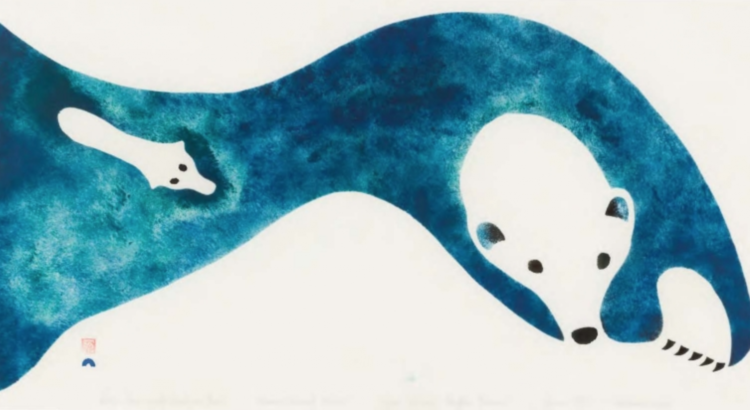
The Power Family Program for Inuit Art: Tillirnanngittuq exhibition showcases 58 works of art from the collection of Philip and Kathy Power. Most of these works are from the 1950s and 60s—the earliest years in the development of carvings and prints by the Inuit of the Canadian Arctic. The entire Power Collection of Inuit Art, gifted to UMMA in 2018, includes more than 200 sculptures and prints.

Visitors will discover innovative stonecut and stencil prints, and exquisite stone, bone, and ivory sculptures of arctic animals based on the artists’ life experience as traditional hunters, attentive in their observation and understanding of the animals in their environment. Slightly abstracted, this art possesses great character and vitality, elegance of line and form. The artists illustrate not only reality from nature such as how polar animals move, but also inventive design choices as they multiply, overlap, and interweave natural forms.

I felt very honored and privileged to witness the beauty of Inuit art, learning about their cultural history through their carved ivory and stone, their etched drawings, and their deceptively “simple” prints. The guided tour and mini history lessons provided commentary and contextualized each piece, talking about the Inuit peoples’ works of art catering to a more globalized economy.

Among the intriguing Inuit things I’ve learned at the gallery, I learned their value of family, some of their past day-to-day practices and customs, such as the importance of sharing stories with one another and their deep connection with nature, coexisting and living together in harmony, and I learned that in times of industrialization, the Inuit have had to switch business practices, as their usual nomadic lifestyle and hunting methods were no longer sustainable in the fast-paced, industrialized world. According to the art historian and curator, one of the things the Inuit turned to as a solution, was their art.

Now, back to my original question: what do fictional animated characters like Sokka and Katara and the “Water Tribe” have to do with Inuit art?

For me, they have everything to do with it.

As a child, I was completely unaware of indigenous peoples and their cultures, with the exception of some minor obligatory history lessons in high school. I’ll admit, I was probably a bit luckier than others in my younger days, because my Michigan elementary school field trips often considered Native American history and culture, where my classmates and I were each given tiny stone arrowheads and cute little pamphlets to take home and share with our families. It was never anything I took seriously, I took everything for granted in my childhood. But then, I started watching Avatar: the Last Airbender.

Now, forgive me for fangirl-ing, but this kids’ animated TV show continues to exist as an absolutely incredible, sophisticated, enlightening, and alarmingly impactful story to me! I’ll spare you the excruciating details, but it handles the multifaceted ideas of ethnicity and indigenous peoples, in tandem with the benefits and drawbacks of colonization and industrialization, discussing crucial topics related to the environment, spirituality, morality, and pacifism in times of war and hardship. It’s definitely a timeless classic for my generation, and for little kid me, it was a pretty big game-changer, without me even realizing it.

Now, as a (somewhat) full-fledged adult, I’m aggressively cognizant of anything to do with marginalized ethnic groups, the “colonizers” and the “colonized,” and basically anything to do with that often rocky relationship. It’s important to understand that these people exist, and representation in this day and age is unbelievably crucial to raise awareness and bring our attention to their history and culture.

Avatar: the Last Airbender might have used the world of fiction to send positive and powerful messages, but the creators themselves admitted to drawing inspiration from the Inuit for the Water Tribe people. As a child, being exposed to people who looked Inuit, even if they were calling themselves “Water Tribe” in the show, ultimately had a lasting effect on me. To be completely honest, I was excited to see the Tillirnanngittuq exhibition partly because of my fondness for the “Water Tribe.” That somehow, what I saw in the exhibition was related to my childhood fascination with the Avatar world and the four nations, particularly the “Water Tribe” and their arctic homes. And I think this just goes to show, the younger and more impressionable audiences, need to be exposed to different cultures and people. It’s extremely important, not only for the sake of diversity but for everyone to understand that the world doesn’t revolve around a singular group of people.

My history classes, K-12 and now at U-M, has taught me that the way history is shaped, the “world” really feels American and Euro-centric. I massively appreciate the Tillirnanngittuq exhibition at the UMMA because it is an opportunity not just to appreciate Inuit art, but ultimately to learn about Inuit history and culture in a society that has long disregarded and erased the cultural histories of these indigenous peoples.

Did I use this post as an excuse to fangirl about Avatar: the Last Airbender? Maybe. Did I use this post to rant about post-colonialism and the importance of racial/ethnic diversity representation in media? I sure hope so. Did I learn anything about the actual Inuit people in writing about the Tillirnanngittuq exhibition itself? Definitely. And am I about to tell you to go see the Tillirnanngittuq exhibition while it’s still at the UMMA? Absolutely.

The Tillirnanngittuq exhibition will be there until October 6, 2019. I hope that everyone will make the effort to go see the beautiful and inspiring Inuit art and learn about their history and culture. I hope that instead of focusing on traditional European paintings and Asian Buddhist statues, everyone will take a look at Inuit ivory and stone carvings, etchings, and prints and walk away knowing that there are so many marginalized groups out there that deserve recognition, representation, and most importantly, respect.


PREVIEW: Captain Marvel

This is going to be a tad dramatic, but I believe in the lens of a cultural analysis of one of the top grossing media empires in the world, kind of important to note.

Two of my favorite characters from the Marvel Cinematic Universe is Captain America and Thor. Human golden retrievers that took a sharp departure from the grim and grit of the anti-hero. I like my movie bad boys, but there is something kind of lovely to see hope and abashed kindness portrayed in a complex, nuanced way.

But it took Marvel a couple of jabs to get them right— Steve Rogers had a middling first movie, followed by a fun but one-note appearance in the first Avengers movies. But The Winter Soldier completely changed everything for Steve, respecting his good heart, acknowledging a changing world, insisting that the past was just as flawed, and that his PTSD is fundamental to his character.

It took until Thor: Raganrok, Chris Hemsworth’s third solo movie and sixth appearance as the character, to cement Thor’s likability, complexity, and heroism. Thor is wonderful and I love him— but we were all late to the game.

Steve and Thor’s status as white men allowed them a couple of misses. Marvel was okay with middling movies, Marvel knew they needed to establish their big heroes, Marvel was okay with an alright box office.

It’s pretty eyebrow raising how long it took for the usually very strategic company to get to a female-centric film. Black Widow was the logical step but was avoided for…reasons. (Now she is getting her own movie and honestly, as much as I like Natasha Romanoff, I think her character arc kind of doesn’t call for it anymore in the grander scheme of the universe.)

So Marvel built themselves this huge anticipation for Captain Marvel. It’s a moment, a change in the field. The last Avengers movies implies that she will swoop in as a major player. And while I adored the Infinity War cliffhanger for our next Captain, Marvel threw themselves into a terrifying situation they created.

Or maybe they could never avoid it.

Sometimes the intense bad-faith backlash to anyone who isn’t your typical lead crawls underneath your skin and just dies there, leaving you with a bad feeling for the rest of your day/week/month. It’s not a “log-off Twitter” type of deal. This is what women (and especially Black women and women of color) face. What happened to Kelly Marie Tran and Leslie Jones makes my heart hurt.

I believe a part of this angered wave is Brie Larson’s own political views. She is devoted to the cause of intersectional feminism and allyship.

You know the critics I am talking about, so I am not going to get into it.

I haven’t seen the movie yet. That’s why this is a preview. I’m going to watch it and I am going to try to expel this all from my already over-hyped brain while I watch it. I might not even like it, and that’s my right. But I don’t think it discounts Brie Larson, the cast/crew, the idea of a female leading production, and the idea of women just existing. It’s just a movie.

Captain Marvel is about an alien soldier who finds herself in an intergalactic battle. Confronted with memories of a past life on Earth, she teams up with familiar faces to end a war. Captain Marvel is particularly exciting, as she was hinted to arrive in a big way at the end of Avengers: Infinity War. You can watch it at State Theater and other theaters near you.

REVIEW: Philharmonia Orchestra – Esa-Pekka Salonen

As a former cellist, I know when I’m listening to music composed by someone who understands the instrument. Esa-Pekka Salonen understands cello. The Ann Arbor Philharmonia Orchestra’s performance of Salonen’s Cello Concerto Tuesday night was marvelous. I knew that it must be a fine piece of music after learning that it was partially commissioned by the Chicago Symphony Orchestra and premiered by Yo-Yo Ma, but this was more than I could have ever expected. The piece was riveting, keeping me at the edge of my seat for at least half of the concerto. My view of Truls Mork, the featured cellist, was obstructed by several heads but I craned my head to keep eyes on him and his dark wood cello the whole time. In Salonen’s program remarks on his composition he mentions the desire to push the cellist to their physical and mental limits while performing this piece. I think that it did more. By the end of the third movement, I felt like I had been reading a complex article for class or doing mental gymnastics.
Salonen’s concerto truly pushed music to its boundaries. The program notes describe the first two movements well. Salonen describes the first movement as an amorphous cloud up in space and it truly felt that way. I struggled to get into this movement as it did not carry an easily followable melody, which I tend to prefer in music. However, the second movement took my breath away. He described this movement as a majestic meteor making its way through space and that is exactly what I saw in my mind’s eye. The piece utilized such a variety of textures and special effects. Mork strummed, plucked, and bowed his way through double stops and harmonics. At one point I became confused, knowing that I heard music being played by the solo cello but his actions not aligning with the music I heard. It later became obvious that the performance utilized a recording device on the solo cello and looped certain sound effects and melodies throughout different parts of the concerto. When the piece ended I found myself motionless and there may have even been a few tears in my eyes. I saw several people in the audience ahead of me get up and leave the auditorium and, honestly, I couldn’t blame them. I could understand going to a performance just to hear that piece performed live.
Luckily the orchestra took quite some time to rearrange during the intermission, giving me time to process the concerto. When Stravinsky’s Firebird finally began, I found myself a bit underwhelmed. Stravinsky was known for being a revolutionary of his time. When Rite of Spring premiered there were riots in the streets. However, compared to Salonen’s modern day masterpiece, it felt tame and classical. Firebird was a the perfect way to come down from the exhilaration of the cello concerto and allowed me to digest it to a deeper extent while enjoying the music of another time.

Picture courtesy of LA Phil website.

PREVIEW: GenAPA Cultural Show 2019: “TECHNICOLOR: Vivid past, vibrant future”

Come out for GenAPA’s (Generation Asian/Pacific American) Cultural Show! GenAPA was founded in 1995; they are the biggest Pan-Asian cultural show in the Midwest. Their shows happen every winter semester.

This year’s show celebrates individual talents and experiences through vibrant colors and pictures that symbolize the Asian and Pacific American community. This is a really great example of the intersection of art, social justice, education, and culture. 

A lot of different performance groups will be featured, including:

  • – KPL x PAPhi Step and Stroll
  • – Michigan Taekwondo
  • – K-Motion
  • – Hula Michigan
  • – VeryUs
  • – rXn Traditional
  • – Sinaboro
  • – Seoul Juice x Emily & Jae
  • – DVN Guy-Girl Traditional
  • – DB3
  • – HEADLINER: DAVID SO!!

Tickets: $12 at the door

Location: Lydia Mendelssohn Theater

Date/Time: 3/15/19, 7pm

Connect

PREVIEW: Triptych (Eyes of One on Another)

Roomful of Teeth

On March 15th and 16th, UMS presents a new work by highly sought-after composer Bryce Dessner composed for Grammy Award-winning vocal ensemble Roomful of Teeth. “Triptych (Eyes of One on Another)” is a co-commission by major orchestras, opera houses, and presenters from around the world, and features the deeply affective photography of the late Robert Mapplethorpe alongside libretto by Kodak Arlington Tuttle with words by Essex Hemphill and Patti Smith.

The work will be 70 minutes in length without intermission and is playing for two nights only at the Power Center. This event promises to be a deeply moving exploration of identity through music spanning a wide variety of styles and genres, poetry, and photography. Roomful of Teeth and Bryce Dessner are among the most brilliant musicians active in the contemporary classical music world today, and this special performance is not to be missed!

The performance will take place on Friday and Saturday, March 15th and 16th, at the Power Center at 8pm. Tickets can be purchased here or at the UMS ticket office.


A note about “Triptych” from the University Musical Society: Triptych will contain a frank discussion of sexuality, queer identity, and race, and may include photographs taken by Robert Mapplethorpe depicting sexuality, sexual acts, nudity, flowers, and classical portraiture.

Robert Mapplethorpe, Self Portrait.

REVIEW: CatVideoFest 2019

Cats are, without a doubt, amusing to watch – and even more amusing to observe in a partially filled theater  of 75% octogenarians, 20% wholesome families, and 5% college-student-not-yet-killed-by-curiosity. The 2019 reel for the annual CatVideoFest encapsulated this entertainment quality unique to cats quite accurately – as lofty as they are, their antics warm the heart and soul.

Cats have always had a mysterious pull on the internet and its users; from live stars like Grumpy Cat to cartoon favorites Pusheen and Nyan Cat, our feline friends have been subject to relentless meme-ingviral videography, and all-around internet-ing. Yet a psychological reason for our obsession with these whiskery creatures as internet sensations remains unclear; some hypothesize that cats exquisitely mirror human behavior and tap into deeper perceptions of human emotion, while others think it as a result of our inclination to procrastinate with feel-good activities. Regardless of the true science behind cats’ internet popularity, the curators of the 2019 CatVidFest reel effectively harnessed all of the distinct qualities of addictive cat GIFs, videos, and animations.

Going into the experience with more than my fair share of paw-slapping cat videos, I had a general expectation of what was to ensue on screen. What I did not expect was the audience’s high responsiveness to anything and everything the cats, both large and domestic, did on screen – with every twitch of the ear and shake of the tail, my fellow cat-lovers roared in hilarity, cooed with empathy, or buzzed with anticipation of the next clip. Needless to say, the majority of viewers were silver-haired, yet a surprisingly substantial number of young families attended. Every 6 minutes or so a tiny chorus of manmade meows would erupt from different sections of the theater, which I interpreted as proof of the bewitching hold that cat videos have on the average citizen.

My favorite clip had to be the little gem strategically shown within the first five minutes of the reel; it hooked me in and set the bar for the later lighthearted, comical videos. The brilliant 41 second nugget portrayed a fluffy-cheeked, domesticated orange tabby in its true form: a predatory bounty hunter. I watched in quiet suspense as the great orange 13 pound beast stared down the slinkily approaching young black bear, as if daring the young contender to intrude further onto the tabby’s turf. Its orange and cream tail swished dangerously for four counts, back arched and prickly, ready to pounce. The naive little Ursus americanus failed to get the memo; as the outraged Felis catus shot forward in one elegant leap, its cowardly prey hightailed it up the nearest tree in an almost feline manner, only daring to slowly inch back down to its natural elevation and habitat once Felis catus was well out of sight.

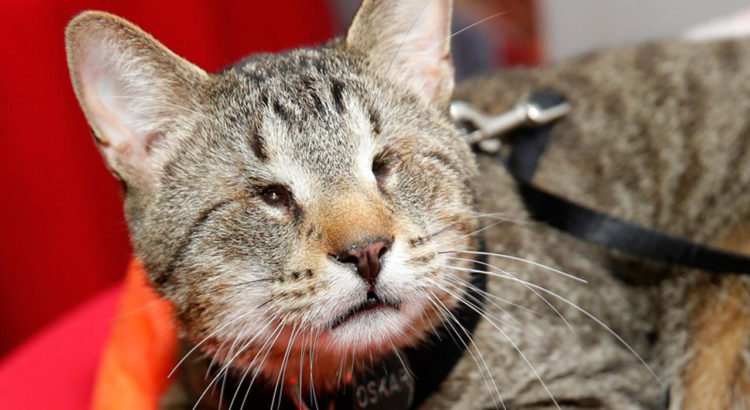
Though the tabby’s bravado elicited a hearty wave of laughter, it was accompanied by a plethora of other heartwarming and inspiring videos about cats and how they function as healers in our everyday lives. Oskar the Blind Cat is a prime example of this – though his recent death was a tragedy for the community, he will forever be known to inspire the blind with his iconic and energetic will to live life to its fullest. Another video followed the story of an abandoned kitten who finds its way into a computer guy’s car engine, and later, his heart. CatVideoFest is far more than a celebration of the ingenuity of various cat videos on the internet – like the organizations that it benefits, it interweaves stories of how cats have strengthened our very own interpersonal connections, bringing harmony as well as endless joy to communities who cherish them.