PREVIEW: Benjamin Britten’s War Requiem

This Saturday, February 16 at 8 pm, the Ann Arbor Symphony Orchestra, UMS Choral Union, and Ann Arbor Youth Chorale will join forces to perform Benjamin Britten’s monumental composition, his War Requiem. The featured soloists will include Tatiana Pavlovskaya, soprano, Anthony Dean Griffey, tenor, and Stephen Powell, baritone.

The work was commissioned for the 1962 re-consecration of Britain’s Coventry Cathedral, which was destroyed in 1940 by a Nazi bomb raid. Composed of six movements, the War Requiem “mixes the Latin words of the Mass for the Dead with poetry of Wilfred Owen, who was killed in action just one week before World War I ended.”

The performance will take place at Hill Auditorium, and it will run for approximately 80 minutes, with no intermission. Tickets may be purchased at ums.org/performance/brittens-war-requiem/ or at the Michigan League Ticket Office.

REVIEW: Complex Rhythms

This past weekend, the School of Music, Theatre and Dance’s Department of Dance staged a fantastic performance entitled Complex Rhythms at the Power Center for the Performing Arts. Featuring four separate works, each had its own unique character and feel.

The performance opened with 7 x 12 and a Little Bit of Cha-Cha, a work by Robin Wilson with a jazzy and joyful, toe-tapping feel. Featuring live music by members of the Grammy-nominated ensemble Straight Ahead, I was immediately taken by the musicians’ position onstage, rather than off to the side. Before the dancers entered the stage, the musicians treated the audience to a jazz feature, solidifying the fact that they were an integral part of the work. Throughout the dancers’ rhythmic choreography, it remained evident that music was intended to play a very central role in 7 x 12 and a Little Bit of Cha-Cha. Additionally, the costume design, with bright colors and swinging skirts, complemented both the choreography and the music.

Next was the premier of Studio A, will you die with me? by Jennifer Harge, “a fire ritual that works to disrupt the anti-black, heteronormative, and capitalist structures that live within the fabric of Western dance studios and dance curriculums.” Featuring a backdrop of rows and rows of lit (electric) candles, ashen-colored costumes, glittering masks, and a long blue piece of fabric spread across the front of the stage, it was a performance that was at once unsettling and challenging, confusing and thought-provoking. Additionally, the soundtrack of the choreography was norm-defying and fascinating – it was an aural hodge podge that was not exclusively music, and for a length of time it was a recording of what seemed to me to be a woman humming singing while washing dishes.

My personal favorite of the evening was Prelude, Fugue, and Riffs, a new work by Bill DeYoung set to a recording of Leonard Bernstein’s “Prelude, Fugue, and Riffs” by the University of Michigan Symphony Band. With a backdrop of lights that resembled a collage of starry night sky and brick wall, the entire performance had a swinging, urban vibe that hearkened back to another era, while simultaneously remaining modern.

Last was probably the most monumental of the evening’s works, Shelter by Jawole Willa Jo Zollar. First staged in 1988 “to address the suffering and isolation of homelessness,” the version performed by the Department of Dance was adapted after Hurricane Katrina “to address the lives of the people that the hurricane left homeless.” It was a powerful performance, featuring spoken word (by Associate Professor Robin Wilson, original company member of Urban Bush Women, who first staged Shelter in 1988) and percussion as accompaniment to the emotive choreography. “I ain’t fled nothing. My country fled me,” Professor Wilson emphatically repeated.

Complex Rhythms explored a wide variety of human emotion and struggle, and it was a boundary-challenging, thought-provoking performance. Congratulations on an excellent performance to all those involved!

PREVIEW: The Ark’s 32nd Annual Storytelling Festival

As a beautiful Ark tradition, The Ark’s Storytelling Festival brings together some of the greatest storytellers for an evening of humor and wit with a touch of heartfelt emotions. This year, the 23rd Annual Storytelling Festival features Laura Simms, Edgar Oliver, and Ivory D. Williams.  Come out to the newly renovated Ark on February 23 at 7:30 PM for some engaging and entertaining stories. Tickets are $25 and can be purchased at MUTO in the League Underground.

REVIEW: 2019 Oscar Nominated Shorts: Animation

The 2019 Oscar Nominated Shorts in the Animation category explore similar themes of family and time, evoking certain emotions over and over again.

Many of the shorts, including Bao and Weekends, were autobiographical. Bao, Disney Pixar’s short released with Incredibles 2 and applauded for its cultural representation, tells the story of a lonely Chinese mother and one of her dumplings when it comes to life as a little dumpling boy. This narrative with animations characteristic of Pixar plays with the idea of parental possessiveness and the need for familial love and attention, taking a harrowing turn at the end that leaves one to wonder the costs of overprotection. Also featuring an Asian-American family is One Small Step, the cleanly-drawn animation about big dreams and realistic achievements. Through the passage of time, Luna must grapple with her dreams of being an astronaut and the obstacles in her way, supported by her single father the entire time. The crisp 3D animation was certainly appealing, turning this “dream-chasing-believe-in-yourself” storyline into something fresh and emotional.

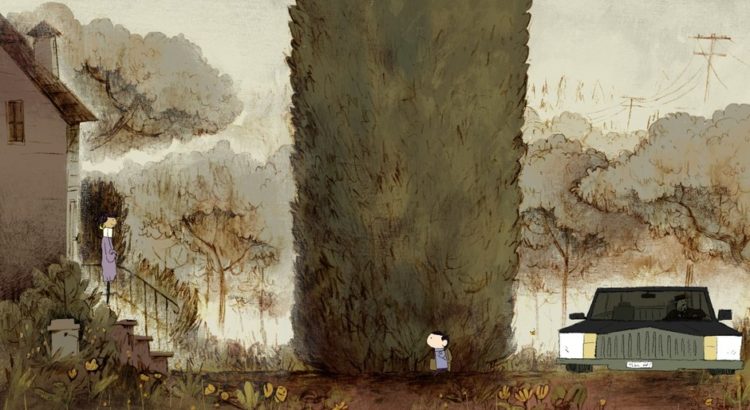
Another short that deals with family is Weekends, a hand-drawn melancholic tale of childhood after a recent divorce. The absence of dialogue brings all the focus onto the universal mood of this film, as a child bounces between homes and lives and relationships evolve as a result, offering a compelling story of a fractured family with purely the art of animation. Late Afternoon looks at the painful issue of memory loss, as Emily, an elderly woman, goes through old memories in order to make sense of the present. Through the use of color, Emily was able to weave through all the different memories, and the flow through time between the present, the subconscious, and the memories. The emotions associated with memory loss was heightened with the use of water throughout the film, washing over her as she searches for clarity.

The last nominee shown, Animal Behaviour, features anthropomorphized animals in a group therapy session. As the most comedic short in the featured films, it is filled with crude animal jokes based on their natural traits until an ape gets going and sets off the dog therapist. The lineup also included two additional selected shorts, Wishing Box and Tweet Tweet. Wishing Box introduced us to a greedy pirate and his hungry monkey companion who come across a box that will give you anything you wish for, while Tweet Tweet gives us the courage to balance on a tightrope as a girl befriends a sparrow who guides her throughout her life.

All the short films used a variety of animation styles, opening my eyes to how diverse animated films can be. From the scratchy and homey feel of the hand-animated Weekends to the colorful, flowy vibe of Late Afternoon to the crisp 2D-on-3D animation of One Small Step, the animation nominees were all both visually appealing and emotionally resonant.

REVIEW: Israel Philharmonic Orchestra

The Israel Philharmonic’s visit to Hill Auditorium had been on my radar as a performance I knew I wanted to see since UMS released their schedule last year.  The original plan was for the orchestra to be led by Maestro Zubin Mehta, a man who is probably the most successful Indian Western classical musician of all time.  Unfortunately, due to health reasons, Maestro Mehta was sidelined for this event, so Maestro Yoel Levi had to conduct in his place.  While Maestro Levi was certainly more than qualified to lead the Israel Philharmonic, a concert conducted by him simply doesn’t have the same allure as one conducted by Zubin Mehta, a veritable giant in the classical music field.  Levi brought excitement to the performance as any good conductor should, but, in my opinion, the amount of technical errors made by the orchestra overshadowed the great energy on stage.  The program started with the playing of the US National Anthem, followed by the Israeli one.  Unfortunately, those were the best pieces they played on the concert.  They started off the real program with a piece for string orchestra.  It was fine, overall.  I didn’t notice any major flaws or anything, but to me it just felt kind of boring.  This could have been due to the piece as opposed to the players, though.  They followed it up with Schubert’s third symphony to round out the first half.  It was OK, again.  My main gripe with this piece was the timpanist’s muting.  Every time he hit a note, there was a sharp, audible cut off an eighth note later.  As a timpanist myself, I can attest that nobody should be making that much extraneous noise, regardless of the style they choose to play or musical background they come from.  It distracted me so much from the rest of the piece that I couldn’t focus on anything else.  Most people in the audience probably didn’t even notice, but to me that was a huge red flag.  The second half of the program was Tchaikovsky’s 6th symphony, a masterwork.  Every major orchestra has played this piece a million times and Israel certainly cannot be an exception to that.  Because of this, I am baffled at how many mistakes they made.  Every time there was a run in the strings or brass, there was absolutely no clarity because they were simply not together.  To make matters worse, there were times when the strings would finish a run and we would be left hearing an incorrect chord.  The brass sounded kind of thin which cannot happen when playing powerful music like that of Tchaikovsky.  The timpanist redeemed himself to an extent on this half.  His strong playing led the orchestra through their best moments of the piece.  Unfortunately, he had some tuning troubles.  He was checking the low drum at intermission with a tuner, so maybe there was some sort of equipment malfunction, but it sounded out of tune at multiple spots.  It was just disappointing to see a world class orchestral play such a standard piece with so many mistakes.  The clarity issues could have been a result of a lack of familiarity with Hill Auditorium, an acoustically superior, yet really weird place to perform.  The other mistakes don’t really have a justification, in my opinion, though.  The encores were solid, but nothing special.  They performed “Nimrod” from Elgar’s Enigma Variations and the “Waltz” from Tchaikovsky’s Swan Lake.  Just when it seemed as though the orchestra was about to redeem itself with an exciting rendition of the waltz, the end fell flat.  As the rest of the orchestra hit an accelerando to end the piece, the low brass fell behind and simply couldn’t hang.  Overall, it was a fitting end to an underwhelming performance by a group that I can only characterize as overhyped.

REVIEW: Oscar-Nominated Shorts (Live Action)

So often I am struck by how little film makers do with their medium. It is an art form that combines visual and audio elements more immersively than reading a book or perusing an gallery can really claim to do. Yet we end up with so many American Pie types, popular but containing no real depth. Emotion and meaning are dulled when movies become uniform in this way, and their power to deeply affect dies. Moreover, even the aesthetic capabilities of the film medium are often ignored, settling for unimaginative school or office buildings, with costume designers seeking normalcy so fervently that their characters’ dress becomes boring.

Fortunately, there are some who understand the abilities film has to deeply move its audience. All five of Academy Award-winning live action short films (Mother, Fauve, Marguerite, Detainment, and Skin) provoked a larger range of emotions in me than nearly any other movie I’ve ever seen. Mother gave me a feeling of creeping cold desolation, with its wide sweeping gaze at the empty beach in the beginning and end. Using the point of view of the lost boy’s mother gives the audience a closer look into her desperation and helplessness. We listen to him with her, clinging onto every word his soft voice says through the phone. The camera work is disorienting, making us panicky with the mother and grandmother as the reality of the situation sets in.

Image result for madre short film

In Fauve, there are two drastically different sceneries: the wildly beautiful Canadian countryside (wildflowers, long grasses, mountains) and a stark mine site (plain grey earth for what seems like miles on all sides, reminiscent of an alien planet). The scenes in the mine site seem surreal compared to the lushness of the fields the boys travel through to get there. I almost expected the earth to begin to rumble and rise, revealing itself to be some enormous living creature.

Related image

Marguerite was the only one to make me cry, and one of the few movies that have ever made me cry. The loneliness she must have felt moved past the screen and into the most melancholy part of my mind. It is unclear whether she loved again after her soulmate was married, but because she lived alone in the movie, it seemed her companionless existence had been eternal. The whole movie had me feeling cold: the slowness of all her actions, the neatness of each room in the house, the millions of wrinkles lining her face.

Image result for marguerite short film

I felt least connected to Detainment, though it disturbed me more fully than the true crime documentaries on TV have ever done. The documentary-esque style of the piece did not go well with the narrative tone, and the same few images of the boys abducting the baby were played over and over again, without adding much value to the film. However, the filmmakers played on the boys’ conflicting stories, which helped create an uncertain, uneasy feeling.

Image result for detainment short film

Skin was by far the most brilliant star of the five. It played on racism in modern America, the psychology of childhood development, gun politics and violence, the idea of innocence and how easily it can be destroyed, the uncertainty of placing blame…I could go on. It made me question my own life and thoughts, those of my family, of the country and the greater world. I had to catch myself when I unconciously started distancing myself from the white family’s attitudes and actions, recognizing the weakness in that thought, the automatic stereotypes I’d applied to make myself feel better. And when the two young boys locked eyes for the second time, I was haunted. Somehow within the film’s disturbing content, there was still an attention to lighting and landscape details that made it uncomfortably beautiful, the exquisite drip of blood, the lonely desert nothingness.


Image result for skin short film 2019