REVIEW: The Pigeon Keeper (Sitzprobe)

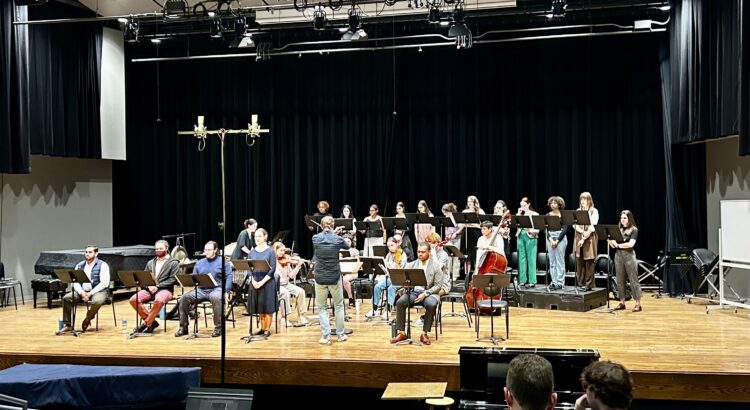
In the world of opera, new compositions are blossoming in opera houses throughout the country. SMTD’s own Voice & Opera Department is currently working alongside the Santa Fe Opera (SFO) to workshop a new chamber opera entitled The Pigeon Keeper. Commissioned by the SFO, the score was composed by David Hanlon with Stephanie Fleischmann’s touching libretto. This piece is still in progress here at SMTD and will have select open performances before its final showing with the SFO in March. This open sitzprobe rehearsal was presented at the McIntosh Theater (Moore Building) last Thursday to a small audience of students and faculty.

The opera showcases six main characters: Orisa, Thalasso (her father), The Schoolteacher, The Widow Grocer, Kosmo, and The Pigeon Keeper. Additionally, a women’s chorus (SSA), serving as crooning pigeons and schoolchildren, accompanies them. The Contemporary Directions Ensemble, under the direction of Jayce Ogren, collaborates with this cast comprised of auditioned singers and chorus members from The University.

The opera takes place on “an archetypal Mediterranean island”, following a young optimistic girl named Orsia and her father. They go on a fishing trip together on the anniversary of Orsia’s mother’s death and find a refugee boy in the water. The two take the boy in, but Orsia’s father proclaims he must stay somewhere else, or he will be sent to “the other side of the island”. With great worry, Orsia searches the island to find him somewhere to live, only to be confronted with shut doors and unwilling neighbors.

“Sitzprobe” comes from the German word for “seated rehearsal” an unstaged rehearsal where the orchestra and vocal parts will first come together. There are no costumes or set pieces, and the focus is entirely on the music In the moment. But the music truly lent itself to creating its own atmosphere. I rather preferred the lack of distraction from any technical aspects, leaving me to fixate on the captivating text. Fleischmann’s lyricism is quite prolific: she depicts such reality through an art form that is praised for being boisterous and grand. Likewise, Hanlon’s music is gracefully whimsical, while rooted in truth about the pressing immigration crisis in the United States and abroad.

The SFO website describes the piece as “[an exploration of] how we respond to those in need in a time of hardship and scarcity; and celebrates the kindness of strangers, the power of human connection, and the unexpected places we find family.”

The final performance will be conducted by Kelley Kuo, alongside soloists Laura Soto-Bayomi, soprano; Bernard Holland, tenor; and Aubrey Allicock, bass-baritone. It will be a free fully-staged performance on March 10th at 4 pm in the Stamps Auditorium at the Walgreen Drama Center. The opera will have its professional debut at the Santa Fe Opera later this year.


March 10, 4:30pm. More on the Santa Fe Opera here.
REVIEW: The Grown-Ups

Directing student Leah Block (BFA 24′) presents her senior thesis: The Grown Ups  by Simon Henriques and Skylar Fox. This effortlessly quirky piece revolves around a group of young counselors from a summer camp who are earnestly cultivating the next generation of camp-goers. The counselors all love camp! And all their camp traditions! Except for the racist ones…like the previous Indigenous name of their predominantly white cohort or the exclusionary structure of camp games (lending preference to older kids and men). But besides that, it’s all fine…..right?

New counselor Cassie joins for her first summer at the newly renamed “Indigo Woods” and meets the easygoing Lukas, high-strung (but well-intentioned) Becca, overly excited Maeve, and the odd and hardworking Aidan. The group indoctrinates Cassie, welcoming her and really  wanting her to have a good experience at camp. Each evening the group comes together at the campfire, recalling scary stories of their previous camp years, debating the best tactics to support the campers all while a national online argument is breaking out, shifting the political sphere of the world. Summer camp can feel isolating for some, (especially as their world is crumbling underneath them) and these young adults are now the “Grown Ups” in the face of crisis.

This cast was thoroughly cohesive and enormously charming. Each character was undeniably unique yet eerily resembling someone you’ve met before (probably from summer camp). Becca (Sarah Hartmus) and Aidan (Hugh Finnigan) were house favorites, with electric chemistry and sidesplitting comedic moments. I enjoyed both their attention to comedic timing and thoughtful physical acting. While I was drawn to Becca and Aidan’s characters specifically, I felt deeply connected to each counselor as an audience member. The way Henriques & Fox crafted their intimate dialogues made it feel as though I instantly knew each of these characters. The seamless flow of the actors’ choices among one another further enhanced the sense of familiarity. This ensemble was tight, with a deep-cutting emotional payoff in the end.

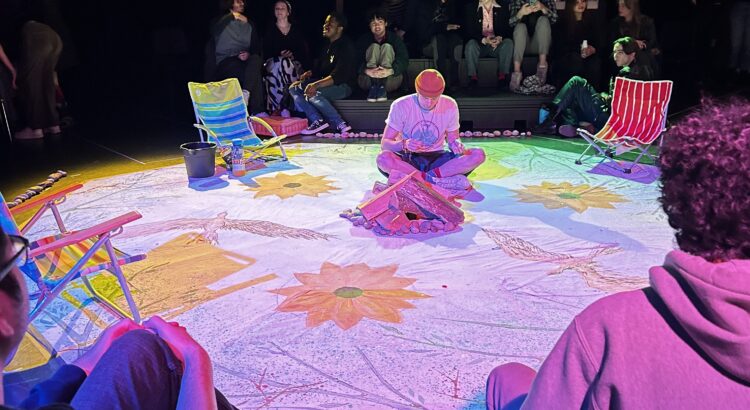
When I walked in, I was apprehensive of an in-the-round setting—a notoriously difficult set-up to direct for. But Ms. Block had perfected it and some. Her direction was personable and genuine, I felt like I was involved in all of the camp discourse, and ultimately a part of the demise. The in-the-round choice was brilliant for the storytelling aspects of this show, leaving another theater full of young adults to look inward at our place in a world facing escalating disasters.  Her vision was clear and cohesive, as so many poignant themes made their way out of the writing onto the stage, cultivating a really powerful performance.

Camp Counselor Leah taught us many things throughout our time at Indigo Woods: “Just because it’s the way we have always done it does not mean that it is the best way”, “comfort is the death of progress”, and “We can’t let resentment of not getting the world we want to stop us from leaving it better than we found it (Directors Note)”. She brought us all inside an idyllic summer camp and from there we were abruptly shot back into reality—perhaps that was the point of camp all along.


[Photo above depicts Sam Smiley as Lukas.] Photo thanks to SMTD’s Theater & Drama Dept.

REVIEW: Arbor Falls

Kicking off the 2024 season for the SMTD Theater & Drama department is Caridad Svich’s Arbor Falls. It is a more recent piece, premiering in 2022 at Illinois State University. Directed by Tiffany Trent, this reflective and quiet play invites the audience to reflect on themes of community, fear, and change. According to newplayexhange.org, this is the fourth time the play has been fully produced onstage.

Arbor Falls is one part of Svich’s seven-play cycle entitled American Psalm. The plot revolves around the members of the dwindling members of a church within a small unnamed town. The preacher of the church allows a passing traveler to stay in their church, and the town unforgivingly reacts with gossip and rejection. The traveler exposes the spiritual and moral values that lie within their society’s foundation, as a juxtaposition to their seemingly neutral spirituality. The town members pressure the preacher to send the traveler away, as the traveler does not immediately fit into the community. Each character is unnamed and un-gendered, named “Preacher”, “Traveler” or “Churchgoer”, so the presentation of characters in this show is quite flexible. The freedom of dialogue and character presentation within the script was apparent, and I can appreciate how each production of Arbor Falls would have its own nuances based on the performers and community.

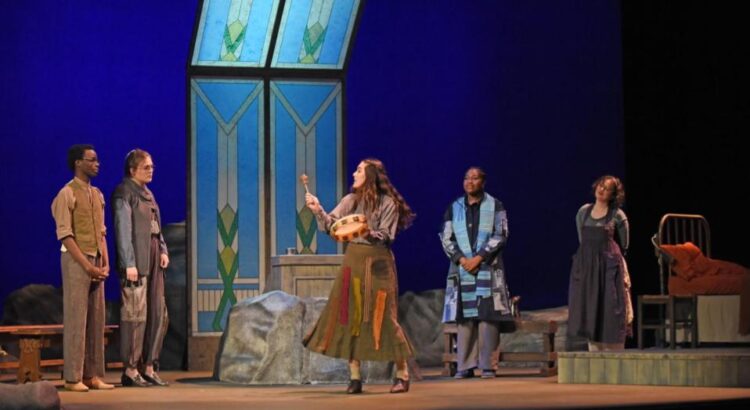
Set of Arbor Falls, Lydia Mendelssohn Theater

The set of the play didn’t entirely establish the environment of the town of Arbor Falls. I understood the simplicity of the townspeople’s viewpoints, their closeness to each other, and the dedication and importance of faith in their community, but I didn’t know exactly where we were (physically, or in time) from the assorted colors and textures. One enchanting aspect of the set was the courteous lighting shining through the top window. It functioned, to me, as the ounce of faith and hope left in the town. Which, is dwindling dimmer and dimmer, until a grand event near the end swoops the piece away.

The dramaturg team describes the play as “..an exploration of love, life, and the mess of all things human.” In my own reflection, this is an accurate description of the overall play, with the humble and morally conflicted Preacher, as well as the judgemental and pious Churchgoers. But moments after the curtain call, I found myself parsing through my memory of what actually had happened the last two hours. Svich’s poeticisms often fell short in terms of plot—their stillness and reflection were often lost to the audience. The story depicts itself at a lull through Act I, until an abrupt scene near the end, where the Traveler turns into a ghost(?) or eagle (?) flying away, absorbing the top of the window fixture. This abrupt moment made me question everything that happened before. This moment felt abstract for the groundedness that was created in the hour and a half before. The scene is still simmering in my mind—possibly the only moment that stuck.

Although, Svich’s blatant messaging regarding how communities treat outsiders was clear. She often explores stories of wanderers and the disenfranchised in her plays, connecting to her roots as a child of an immigrant. This relevant messaging shined through the rather monotonous performance.

The Department of Theater & Drama will present Anton Chekov’s The Cherry Orchard in the Arthur Miller Theater later this spring. Shows will run April 4-14. Tickets are available here.


Photo thanks to University of Michigan SMTD.

REVIEW: The Grown-Ups

At the end of your time at SMTD many seniors choose to show off their skills and talents in a senior thesis. This weekend I had the chance to see such a performance. The Grown-Ups written by Skylar Fox and Simon Henriques is the directorial senior thesis of SMTD student Leah Block. It’s a two act play that follows five camp counselors as they navigate their friendships with each other, their collective and individual pasts, and their role as counselors. The play is a comedy, and while it does cover more serious topics in act two, it generally keeps that tone throughout.

One of the first things I noticed about the performance was how the space was arranged. The audience surrounded the stage, which consisted of a small circle of lawn chairs on a blanket. Everyone in the audience was seated in a chair on the floor too, and it made the space feel like being at camp. I could totally imagine being in the woods and watching this while sitting on some kind of makeshift chair (maybe something like a tree stump).

The plot mainly centers around Cassie’s experience as a new counselor at the camp. Mostly consisting of her struggles to fit in and gain acceptance from the other counselors, many of whom have been coming to camp since they were children themselves. The use of props and costumes is another thing that I really enjoyed about the play, and Cassie’s gradual acceptance could be tracked through her accumulation of stickers, camp paraphernalia, and camp specific acronyms.

Another aspect of the plot relies on the counselors abilities to shield the campers from a heated debate online, which made me think about how weird and strangely isolating summer camp is in general. Who thought it was a good idea to entrust a large group of kids to a small group of people barely not kids themselves? The play touched on this concept many times, and it was made all the more entertaining by the increasing severity of the conflict in the outside world.

Overall I really enjoyed the chance to see The Grown-Ups. I always really enjoy the opportunity to see productions by other SMTD students, but I found this one particularly funny, and a uniquely versatile setting and concept.

Picture from The School of Music, Theatre & Dance events website.


REVIEW: Arbor Falls

7:30pm • Thursday, Feb. 15, 2023 • Lydia Mendelssohn Theater

The School of Theater, Music and Dance’s production of Arbor Falls this last week was a unique and memorable take on faith, community, and change. Arbor Falls tells the story of a small town grappling with change. A traveling stranger has come to town, granted refuge in the preacher’s small, failing church. The stranger’s presence in Arbor Falls resurfaces the old hurts and prides of the residents’ lineages, forcing them to reckon with what it means to preserve one’s history and when to move on. Having grown up in a small town, it was interesting to compare and contrast the world created in the play with my own personal experiences.

For me, the best part of this play was the script, the core around which the rest of the performance was built. The play was written by Caridad Svich, a much-awarded playwright who also translates works of theatre in English and Spanish. For me, it felt like she captured the essential characters and perspectives of a small town, then romanticized them into something altered but recognizable. Arbor Falls was like my home-town portrayed through an Art Nouveau lens, all curliques and flourishes. She wrote much of the dialogue in an unusual syntax, perhaps meant to evoke rural dialects, which engaged my curiosity. I could sort of imagine the script being read by people I grew up around, but those words felt awkward spoken in theatre students’ voices. Real but unreal.

Stylistically, the production felt untethered in time and space. The Arbor Falls onstage was like no small town I’ve ever lived in, but recognizable at the same time. Svich’s treatment of religion in the script merged the mundane with the otherworldly, and the set and costumes materialized this tension. The costumes were a bit bohemian–they reminded me of clothes you would see at a small folky music festival, or maybe a renaissance fair, made new to look old. Not like anything I’ve ever seen anyone wear, but they helped create the unique world of Arbor Falls. Similarly, elements of the set, like the preacher’s pulpit, appeared to in the process of sinking into (or emerging from) boulders. Or, perhaps, they were symbolically embedded in the land as a representation of the characters’ roots in Arbor Falls.

Overall, I thought Arbor Falls was a beautiful interpretation of how we might maintain or fail to maintain our values, how we grapple with the baggage of our heritage to navigate change. I wish I could watch it again to really grasp all of the nuances in the language, but I deeply enjoyed my experience watching this last Thursday.

Featured image from SMTD digital program.

REVIEW: Alexandra Collins’s “Hyper Light”

Seeing Stars with Alexandra Collins’s Exuberant “Hyper Light”. 

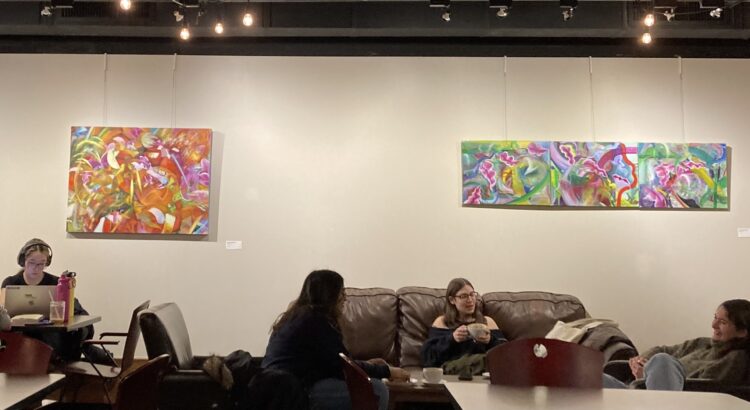
On Friday February 16th, I had the pleasure of attending the opening reception of Stamps senior Alexandra Collins’s first solo exhibition “Hyper Light ”. The work is on display at The Common Cup, an Ann Arbor coffee shop on Washtenaw Avenue.  From still lifes of jello molds and glassware, to large zinging abstracts of flowers and shapes, the series is a colorful and bold exploration of the relationship between energy and tension.

“Red Jello on Purple Tablecloth”

Collins’s eye finds movement in stillness. Investigating the organic in the inorganic, she uses bold colors and streaky light to create energetic portraits of jello and glass. The tension between energy and stillness holds as a focal point in her still lifes like the horizon of a sea scape. The lively dynamic style contrasts and emphasizes the stillness of the subjects like a loud silence. Maybe you shouldn’t have ordered that second Mayan Mocha, or maybe you caught the jello jiggling from the corner of your eye.


“Superbloom”

Collins plays with the constraints of the canvas, in some works lining up several panels, in others tacking panels on in unexpected ways. The larger and more abstract pieces expand and challenge what can contain them. Pieces such as “Superbloom” are colorful menageries of plant life, bubbles and baubles, and streaks of light. Reminiscent of exploding stars and streaking galaxies, the arrangements represent a synthesis of color, shape, and form. The flowers are closed, and the paint around them vibrates and thrusts and sings like it just can’t be held anymore. Like the build up of a song with no release, we are held in those moments before explosion.

On a blustery February day, the basement location of the exhibition makes the colorful paintings feel like an underground secret, like spring charging beneath the earth. I felt a celebration and investigation of the feminine in the flower motifs and dining room still lifes. The celestial exuberance and energetic synthesis of shapes and color asking what feminine energy might look like, and where we could put it down. When I parked at a table for a few hours to sip coffee and send out piles of resumes and cover letters, I felt Hyper Lights hum resonating around me, not with the glory of the finish line, but with potential.

“Supernova”

“Hyper Light” will be on display at The Common Cup on Washtenaw Avenue for about two more weeks, until March 2nd. The paintings are an energetic and possibility expanding presence in the cafe, which is a great place to study or meet with friends. You can find more of Collins’s work on her website and instagram, or by attending Commence, a graduating senior exhibition held at the Stamps Gallery in April.