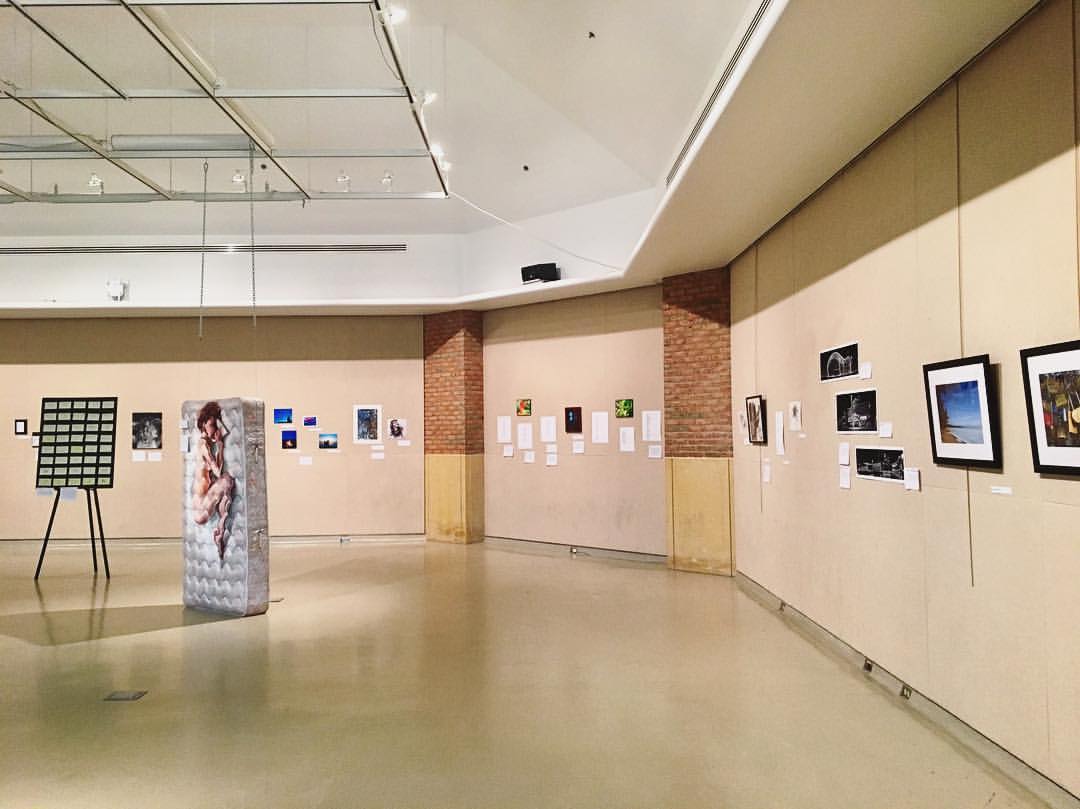
Blueprint Literary Magazine is hosting their issue 6 release event & reception with the Celebrate Creativity Art Show tomorrow night from 4-6pm. The art show has been running from February 13 and will go until Friday, the 24th. A link to the art show and release event is here – Facebook: Art Show.
After briefly stopping by the exhibit at the Duderstadt Gallery on North Campus, I was surprised by the modernity of the space. From a quick glance, there is everything ranging from photography and poetry to sculptures made from mattresses. Some of the art on display will also be featured in Blueprint’s 6th issue, and magazines will be for sale at the reception.
There was a decent audience filling the spacious power center on this unseasonably warm Saturday night. I saw people of all backgrounds represented in the audience as I filed into my seat for Beyond Sacred: Voices of Muslim Identity. I was seated on the balcony, with a perfect, if somewhat distant, view of what was going on onstage.
The lights dimmed, and the five cast members in the show filed onto stage one by one. They introduced themselves in their native language, only three of the five speaking English. They started off chronologically, talking about the muslim men and women who have been part of America since the very beginning. Then they slowly dove into each of their personal stories, still going chronologically. Each speaker spoke their words with a loud and well rehearsed tone of voice, accentuated by clapping and parts of the performance that were done in unison. At two different intermission-like segments music was played as the performers got up and moved, carrying their binders with them only to sit back down at different chairs. I was struck by how well these non-actors were able to perform, as well as how tightly the story was woven together despite telling very real stories of these people’s lives. I enjoyed learning a little bit about each of their lives, be it the muslim-convert Tiffany who has found a community in her faith or Amir who worked at Chuck-e-Cheese for several years to make ends meet. If any more of this performance series, Undesirable Elements, by Ping chong come to town I won’t be able to keep myself from going.
Full Cast of Beyond Sacred
The end of the show presented the cast members various thoughts on the first month of the Trump administration. Some were fearful, others hopeful, still others largely pessimistic about what this signified. The only shared characteristic is that each and everyone of them was reading their lines with a raw intensity. We later learned that this was the very first time the cast members had performed this part, which was why it sounded so raw.
Directly following the show, the cast members were invited back on stage for a brief Q&A session. I was able to find a seat downstairs for this part after half the audience had left. A fair amount of people stayed behind, and while I’m no expert as guesstimating numbers I would guess several hundred people remained in the theater for the Q&A. It was interesting to get to hear them talk outside of the scripted performance, you could tell that several of the cast members in particular, Maha Syed and Amir Khafagy, were naturally ver adept at public speaking. I appreciated the Q&A session and was glad to have attended, however there were quite a few times that the questions asked were intrusive or combative.
Overall I had a wonderful experience, and think I gained new insight into the diversity of muslim experiences in America as well as the real damage islamaphobia causes.
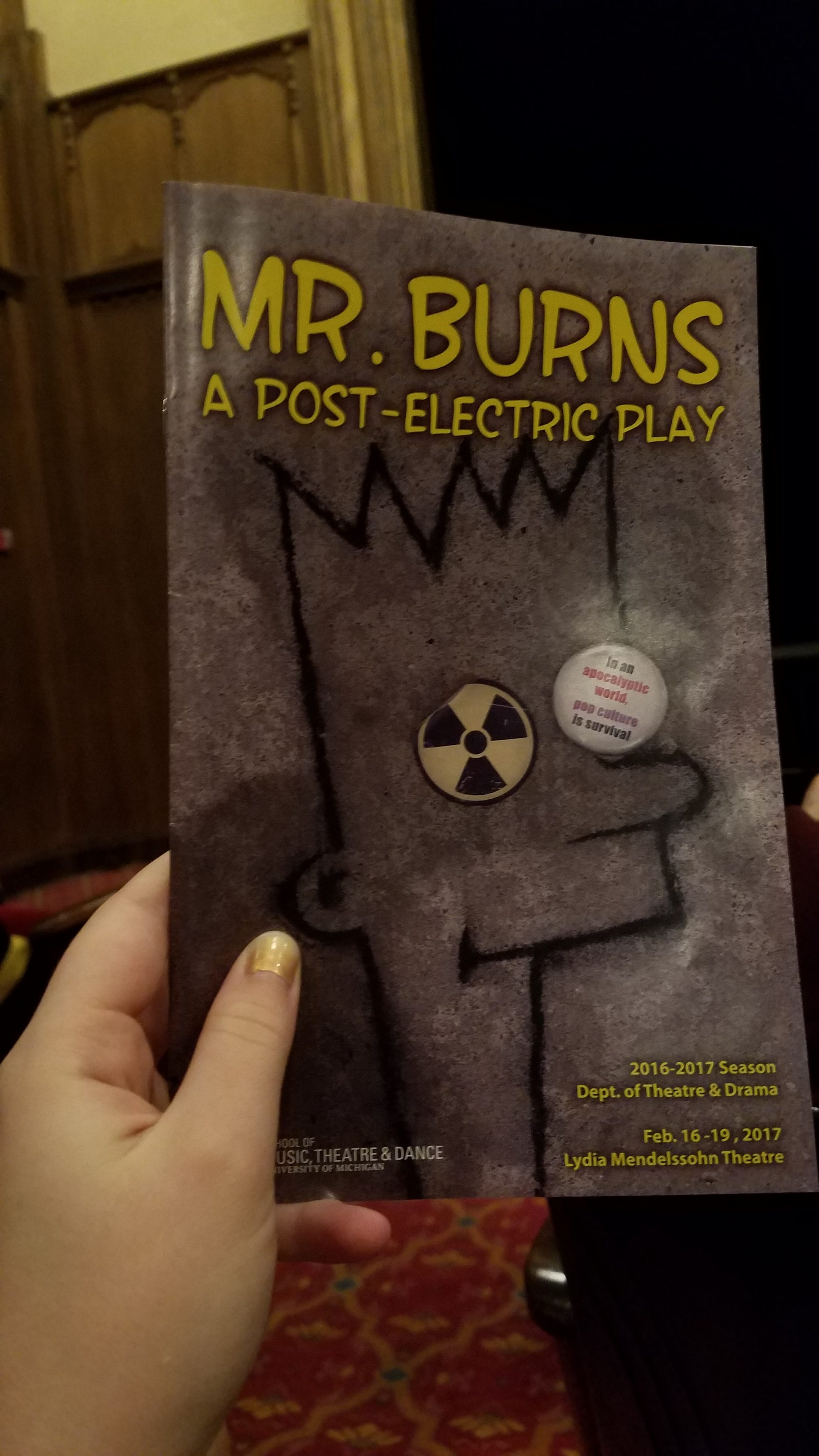
Mr. Burns, a Post-Electric Play speaks to the very nature of storytelling, its ability to evolve and change as society does. It’s like one long drawn out game of telephone- one in which the pop culture icons The Simpson’s star. The production put on by the University of Michigan’s Department of Theatre & Drama this past weekend was inventive and entertaining, featuring a cast that was diversely talented and dynamic.
Visually the show was vivid and full of beautiful surprises. The set was at turns grungy and battered, dazzling illuminated, and later terrifyingly imposing. Moving through three distinct locations, one for each act, each was unique and reflected the changing times after the end of the world. And the costumes tied the scenery together. At first, they were everyday clothes that you and I would wear, but battered and obviously routinely slept in. Then the first leap 7 years after the world-ending-electricity-lost event they are still familiar but as the actors attempt to re-enact a live performance version of The Simpsons the costumes become slightly off. They have obviously been scavenged and the actors are making do with what they can find. The last leap puts us 75+ years after that ominous event. Actors are wearing caution tape and paint as dresses. Pencils function as Bart’s hair, as his mother, sister, and father wear pieces of plastic bottles and cut up solo cups. When Lisa walked out in a garbage bag of a dress covered in solo cups, I almost lost it- it was that ridiculously funny!
What also got me was when in the second act (7 years out) the actors are all suddenly singing. I was very unaware there would be singing at all in this play but we took a short break, from the serious possibility that they were all dying from radiation, to listen to a well executed mash-up of hit songs. This act really allowed the actors to stretch themselves into their characters and flesh-out the relationships we’d begun to see in the first act. The interaction between actors during this first act was key to setting up the rest of the show, though it was by far the most serious- it took place shortly after the worst of the power loss. The well enacted backstories become key in the second act because we’ve become invested in their fates.
I was sad to lose them in the third act and to never know for sure what had killed them- guns, old age, or radiation. The third act was strange and fun and startling as we saw how 75+ years had transformed the idea of The Simpsons; it became strangely merged with the tale of the end of the world as we currently know it.
It left me wondering; regardless of if we have electricity or not 75 years from now, what will be the part of culture that survives? For all the brilliance of Mr. Burns, I really hope The Simpsons isn’t the one thing that future generations hold on to.
As I took my seat in the Power Center on an unusually warm Saturday evening in February, I am greeted by the words “BEYOND SACRED: Voices of the Muslim Identity” being projected on a black backdrop. As I wait and wiggle around in my seat, the second half of the phrase changes, alternating to so many different languages that I lose count; many I could not name just by looking. I am already excited.
Beyond Sacred: Voices of Muslim Identity by Ping Chong + Company is one of those works whose creation process is as interesting as the performance itself. It is full of contradictions and clarifications and is a fuller narrative for it. As an English major and lover of the theater, Beyond Sacred showed the innate power of well crafted stories to be more powerful than show stop numbers (though I love them dearly). The words were all the razzle dazzle this company needed to leave their audience spellbound.
The production style was minimalist. 5 chairs, 5 music stands, 5 microphones, 5 spotlights, 5 performers, 2 American Sign Language interpreters, and a handful of projections on an otherwise empty stage. As I said, they didn’t need anything more. The minimalism was combined with patterns of clapping, repetition of dates, alternating spotlights as the narration passed from person to person to create an interweaving and complex story of what it means to be Muslim, today and historically. 5 stories of identity, among a vast diverse range of intersecting identities that make up the Muslim community worldwide. Because their main message revolves around subverting the misconception that there is a single Muslim identity.
To give context to these five stories, one of the first parts of the performance is a quiz style list of important dates. Here, early on, the important role of research is evident- Research into the history of Muslim identity. As well as the careful construction and presentation of information. All the performers on stage are telling their own stories, but they are interwoven with their fellow performers narratives. They pass the spotlight between them if you will.
Originally, each performer responded to a call for people to tell their story. They were interviewed by the writers. Then from those interviews, these 5- Tiffany Yasmin Abdelghani, Ferdous Dehqan, Kadin Herring, Amir Khafagy, and Maha Syed- were chosen. From those interviews the writers created Beyond Sacred. During the Q&A, we learned that the performers always had the ultimate say on wording- it was of course their story-, and it was interesting to hear the there was often back and forth as the creators searched for just the right presentation.
Want to learn more about the creation of Beyond Sacred: Voices of Muslim Identity? Check out this YouTube video below:
As I noted, there was a Q&A afterwards. I found this part really interesting because here the performers were able to address how they had re-written/added to the ending which addressed recent events during the Trump administration’s first days in office. They had re-written the ending after the election and even within the last month since the inauguration, it had started to sound dated. So in the last week or so each performer was asked to put into words their thoughts. Their words focused on the importance “of telling your own story” and not letting others create representations of you (Amir Khafagy).
When asked by an audience member about their thoughts on doing this performance when those buying tickets were open to their message and likely “sympathetic”, the response was overwhelmingly that it is still important. Khafagy urged us to realize that question in itself comes from a place of privilege, encoded with the idea that we already know everything there is to know about being Muslim. Other answers focused on how the show is empowering and enlightening to everyone, or the performers wouldn’t feel they didn’t do what they set out to.
Overall, the night was 75 minutes of intense emotion, laughter, revelations, self reflection, and an urgent call to be an active ally and activist. I would recommend everyone see Beyond Sacred: Voices of a Muslim Identity.
And with UMS’ archived livestream you can! Click below! Livestream begins around minute 16.
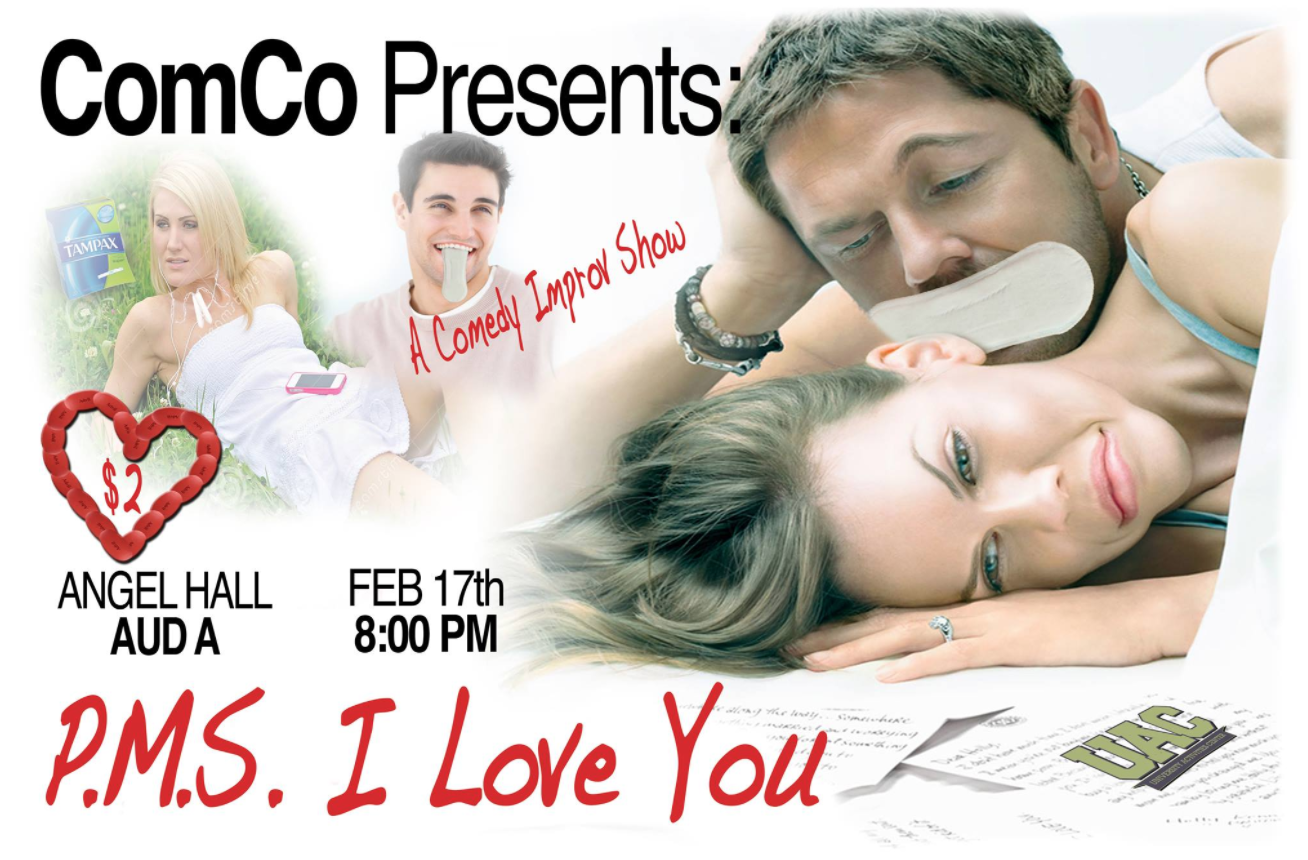
The room was just as packed as the last time I had gone to a Comco improv show, thankfully this time my friend and I had arrived a good half hour early and managed to find ourselves decent seats near the front. The show apparently had 364 people in attendance, so you can only imagine how packed the lecture hall ended up being, but that only added to the lively atmosphere. The show opened with a short video clip detailing a meeting of the fictional “hookup culture club.” The video quality was extremely impressive, very reminiscent of the pre-recorded SNL skits that air in between live ones, and it got quite a few laughs from the crowd. You can watch the the full clip below.
After the video set the mood for the night’s performance, they started with a relatively simple “freeze”-like game, where the actors run in and replace their fellow actors in scenes, changing the scene as they do so. Very quickly a running gag appeared that would end up resurfacing several times throughout the night. The joke was that “double frappuchinos” needed to be made with two people. Once again, I was struck with how quick witted and versatile the entire cast is, being able to play off that relatively simple joke in a wide variety of ways.
Another one of my favorite games was where a selection of cast members came up to play various “radio stations,” either real or fictional, all derived from audience suggestions. For this game the lights are turned off and a single cast member shines a flashlight onto each one of the cast members when it was their turn to speak. We had a variety of radio stations such as “NPR pets” where a cast member droned on in a dry tone of voice about the various antics of a dog “fluffy,” or the charming musings of “Grandma radio” played by one of the male cast members.
Another one my favorite games the whole night, and one I personally hadn’t seen before, was one where one comco actor was made to guess basic activities, and extreme strange details about those basic activities chosen by the audience, while three other actors who knew the details had to act out the scenes using only non human language. It was interesting to see how the four actors ended up coming up with a similar sounding nonsensical babble that resembled a real language, even coming up with a few words for certain established objects and meanings throughout the course of the game. While not getting all of the answers right the actor doing the guessing was able to figure out she was doing wild things such as doing laundry with keys instead of detergent with the pope and water skiing in a wedding dress.
At this point a previous cast member who had been sitting in the audience was invited to join them on stage. Judging by the rousing chorus of cheers from the audience he was well known among the crowd. After a quick game, they finished the night with what apparently is a Comco tradition, “I like my men like I like my ___.” for this game the audience would shout out random words and the cast members would have to come up with witty one liners beginning the the aforementioned phrase. By the time the night was over my cheeks hurt from smiling and I was ready to begin my weekend on the right foot.
Comco’s next performance is March 24th and you can find all the details on their Facebook page here.
Ping Chong receiving the National Medal of the Arts
Before Ping Chong’s talk in this week’s Stamps speaker series, we were reminded of how influential and highly lauded of a figure he is in the art community, having been recently awarded the National Medal of the Arts by Obama himself. Ping Chong is a seminal figure in American contemporary theater, having created over 90 productions in the span of his career. He was born in Toronto but was raised in New York City’s Chinatown. He then attended the School of Visual Arts and the Pratt Institute for filmmaking and fine arts respectively, and as he admitted in his presentation, did not expect to end up working in theatre. He started working with Meredith Monk in 1969, first stepping foot into the world of experimental theater. After collaborating with her he went on to found his own theatre company, now known as Ping Chong & Company.
Cast members from Beyond Sacred
The presentation began by showing a what I estimate to be a 15 minute long video about the cast members of Beyond Sacred and exactly how the project was put together. It was interesting to get to know each of the cast members, and get glimpses of their personal stories in preparation for the show on Saturday. What was even more interesting was seeing the way that that Ping Chong was able to take real people, and weave their stories together into an inspiring production. Hearing the cast members speak so highly of his skill and delicacy as a director was extremely inspiring. Watching this video only made me more excited to attend Beyond Sacred and witness the performance for myself. The video is on youtube and I have attached it to the end of the this blog post for your viewing pleasure.
an example of the Undesirable Elements series format
Beyond Sacred is part of his widely known Undesirable Elements series. He first began this series in 1992 to explore the experiences and identity of various communities, particularly those who identify as outsiders. All of the works in this series follow the same format, which is seated cast members, usually real people belonging to that specific community that he had interviewed and hand selected, reading a script off binders to a rich soundscape and supplementary projections. This format is highly adaptable to the needs of different communities and relatively quick to produce, while also allowing non-actors who might be uncomfortable with memorizing script or blocking preform and share their stories.
A scene from Collidescope
When Ping Chong finally began his talk, he wasted no time quickly dived into describing one of his more recent productions, Collidescope: Adventures in Pre-and Post-Racial America. The main plot of the production is that a group of aliens came across the Earth and confused as to why humans were killing each other over race, and summarily set off trying to find answers. An interesting look into race and class in America, Ping Chong adapts the production for each location it is performed at, bringing in a local event to be discussed by the aliens.
Another scene from Collidescope
The production also showcases his unique skill in blending theater performance, video projections and soundscape into a singular production. He talked briefly about how in the past, traditional theater often ignored the use of sound, instead purely focusing on the script as a text. He, instead, enjoys using a rich and dynamic soundscape to further the immersive environment of this works. He also talked about how he cast people across all races and genders to play each and every role, to further drive home the absurdity of racial divides when we are all one human race.
Finally, we were given a brief peek into what Ping Chong has coming up in his undesirable elements series. He talked shortly about a project he is working on about the history and peoples of the state of Alaska.
While I find Ping Chong’s insight into specific piece to be fascinating, I only wish he had talked longer, having only taken the mic for around twenty minutes after the video about Beyond Sacred was finished. I’m not entirely sure Ping Chong knew exactly what the format of the Stamps Speaker Series was, and I wish all of the students and community members in attendance could have gotten a better insight into his works and creative process.
The Penny Stamps Speaker series will return March 9th with Andrew Logan, and will continue for the rest of the semester with new talks every Thursday at 5:10 in the Michigan Theater. All of the talks in the series are free to the public and and you can check out the full schedule here.