Trolls review

Not to be a party pooper but in the first half an hour of this movie, I thought I was going to faint because it felt like Elle Woods from Legally Blonde on steroids! Or perhaps a better description would be an ecstasy trip! Or better yet a Lisa Frank’s fantasy world. I should add that I myself have been compared to Elle Woods because of my effervescence. But, I just thought things were a little too happy and the color of the animation a bit over-the-top.

But, as time progressed this movie contained character arcs, changes, and twists and turns.

Brief Synopsis: The Trolls are little critters who are always happy. Always. They hug, sing, dance, scrapbook, and even poop cupcakes! They even plan hug times. But alas, about 20 years ago they were spotted by the Bergens who cannot feel happy. The only times the Bergens can feel happy is if they devour a troll ( talking about an oral fix in terms of filling a void).

20 years later, Princess Poppy is in charge ( her father King Peppy used to be ruler of the roost)- and she is as optimistic and happy as they come. She decides to throw a party to the celebrate the 20th anniversary of the escape from the Bergens. But a rather grey (on inside and outside) troll named Branch says that this would be a terrible idea- because it would attract the Bergens. And he ends up being right.

Some trolls get captured. Poppy realizes that she is one of the only ones who is one of the only ones who is willing to go to Bergenland to get rescue them ( this made me sad and wonder if most of the Trolls happiness and kindness was superficial). On the way she gets captured by spider- like animals in the forest and Branch comes to her rescue.

They make it to the Bergenland where it is soon discovered that the trolls are being guarded by the scullery maid Bridget. They also discover that she has a crush on the prince of the Bergens. They strike a deal with her- that if she frees them, then they can turn her into ‘Lady Glitter Sparkles.”

Eventually the date happens. And later.. the trolls are captured. Partially thanks to a mole troll. Branch gets some color in him. And well… you will have to see the movie to see the rest.

I will say that there are two characters who confess their love by ‘romantic hugs.’ And I was surprised that there were no kisses between such characters! Perhaps, you the reader can guess which two characters romantically hug? The Bergen couple or the troll couple..

The film gives some good messages. Especially that happiness is inside all of us- and that we need a way to access it. A friend of mine recently was saying that she felt that I was discussing a crush/love interest way too much. Her reasoning was that I needed to find God to mainly focus on and that perhaps I had a void. According to the Bergens, you found happiness by eating trolls. I guess Poppy’s answer would be to access the happiness inside you- the happiness that all of us have.

On college campuses many of us do try to look externally to find happiness. Especially through temporary devices of pleasure. Starbucks coffee. Clothes from Pitaya; friends, and even “friends.” With so much stress in a new environment– it’s easy to understand why. But perhaps, we need to be reminded of Poppy’s message- that we have happiness within, we just need to access it.

So if you are thinking of accessing this message or boosting your happiness within go see this movie! With the exception of me most mind find the bright coloredness of this film an amazing world to enter into.

OHHHH and Before I forget I wanted to say that The 70’s music was great as was the 70’s style roller rink segment. Having lost a parent recently, the song “Sound of Silence” was a great one to hear. But for those boosting pleasure and happiness, other songs from hippie, funk, disco era are omnipresent. So go, see and be happy!
REVIEW: Beyond Sacred: Voices of Muslim Identity Ping Chong

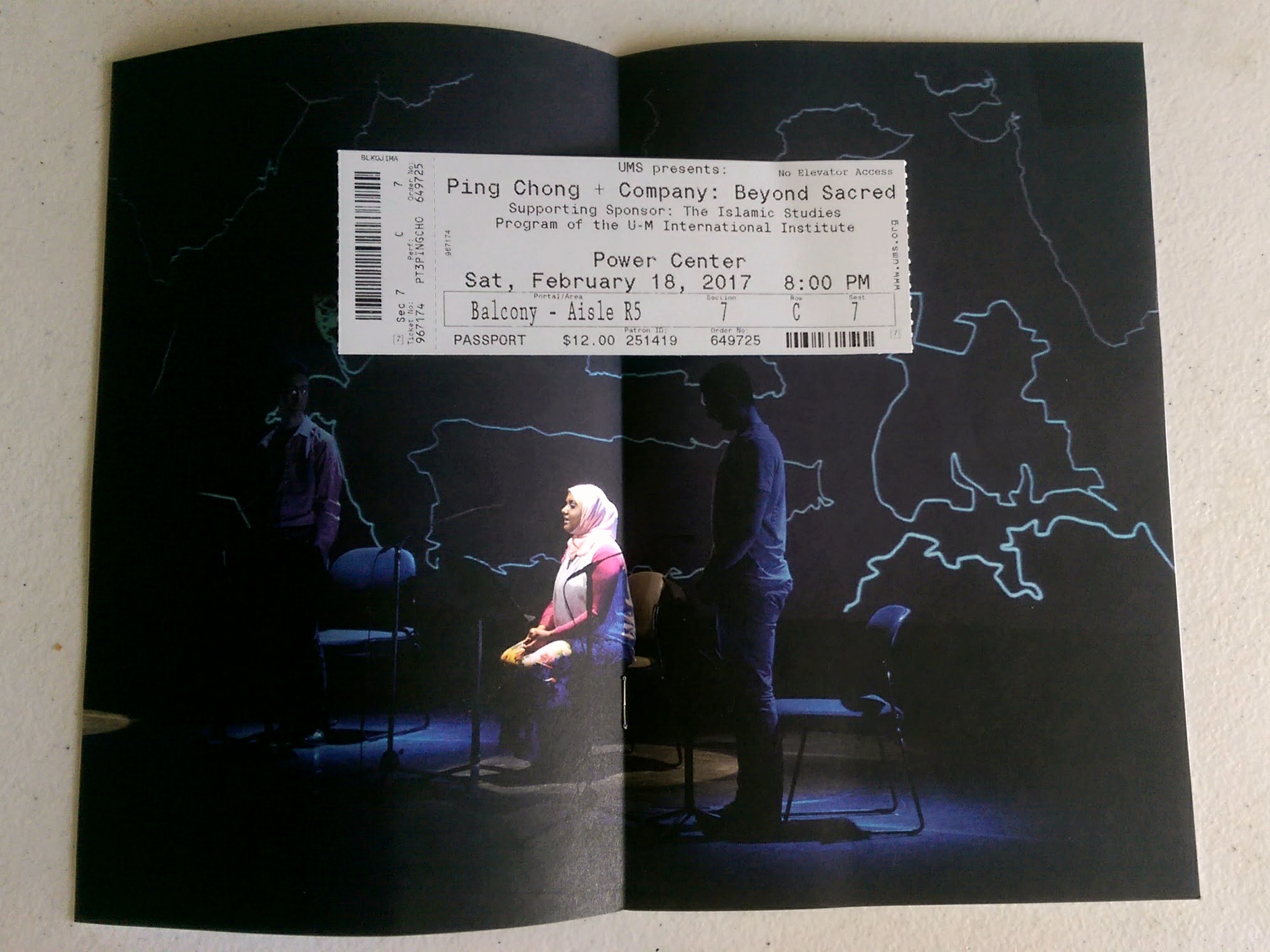
Ping Chong + Company spend hours interviewing volunteers for their “undesirable elements” series. For Beyond Sacred, they chose 5 Muslim New Yorkers.

All five of these individuals came to the stage, sat down, and began reading autiobiographical scripts.

We heard from Tiffany Yasmin Abdelghani, a woman whose Muslim father stopped practicing and when prompted about the faith told her “I don’t do that anymore.” Lost for many years, she sought out Islam on her own and chose to convert and wear the hijab.

Ferdous Dehqan emigrated from Afghanistan to escape the destruction caused by the Taliban as it swept through the country. He expressed his frustration at people when they see him and assume he is a terrorist, when he hates the Taliban just as much, if not more the average American.

Kadin Herring brought with him the perspective of a young, African-American queer man. Not only does he have to contend with anti-immigrant and questions about his faith and allegiance to his country, but he also has to face the daily struggles of being a black man in the United States.

Amir Khafagy described his upbringing caught somewhere between Arab and Puerto Rican culture, as well as his experiences with class struggles.

Maya Syed told us about her path to becoming a human rights and gender equity advocate, from volunteering for the Peace Corps in the Dominican Republic to helping immigrants understand their rights in New York.

Beyond Sacred was different from any other play I had experienced before because it involved real people telling real stories–no actors and no fabricated scripts.

The overall message from the night was something along the lines of “minorities are regular people too.” All of the actors expressed frustration at constantly being asked questions about Islam or terrorism, and about all the looks they receive from people on a daily basis.

Furthermore, the actors explained how they felt they had to act as model Muslims as a way of overcompensating for the perceived violent nature of Muslims by much of the world. Lumping all Islamic cultures together is also ridiculous, they added, pointing out that Indonesia is nothing like Saudi Arabia, which is nothing like North Sudan.

After attending an event like this, I wondered what it would have been like hearing professional actors read the same scripts. I have to admit that I think professional actors would have done better, and made for a more moving performance. Instead, I left the event feeling like something was missing. A little over an hour was all we had to hear the stories of five complex people. How could that ever be enough time?

I wish I could’ve recorded the performance. Luckily, here’s a link to a brief audio snippet.


REVIEW: Spectra: Voicing Our Experience A Night of Spoken Art & Music

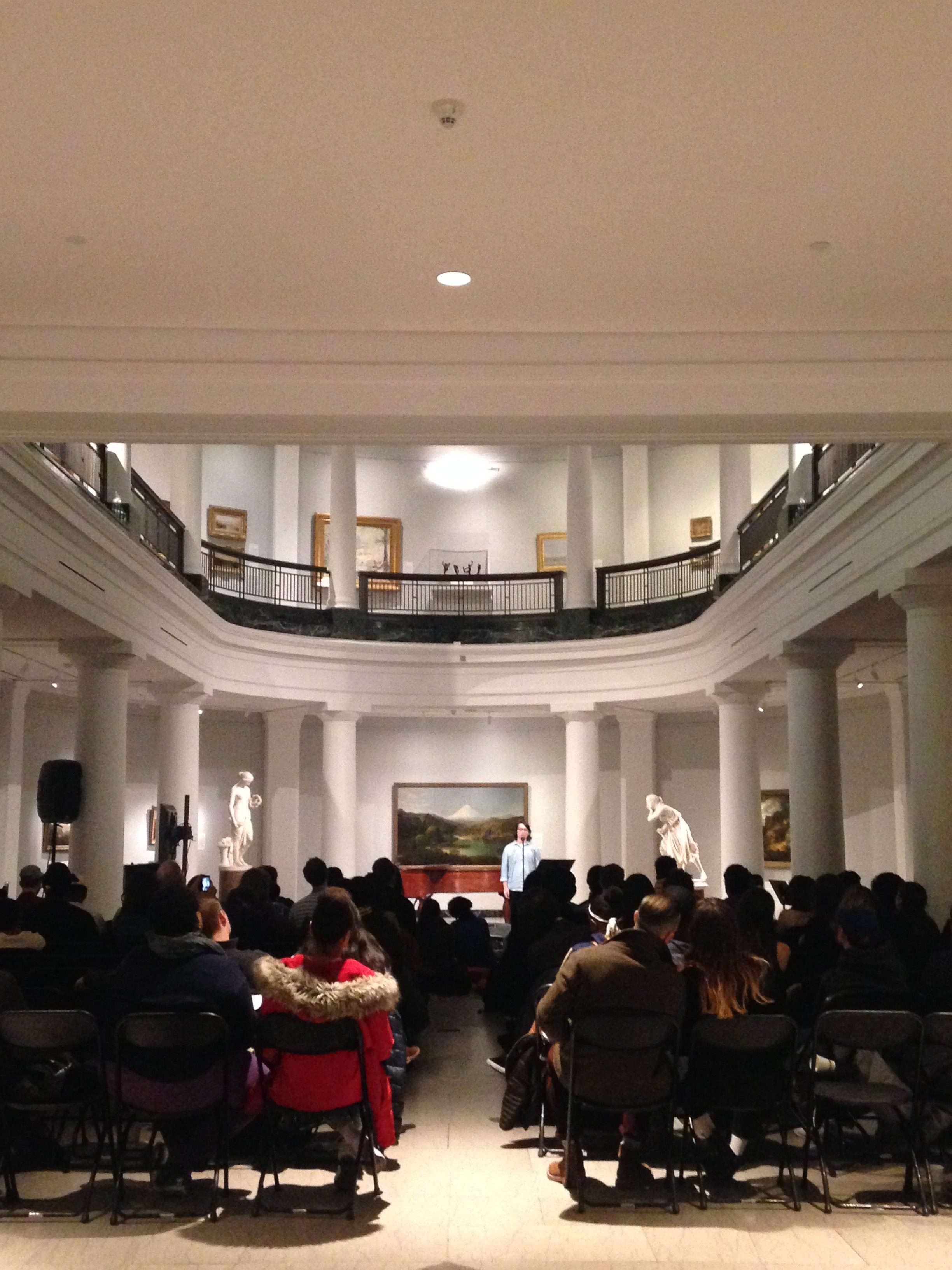
Walking into the museum space, the former white, marble-esque floor was covered by carpets, pillows, and tea lights’ electronic flicker. It looks like it could be the second floor of your favorite local-coffee-shop-poetry-reading, if they too were surrounded by renowned works of art. Often, UMMA’s space can appear a bit aloof, a bit austere and refined, but for this night it was transformed into a warmer, more intimate atmosphere. People mingled in, munching away on their biscotti and hot chocolate (again, your local coffee-shop-vibes), and ArtsX opened with emphasizing the importance of sharing our experiences through the various forms of art. I loved that all the different forms of art and expression flowed together, as if they were created with the intention to work in succession. With the spoken word and poetry pieces, voices and words filled the space. Perhaps it is a bit contrived, but I liked to imagine that these intangible words, pieces of art themselves, hung in the art alongside the paintings, student contributions adding to a recording of human experience.

The first few pieces, a musical duo that may have changed my mind towards jazz music and spoken word poetry that painted a picture of the museums of the future looking make on today’s society’s mistakes, served to set the tone of students sharing their experiences and voices for other students. One of my favorite pieces of the night, an unexpected form amongst the more customary fields of song and poetry, was the work of Sarah Baruch titled Here I Am, How Did I Get Here and Where am I Going?. Chronicling her path from high school to the present, through undergrad and med school, she wove what is a common story for anyone traveling through university in a way that felt like an engaging conversation with a friend over coffee. It was saturated in her own voice and humour and caused me to think and contemplate over the inevitable moment I am standing in a similar position.

The performance was longer than most at UMMA, though that is likely just the nature of the number of performers. I never felt as though it became too long or repetitive; the constant changing and difference in performance styles kept each work feeling new and exciting. Some people chose to stay for a piece or two while others were there for the entirety; it was very much a “come as you are, go as you please” feel. If you get the opportunity to attend any performances at UMMA, I would highly recommend it on the space alone. ArtsX UMMA’s Spectra proved to stand out by its casual and inclusive nature, and I’m up for hearing other’s stories genuinely poured out anytime.

REVIEW: A Night of Rakugo

Sitting on a 2’x2’ cushion on stage, in front of a large audience, telling a funny story — that is the 400-year-old art of Japanese storytelling, or rakugo.

Having some prior knowledge of rakugo, the moment I heard about a live performance in Ann Arborfree of charge — I knew. I was there. Doors opened at 6:30PM in U-M’s Modern Language Building Auditorium 4. The performance was planned for 7PM sharp. Although my friend and I arrived on time, we were greeted by a full house. In fact, it was so crowded, people were standing against the walls. We were handed a very nice program that was half in Japanese and half in English, detailing the night’s schedule.

Organized by the U-M Japanese Language Program and Center for Japanese Studies, I saw the faculty dressed in kimonos. In case you don’t know what kimonos are, they’re long, loose robes with wide sleeves and tied with a sash, originally worn as a formal garment in Japan.

Seeing beautiful and intricate patterns, colorful fabric, wooden sandals, I could feel my heart punch a hole through my chest. This was the real deal.

Well, thanks to my punctuality, my friend and I found front row seats…on the floor. The faculty handed us Japanese newspapers to sit on and apologized that there were no seats left. It was really no trouble, though. Sitting on the floor was a pain in the butt, but the show was free, and we had a great view of the stage. It was red, with a lush purple 2’x2’ cushion sitting on top of it. A paper lantern stood on each side.

The show began by first teaching the audience a little bit about rakugo and giving a short demonstration as to how a typical performance is done.


Rakugo
is a traditional comedic performance that definitely throws anyone for a loop the first time around, but it’s actually pretty easy to understand. Long story short, the performer sits on the cushion on stage and tells a story. They do this by enacting every character in the story, and using their only two props: a paper fan and a tenugui (Japanese towel). They may stand up on their knees but never on their feet, so the performance never leaves the cushion.

Because the performer has so much to act out, their creativity and skill shine through the performance. They can use the fan as a pair of chopsticks or as a pen, they can use the towel as a letter or a book! The performance really delivers the story.

After the crash course on rakugo, the performances came next. Because the show was organized by the university’s Japanese Language Program, students studying Japanese were able to participate in this unique art of storytelling. One by one, short stories a couple minutes long were told by each student.

One of the students told a story about a little girl greeting her father who had come home from a seaward trip. The girl urged to see his photos of the ocean, gushing over the fish swimming underwater. In one photo, the girl found a sea creature that was uglier than the rest and, disgusted, she asked her father what it was. Then the father scolded her, because it was not a fish — it was her mother!

In rakugo, the story typically leads up to a hilarious punch line at the very end. And honestly, they were really funny! I was cracking up on the floor, trying to hold in my hideous snorts.

After the students were the two Japanese rakugo performers, who had flown to the United States all the way from Japan as cultural envoys. Rakugo professionals.

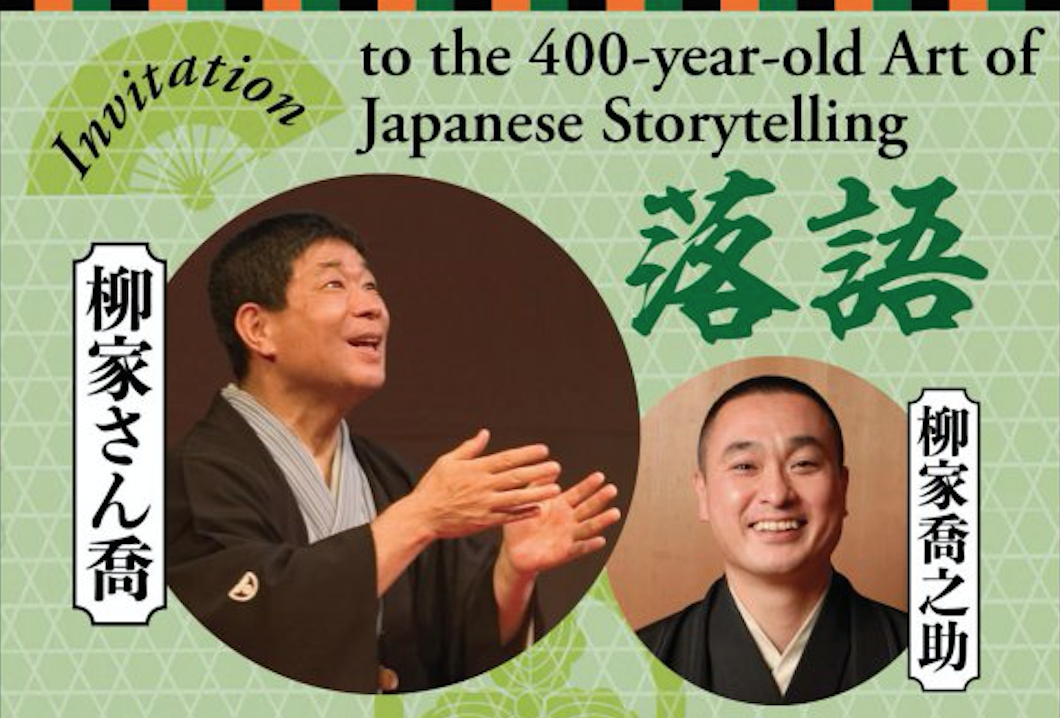
Yanagiya Sankyo (柳家さん喬) and Yanagiya Kyonosuke (柳家喬之助) are two widely famous rakugo performers in Japan, and tickets to see their shows are priced usually over $30 per person! It was the biggest honor to be able to see their performances for free. I was just happy to be there. Even if I was sitting at eye level with people’s feet.

Unfortunately, photography was prohibited for the two famous rakugo performers. But I promise you, they were amazing. Sitting up there with their commanding presence, their expressions and voices varying with every character — it was truly an art. Just by a small turn of their torso, they suddenly became a different person! Their performances were definitely the highlight of the night.

Yanagiya Kyonosuke (柳家喬之助) performed first with the story Hatsu Tenjin (初天神, “First Tenjin Festival”), which was summarized in the program: “A precocious boy named Kinbou convinces his father to take him to the festival at the Tenjin shrine, on the condition that he won’t bother his father to buy him anything. At the festival, of course, Kinbou can’t help asking for everything he sees, causing problems for his father.”

It was a hilarious performance, and the room roared with laughter as Yanagiya Kyonosuke pouted and wailed as the child. Kinbou was one spunky child, and I loved every second of his character on stage. It was an incredible performance by an incredible performer!

The last performance carries the most prestige in a rakugo show. After a brief intermission, Yanagiya Sankyo (柳家さん喬) delivered the last performance, telling the story of Shinigami (死神, “The God of Death”). In the program, it was summarized: “The God of Death tells a man who has decided that he wants to die that it’s not his time yet and teaches him a way to make a living as a doctor. He grants the man the ability to see the God of Death and teaches him a spell. If the God of Death is sitting by the patient’s feet, then the patient will recover. He simply has to recite the spell and the sick person will get well. If the God of Death is at the patient’s head, there’s nothing that can be done for him. The man becomes very wealthy but spends lavishly on trips and ends up broke. When patients stop coming, he becomes desperate to regain his fortune. But is it possible to trick the God of Death?”

Shinigami (死神, “The God of Death”) is one of the most popular and famous rakugo stories out there, and although it’s a little on the scarier side, it has its funny moments. Shinigami was beautifully told by Yanagiya Sankyo. Everyone was plunged straight into the story as he acted out the God of Death and the cheating doctor. As the God of Death, Yanagiya Sankyo held the fan like a cane under his hands, chuckling at the man’s misfortune. I was enraptured by his performance, visualizing the elements that weren’t there. It was a wonderful story told by a wonderful performer to end a wonderful night.

If you ever catch the word rakugo keep your ears peeled. A story will be told!

REVIEW: Consent by De-Zine Release Party

Cover of the SAPAC’s zine “Consent by De-Zine”


I wander into a room that sings a song from hidden speakers while people are arranged in clumps by the pizza table. A banner of hearts that reads “CONSENT BY DE-ZINE” is sprawled over that table. Unfamiliar with those around me, I slowly walk around until I stop at a table that has little blue books sprinkled on it. That’s when I see a girl with short, jet-black hair who greets me with a smile.

She introduces herself as D, the graphic designer of SAPAC: the Sexual Assault Prevention and Awareness Center. I’m at the release party for their zine, but I don’t really know anyone at the event or know what’s going on (I showed up late because of a meeting). D fills me in: this zine, called “Consent by De-Zine” is a compilation of visual art and poetry that students from campus submitted. The content ranges from healthy relationships to the topic of consent, both being very delicate yet important points of conversation on a university campus setting. This zine happens to be the first that SAPAC has put together, and so this achievement is being celebrated through music, food, and good company. I share D’s delight in this accomplishment, and then she takes me over to other members of SAPAC so that I can have a chance to meet more of board.

Page 12 of the zine. Created by Liana Smale
Page 17 of the zine. Created by Lena Briggs

Through energetic conversations and warm smiles, I meet Christina Kline, the investigator with the UM Office of Institutional Equity. I also meet members of SAPAC such as Rodrigo, who shared the experiences he’s had so far with SAPAC. At some point, some SAPAC members and I discuss the content of the zine. Grabbing one from the table in the front of the room, I flip through the colorful pages of the zine, impressed by my peers for taking the step of courage and publishing work that pertains to such delicate topics. D eagerly shows me her favorite page of the zine, which features cats and a lovely background of yellow. I continue to chat with her and others, about the zine, SAPAC, and eventually random things like speaking in different languages when drunk.

D’s favorite page from the zine!

By the end of the night, I’ve made some new acquaintances, learned more about SAPAC, and got my own copy of the zine. I thanked D and Christine and others for being so open, and made my way out. I’m definitely planning on attending future SAPAC events, such as the their 12th annual art show: rEVOLUTION: Making Art for Change. There’s just something about taking heavy topics such as sexual assault & relationships, and translating that into works of art and words, that allow viewers to digest content that would normally make them turn their heads the other way.

PREVIEW: Beyond Sacred: Voices of Muslim Identity Ping Chong + Company

“Beyond Sacred: Voices of Muslim Identity Ping Chong + Company” features a foundation of interviews, telling the stories of young Muslim New Yorkers post-9/11. UMS states that this piece work[s] toward greater communication and understanding between Muslim and non-Muslim communities”. In our changing and uncertain world, fostering dialogue and offering platforms for often unheard voices has never been more important.

Ping Chong + Company will be at the Power Center with this amazingly moving work for one day only. This is an event not to be missed! There will be a post-performance Q&A as well.

Details
When: Feb. 18th, 8pm
Where: Power Center
Tickets: Passport to the Arts

Livestream Link