REVIEW: The JACK Quartet

In case you are wondering, there is no one named Jack in the JACK quartet. The name is actually an anagram for its four members, John Pickford Richards, Ari Streisfeld, Christopher Otto, and Kevin McFarland. On March 8th, The University of Michigan’s School of Music, Theater and Dance hosted the JACK quartet as they performed a guest recital at Stamps Auditorium. The recital not only featured pieces composed by UMich students in the Composition PhD program at the School of Music, but two pieces by other contemporary composers. It was an incredibly diverse program that emphasized the talent and energy of what many call the “superheroes” of contemporary music.

A notable feature of this performance was the fact that the JACK quartet premiered Carolina Heredia’s piece, Ausencias/Ausencias/Absences. The piece was powerful, inspired by Heredia’s research into the suicides of female artists. Not only did she compose a beautiful piece for the quartet, but implemented an electronic element that featured moments or pieces of the lives of three female artists who committed suicide. Played in tandem with the quartet, the electronic elements combined seamlessly with the musicians, creating one powerful piece that expressed the sorrow and intensity of these talented women’s lives.

Throughout the performance, the quartet used their instruments in surprising and unique ways to produce a cacophony of sounds that was all at once dynamic, engaging, and unexpected. My previous experiences with string instruments has always been very traditional: the musician glides the bow across the strings and holds his or her finger down to produce different notes. But the pieces that the JACK quartet played were the exact opposite: untraditionally using their instruments to produce unique and often startling sounds. In Heredia’s piece, the quartet drummed on their instruments with their fingers during the third movement, and in Ritonrello 2.sq.2.j, they lightly tapped their bows against the strings to achieve a more muted pizzicato sound. This creativity produced a dynamic performance that was impossible not to enjoy.

However, the piece written by John Luther Adams, a composer known for his love of nature and the environment was the highlight. The Wind in High Places layered the sounds of the strings to create a tone that mimics the wind. None of the three sections sounded anything alike: the first section layered the sharp, high sounds of the violins over the softer, moving cello that died away slowly; the second section increased the intensity, as each instrument played quickly, meshing their sounds together; the third was a slow, steady and rhythmic conclusion to the piece. What was most significant, however, was that throughout this piece, the musicians never touched the fingerboard of their instruments. Their strings were played completely open or by only applying light pressure, creating sounds that resembled a harp, or wind chimes.

JACK quartet’s creativity and energy demonstrated the sharp difference between contemporary classical music and traditionally classical music. Their performance was enrapturing, my eyes unable to leave their as they played each piece. Overall, this dynamic and engaging performance made me rethink my definition of classical music as it presented an out-of-the-box recital that deserved the standing ovation it received. If you have are looking for a way to spice up your perspective on classical music, I highly recommend you check out JACK quartet.

REVIEW: Big Fun plays Electric Miles Davis

This weekend, jazz group Big Fun played a concert of electronic renditions of tunes by the prolific jazz trumpeter, Miles Davis. The group consists of several skilled and colorful musicians, many of whom are faculty at the music school: Mark Kirschenmann on trumpet, Stephen Rush on keyboard, Jeremy Edwards on drums, Jonathan Edwards on guitar, Dan Piccolo on percussion, Tim Flood on bass, and Patrick Booth on saxophone.

20160311_212054

This concert took place on two nights and in two venues: the first concert was on March 11th at East Quad’s Keene Theater and the second on March 12th at Encore Records. I went to the first night in Keene Theater, which I thought was the perfect space for the concert: low-lit and intimate like a jazz club. Big Fun played Miles Davis pieces from the 1970s and onwards including “Bitches Brew,” “Right Off,” “Black Satin,” and more. Each piece flowed seamlessly into the next; there was not one moment in the concert when the energy was let down.

Watching this concert was akin to a satisfying workout; it was long, breathless, packed with adrenaline, and most of all, fun. I could tell that the performers were experienced with performing together (and with performing in general) by the way they dug into the music with contagious confidence.

Each musician had a unique playing style that added dimension to the listening experience. Mark Kirschenmann, whose trumpet was made electric with various pedals, cleverly played with and reworked melodies. Stephen Rush’s electric piano and organ gave the music a wild harmonic crunch. Jeremy Edwards’ drum playing was both energized and reliable. Jonathan Edward’s guitar playing and Tim Flood’s bass playing provided smart and stylish counterpoint and foundational motifs. Dan Piccolo’s various percussion instruments offered refreshing splashes of color, and Patrick Booth’s saxophone lines were long and smooth.

During the concert, a live, interactive video created by Simon Alexander-Adams and videographer Theo Schear was projected on the screen. The visuals were successful in reflecting the compactness, intricacy, and diversity in the music.

This was one of the most impressive concerts I have seen all year. While being loyal to Miles Davis’ musical fingerprint, Big Fun was comfortable and confident with experimenting and digging in with their own unique voices. The musicians devoted a huge amount of energy to their performance and gave the audience a convincing and cutting-edge Miles Davis experience.

REVIEW: Open Mic @ Voices of the Middle West

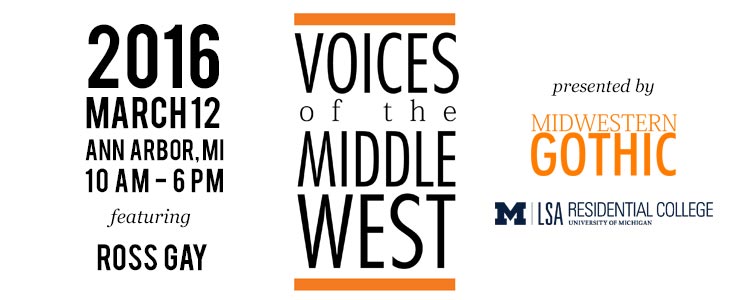
Saturday the 3rd annual Voices of the Middle West Literary Festival brought together writers and independent presses from all around the region. Among a book fair and various panels, the Festival also hosted an Open Mic event! The MC was Rachel Hurwitz, a Midwestern Gothic intern and RC student, both organizations which made the Festival possible.

Festival Flyer Logo
Festival Flyer Logo

It was a fun hour of sharing and listening to local, mostly student, artists read their own work. There were nine readers who signed up before the event and since there was extra time a handful of others also volunteered to read on the spot. This event showcased a variety of different styles, themes, and voices. We had everything from a structured ghazal poem to stream of consciousness spoken word poetry set to music. Themes and topics included rants about emojis, loss, fathers, brokenness, love (there were lots about love as one would expect), stars, and skunk ape- Which I learned is another name for bigfoot because in different regions he has different names. The Open Mic was informative, fun, humorous, thought provoking and created a sense of community and support that truly encapsulated the purpose behind the Festival.

REVIEW: Writers’ Tea with Ross Gay

Thursday evening, Ross Gay met with college writers in the Benzinger Lounge to share his stories and talk about their questions. He was charming, personable, and reflective. His poems are very voice based works of art and it was a wonderful experience to hear them spoken by him.

My copy of Ross Gay's latest book
My copy of Ross Gay’s latest book

After being introduced by Laura Thomas, Ross Gay read 3 poems: “The Opening”, “Ode to Sleeping in My Clothes”, and “Ode to Buttoning and Unbuttoning My Shirt”. His most recent work, and also the book he read from, is titled catalog of unabashed gratitude. All of Gay’s poems link beauty and sadness in astonishing images that lead the reader to see not just the problems we face as a society, but also the beauty in the everydayness of our world. One of his elements for achieving this, in conjunction with his vivid imagery, is his titles. As can be seen by the poems he read and as he said himself, “Titles are important”. The can have a profound effect on the tone and perhaps surprisingly the conclusion/outcome of a poem. Just looking at the table of contents to his latest book, where there are titles like “Spoon”, “Armpit”, and “C’Mon!”, and readers know Gay has mastered the art of titling a poem.

In addition to speaking about his love of teaching and working collaboratively with other artists- a really “delightful” activity- Ross Gay spoke about the inspiration/process involved in his individual work. In some ways his poems ask questions more than they answer them. Or at least that’s how they start, often pertaining to the theme of justice or of a personal instance. He uses the image or metaphor of a garden or orchard often because they bring a sense of conversion or change to the poem and the narrator. In that way the poem will often begin to shift from questioning to pondering. These natural growing earthy images are reflective of the emotional state of the narrator as he guides us through the poem in what can sometimes seem as wandering poem but often is all the more powerful for the journey it takes us on. This is also why certain poems play so carefully on the use of end lines, often cut off in seemingly odd places that makes the lines unstable but where new meaning is found in that instability. It is in this instability or wondering association of images that readers and Ross Gay himself says find new meaning, or at the very least a shift in perspective. At the Tea Thursday evening, Gay said that he wrote a poem that through the writing process transformed his relationship with his father, which had been strained.

My favorite poem though in catalog of unabashed gratitude is “Spoon”. It is a beautiful, amazing piece that he wrote for a friend of his that was murdered. Both sad, joyful, political, and natural, I think it captures what a poem can be and the dexterity of Ross Gay’s talents. Listen to him read “Spoon” here.

Preview: Writers’ Tea with Ross Gay

Ross Gay, the renowned poet and essayist, is coming to U of M’s Residential College. Writers’ Teas are held a couple times a semester and are largely attended by RC students, often majoring in the RC’s Creative Writing and Literature Program. I myself recently declared a second major in creative writing and, even before declaring, have always enjoyed the Teas. It’s a chance for students to share their work with each other and, occasionally, even with professionals! Like Thursday, March 9th at 7pm in the Benzinger Library when Ross Gay visits.

An author of three books- Against Which, Bringing the Shovel Down, and most

Photo Credit: Natasha Komoda

recently Catalog of Unabashed Gratitude– Ross Gay grew up in Levittown, Pennsylvania. He currently teaches at Indiana University. In addition to many nominations and honors, Catalog of Unabashed Gratitude is a finalist for the National Book Critics Circle Award this year. He is one of the founding editors of Some Call it Ballin’ (on online sports magazine), as well as being an editor for several chapbook presses. Outside of the literary field, he is involved in a free-fruit-for-all food justice project, Bloomington Community Orchard, as a founding board member. Check out his website to learn more about his many accomplishments and his writing: Ross Gay

I look forward to hearing Ross Gay read his work and talk about his journey as a writer. And to hear what my peers have been writing this semester!

PREVIEW: Voices of the Middle West

Do you enjoy reading? Meeting authors? Bookfairs? Open mics? Literally anything to do with the written word? Then come on down to East Quad this Saturday and attend the Voices of the Middle West festival! There will be a bookfair in the main atrium in EQ all day (10am-5pm) and panels with authors, professors, and publishers in the Keene Theater (basement of EQ) from 10am-3:30pm. For a list of the various panels and panel speakers, see here. Then, there will be an open mic from 3:45-4:45pm and finally, the keynote with Ross Gay at 5pm. It is the best literary event to happen on campus all year, so don’t miss out!

And, if all that’s not enough for you, come to the Voices of the Middle West Kickoff Reading at Literati, this Friday at 7pm.