
REVIEW: The Magic Groove Bus

I first watched Groove perform on my very first day in Ann Arbor. Tired, lost, and fresh off a plane from a small town in South Florida, I stumbled into Artscapade at the Umma, an evening of games, live performances, and crafts meant to introduce scared students to one of the University of Michigan’s artistic centers. Watching Groove perform through the thick crowd of people, I was awed by their incredible show. Having never played an instrument in my own childhood, I was amazed at how intricate, and yet how high-energy, the performance was. 

Flash forward two years, and I finally got to watch Groove again. One of Ann Arbor’s premier entertainment groups, Groove combines traditional instruments – drums, cellos – with non-traditional instruments – steel ladders, construction buckets – to create something truly special. At Friday night’s performance, “The Magic Groove Bus,” they blended together spectacular musical talent with hilarious comedy to wow the audience in a dizzying two-and-a-half hour performance. 

I don’t think there was any sort of cohesive theme for Friday night’s show, but Groove managed to weave together a bit about environmental destruction by evil corporations, a whole bit celebrating France, a bit titled “size doesn’t matter,” and so many more. Considering the amount of ideas compiled into one performance, it was actually incredible that they managed to fit it all in under three hours. However, the performance was so excellent that I could have stayed for the rest of the night. I don’t know how Groove managed to find a group of students all with such a unique stage presence, but the blending together of personalities made the show completely distinctive. Every time I thought the show was over, someone would start singing, or playing the cello, or doing acrobatics on stage, or pulling out a trumpet. There was a mind-boggling amount of talent on stage. 

At only $5 a ticket for students, Groove is an accessible performance for almost everyone. In fact, considering the quality of the show, they could have charged me $20, and I would have willingly forked it over. I now understand why Groove puts on only one show a semester: due to the length and complexity of the performance, I’m sure they needed countless months and hours to prepare. With an almost full audience at the Power center, I know I’m not alone in my opinion. The Magic Groove Bus was truly a sight to behold. 
REVIEW: Everybody

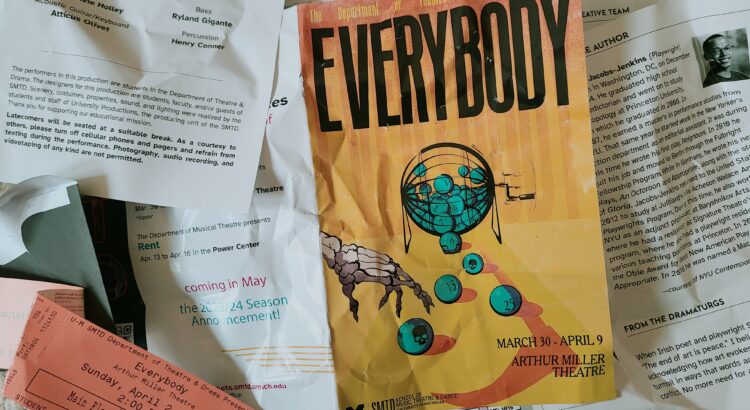
2:00pm • Sunday, April 2, 2023 • Arthur Miller Theater

Everybody was a very strange experience. The play is based on the 15th-century play Everyman, a morality tale which uses allegorical characters such as Death, Everyman, Fellowship, Kinship, and Good Deeds, to explain how one attains Christian salvation. This adaptation, written in 2017 by Branden Jacobs-Jenkins, modernizes the story into a more inclusive, interfaith exploration of morality, death, and afterlife. Jacobs-Jenkins points out similarities with Buddhist philosophy in the story’s moral framework, and builds upon those similarities by questioning reality and emphasizing points such as Everybody’s attachments to the material world and the self. He also makes the play more interactive, using a lottery at the beginning that determines which actors will play which characters, and opening the play with several of the actors hidden among the audience.

I appreciated how the affordances of the physical space of the Arthur Miller Theater, the elements of audience participation, and the blending of the cast with the audience added to the surreal tone of the play. I wasn’t entirely sure when the performance had actually started, because the “ushers” spent a long scene in the beginning explaining the theater etiquette and executing the lottery. These elements made the play feel personal and “real,” which made the more surreal scenes even more jarring. For example, immediately after bantering cheerfully with the audience and explaining the reasoning behind the play, the ushers became conduits for the voice of God, speaking simultaneously and doing simple, mildly disturbing partner gymnastics while a distorted, echoing recording played over their voices.

By chance, two different cast members sat next to me over the course of the performance. The first was there when I entered the auditorium, noisily interacting with (who I later realized were) other cast members in the audience. The second actor played the role of a random child, which meant that midway through the performance a person in a puffy Alice-in-Wonderland-looking dress entered quietly, plopped down next to me, and rummaged around in her pocket for a Fruit Roll-Up. She put one end in her mouth and unrolled the whole thing into her lap, slowly sucking the strip into her mouth. It was weird, and I was uncomfortable. I felt this brief sense of relief when I realized she was an actor, but also sort of guilty. What if those actors had just been people being people? A more critical awareness of my own “othering” tendencies was an unexpected result of the performance.

I appreciated the weirdness with which SMTD executed this production of Everybody, and I wish the audience had been a little fuller, although it was a Sunday matinee performance. The cast did a great job, and I look forward to hopefully seeing them in some other productions during the next few semesters.

REVIEW: 17th Annual Multicultural Greek Exhibition

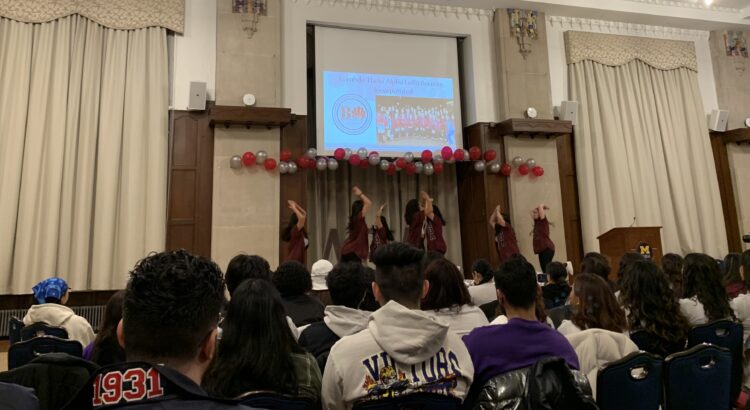
*The image above features Lambda Theta Alpha Latin Sorority, Incorporated; sorry I didn’t have a good seat to take a picture from :,)*

I saw many familiar organizations from the Yardshow last semester at the Multicultural Greek Exhibition (MGX) on Saturday. Since this event was in a smaller and more private venue, I think I got to know more about the community; one art form I really appreciated seeing again is called a ‘salute’. It’s a tradition unique to many Latino-Greek organizations and is performed in a line formation. They described it as being different from a step or stroll, which are more dance-like, and compared it to a form of poetry expressed through both recitation and movement honoring past accomplishments and cultural history.

Saluting can be startling when seeing it for the first time due to its intense nature, and I hadn’t heard of it before last Saturday; when I first saw it at the Yardshow I didn’t even know that some of the performances I was watching were called a salute. I’m sure many others haven’t heard or seen a salute before either because of how integrated it is in Greek (specifically Latino-Greek) culture and there aren’t many opportunities to see them. I highly recommend it though, because it’s truly a special experience.

It’s impossible for me to capture the salutes I saw only in words, but in my best attempt to describe it the members were SO powerful with their facial expressions, had amazing coordination, showed unbreakable unity, and expressed passionate language. You truly see a whole other side to someone who is performing a salute. Their hard work is so impressive.

I did enjoy the other groups too! I’ve only been attending more serious dance-focused events recently, as in the performers and centered around dance performance, and coming to this event reminded me of how much fun it is for the audience AND the performers when they’re not even ‘dancers’.

While I don’t want to compare, I did prefer the Yardshow more, largely due to the location. Since it was indoors and in a smaller room, there wasn’t much awareness or accessibility to the general public that the event was happening. This meant that the amount and kind of audience were limited and the view I had of the stage wasn’t very good.

Still, it was a fun time and I’m glad I went! Shoutout to all the organizations that performed, especially Lambda Theta Alpha Latin Sorority, Incorporated for organizing it and doing such a good job hosting.


PREVIEW: Survivors Saving Survivors: Photographing the Ukrainian Refugee Experience in Poland

In 2022, photographer Chuck Fishman traveled to Poland to photograph the influx of refugees from Ukraine. He wasn’t capturing the devastation and agony of the war, but rather something optimistic: the power of humanity in healing and uplifting communities and the ability for different groups to band together in times of exhaustion and pain. The Copernicus Center for Polish Studies, or CCPS, is holding an exhibition of Fishman’s work, titled Survivors Saving Survivors: Photographing the Ukrainian Refugee Experience in Poland. Surprisingly accessible at 547 Weiser Hall, which is right next to the Central Campus Transit Center, this exhibition is a great opportunity for students to learn about global current events, empathize with victims of crisis and war, and view the extraordinary work of an acclaimed photographer.

As a traditional artist, photography hasn’t been within my range of intense interests, but recent coursework and experimentation has led me deeper into the realm of reportage photography. I find photojournalism that has an empathetic and humanitarian approach fascinating— when the photographer strives to portray the complicated humanity within global crises, the audience is shown something emotionally important that is not typically portrayed through unbiased journalism. Chuck Fishman is noted— and has received awards— for his often black-and-white portrait photography of social and political issues in particular. He initially photographed Jewish life in Poland since 1975, and has traveled around the world to capture everything from the energy of political figures to joyous cultural moments in jazz clubs. His photographs have appeared on the covers of Time, Life, Fortune, Newsweek, The London Sunday Times, The Economist, and many others. I am intrigued to see how Fishman has portrayed the current crisis. and what kind of narratives can be brought to the surface.

The exhibition runs through April 28th, and it’s smack in the middle of central campus, tucked where you wouldn’t even notice it. Head to the International Institute Gallery at 547 Weiser anytime between 8am and 5pm to see some incredible work from an experienced artist and learn more about the Ukrainian refugee experience in Poland.

REVIEW: Don Giovanni

8:00pm • Saturday, March 25, 2023 • Lydia Mendelssohn Theater

I was skeptical of all the articles I read before attending Don Giovanni that said it encapsulated “the full spectrum of human emotion.” I feel that when I attend live performances, I am easily impressed by talent in singing and dancing, but I’m rarely moved. However, this production of Don Giovanni was genuinely movingThe artists onstage deftly wove between moments of comedy and tragedy, creating an emotional journey that was surprisingly engaging.

Some of my favorite examples include Donna Anna’s reaction after the murder of her father and her duet, “Ah, vendicar, se il puoi, giura quel sangue ognor!” with Don Ottavio, which realistically captured her shock and grief and his devotion.  There were also laugh-out-loud moments, such as the opera’s first interaction between Don Giovanni, Leporello, and Donna Elvira and particularly “Madamina, il catalogo è questo” (although I must qualify that I was more entertained by the delivery of that aria than its contents). Throughout the performance, though her character was often used comedically, I was captivated by Donna Elvira’s complicated combination of longing, betrayal, rage and vengefulness, as well as her piety.

Because I love giving shout-outs to my favorite artists, for this production of Don Giovanni, I want to highlight Sitong Liu (Donna Anna) and Joshua Thomas (Il Commendatore), who had, in my opinion, the most beautiful voices of the evening. Liu’s regality and her icy grief were a stark contrast to some of the more comedic elements of the play, and her voice was breathtakingly clear. I regret that the character of the Commendatore has so few arias, because I would have enjoyed hearing quite a bit more of Thomas’s voice. Finally, my favorite all-around performance was probably from the aptly-named Aria Minasian (Donna Elvira) for her ability to embody both the humor and the darker, more painful emotions of the story. She really had the best facial expressions.

There’s so much to talk about with this opera, but I wanted also to note some dramaturgical choices which were made with this production. The program describes how the production crew wanted to be critical and careful of the themes of abuse and violence towards women, a mindset which I feel they executed well. I could see how they emphasized the relationships and support among community members which make accountability possible in the play, as well as realistically and sensitively portraying the impact of the traumas the female characters experience.

In conclusion, this production of Don Giovanni helped me appreciate opera on a new level. Even though the performance was over two and a half hours long, it remained engaging, and as I continue to reflect on the performance I can dive deeper and deeper into my admiration of the story and the art form.

REVIEW: The Canterville Ghost

Saturday, March 26, 2023—


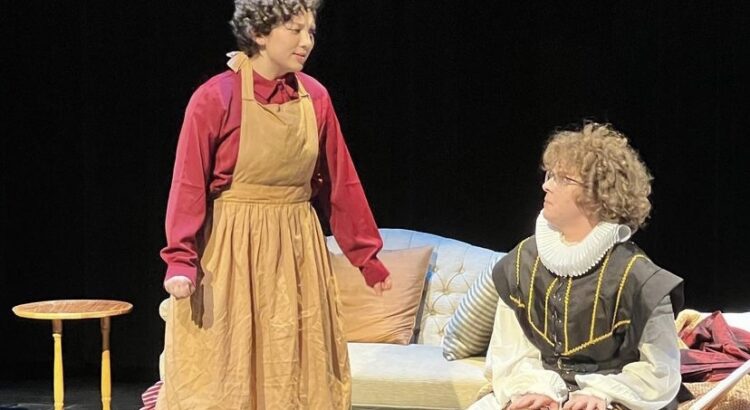
“The Canterville Ghost” is a short story by Oscar Wilde and was originally published on March 2nd, 1887. And this past weekend, the R.C. Players put on their own production of the humorous tale at East Quad’s Keene Theater. Sophomore Isabelle Zeaske wrote and directed the production and she did a fantastic job at it! In her director’s note, she says this about the original story: “The first of the two parts is a slapstick, and queercoded satire of both Americans and Brits” and she “wanted to create a new adaptation that honors the first chapter . . . but keeps the themes of life, love connection, and closetedness” from the latter part.


Before the show began, Lord Canterville (Maddie Nolen) and The Canterville Ghost (Will McClelland) roamed the isles and entertained the audience with in-character banter. They treated the whole theater as the Canterville Chase, delightfully immersing the audience into the story’s world.


Senior Will McClelland stole the show as the Canterville Ghost from the moment he stepped on stage. His voice had an impressive range, one moment portraying himself as evil and haunting, and the next as meek and pathetic. My personal favorite moment of his was when he took advice from the audience on how he should haunt the mansion’s new American residents. He ended up scooting across the floor like a worm, taking the word from a viewer to keep his “but up.” 


Another stand-out character was Washington Otis (senior Adrien Beyer), the oldest son of the American family that just moved in. His jealousy of his sister’s mysterious manly suitor was performed dramatically through anguished squeals and head motions that had the audience laughing heartily in response.


Speaking of the sister, Virginia Otis (junior Dax Sheedlo) held the heart of the story. She went through hoops and hoops to keep from her family her reluctance toward getting married, even employing help from the Canterville Ghost himself. The interactions between the two simultaneously brought much warmth and comedy to the story. My favorite moment between the two of them was when Virginia claimed that she just hasn’t “found any man that she likes” and the Ghost looks toward the audience with a face that knows exactly what her romance problem is, dramatically mouthing “Oh—that’s what it is.”


Other than the actors, I very much appreciated the costumes: from pristine suits to large and flowy dresses. They made the play feel that much more real. 


This was the last production for the R.C. Players for the semester, so I’m glad that they went out with a bang. I highly encourage everyone to keep an eye out during the coming semesters for more of their comedic and touching productions. 


You can learn more about them through their Instagram: @rc_players.


Header image from @cantervillercp on Instagram.