REVIEW: Campus Symphony Orchestra & Campus Philharmonia Orchestra

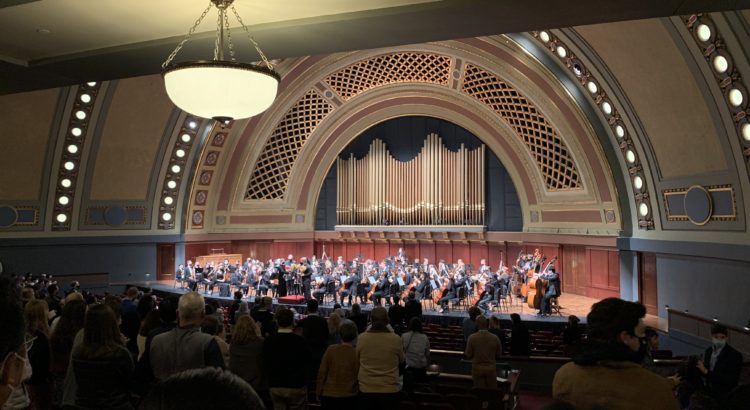
Amid the stresses of midterm season一because, let’s be real, it’s never truly confined within a “midterm week”一I did not anticipate the restorative effects of spending a couple of hours in the cushy seats of Hill Auditorium, bathed in ringing live music and the warm glow of stage lights. The Campus Symphony and Campus Philharmonia Orchestras, made up of non-music major students, performed a delightful fall concert last Sunday night. Despite it being my first orchestral concert here, having friends scattered around in the audience and on stage gave the performance a very welcoming, intimate feel. 

The Campus Philharmonia Orchestra opened the concert with a bold, contemporary piece by Chad “Sir Wick” Hughes. Visions of a Renaissance featured many quirky textural elements, blurry meter changes, and grand melodic lines that came together to paint quick snapshots of a chaotic bustling city. As a first-time listen, the piece is shocking and confusing. However, I find that the charm of contemporary music is that you fall more in love with each piece with every listen.

Next, we were rewarded with the familiar haunting introduction to Beethoven’s Symphony No. 7 2nd movement. The lower strings did an excellent job of establishing the rumbling warm, ominous motif for the violins to glide over. However, playing such a widely known piece also comes with high expectations一I couldn’t help but wish for some more delicate phrasing in the exposed melody. 

CPO’s third piece, Dvorak’s Slavonic Dances Op. 46, No. 2, was dark, lively, and distinctly nationalistic. Ensemble-wise, the performance was very cohesive and had a lovely push-and-pull of tempo and dynamics throughout.

The final piece, Edward German’s Three Dances from Henry VIII, was a refreshing conclusion to follow the richness of the previous pieces. Morris Dance featured a march-like drum with a crisp melody weaving through the beats, while Shepherd’s Dance felt more playful with light bass drum pulses throughout. The final movement, Torch Dance, was busy, intense, and filled with tension.

After a brief intermission, the Campus Symphony Orchestra took to the stage with the silky cinematic tones of “Overture” from The Song of Hiawatha. The piece opened with a beautiful harp solo accompanied by soft strings and transitioned into a plush, longing motif that traveled around the orchestra. From my view from the audience, I immediately noticed how every single violinist swayed together to the music.

Following this was Pietro Mascagni’s “Intermezzo” from Cavalleria Rusticana一another pretty piece showing off the ensemble’s lavish tone and phrasing. The introduction was soft, delicate, and purely strings. Soon enough, the woodwinds snuck in echoing the violins, and the low rumble of the basses blended in very nicely. 

Finally, we arrived at the part of the concert I was most excited about: Tchaikovsky’s Symphony No. 5 in E Minor. A feat of musical stamina, the four-movement work was excellently executed and a sound to behold. Some of my favorite highlights were the soaring violin melody in the first movement and the bold, triumphant fourth movement. If you are unfamiliar with the piece, you should definitely give it a listen during your next study session. I also have to commend the soloist for the famous horn solo at the beginning of the second movement. After the final note, the audience immediately launched into a well-deserved standing ovation一though I wished they allowed some time for the last sound to ring!

Again, I’d like to congratulate all the soloists and musicians for their wonderful performance on Sunday. I recommend everyone to come to support them at next semester’s concert!


REVIEW: Funny Girl

Musket’s production of Funny Girl, originally a Broadway musical with Barbara Streisand, has an electric energy that can’t be forgotten. Running for just three nights at the Power Center on Central Campus, it can easily be missed; but, for all musical-lovers and Michigan students within walking distance of the theatre, keep your eye out for future productions at this location and other productions by Musket. The effortless humor and colorful characters of Funny Girl filled the venue with a liveliness that stuck with me even after I left.

I am typically not a musical-goer, as I prefer the believable effects and immersive atmosphere of typical movie theaters, but something about Funny Girl set it apart and drew me directly into the bustling and competitive setting of New York City. Surrounding the life of the awkward, stubborn, yet uniquely charismatic actress Fanny Brice, the musical explores her strenuous rise to fame. We witness her navigate the cutthroat competition of theatre in the Big Apple; we see her embrace her triumphs and mourn her defeats; and, most notably, we watch as she learns how to navigate the complexities of love and family in her gold-gilded life as a star. My favorite aspect of the story— besides experiencing the exciting growth of such an interesting character— is the focus on theater. Watching a musical about musicals adds a sense of realism; the actors are performing a story, but it is a story that is relevant to their own experiences. Many songs are performed in a fictional musical, so watching those scenes in an actual musical theater setting feels completely immersive.

The stellar cast raises the performance to another level. Carly Meyer, who plays Franny, captures the awkward humor and headstrong demeanor of the character perfectly. From classic clumsiness to goofy dance moves, the loud and unapologetic ambition of Franny echoes throughout the venue, as well as her strong and expressive voice. Each cast member brings incredible vocal talent to the stage as well as a specific energy and personality; ranging from the mysterious and wealthy Nicky Arnstein, played by Sohil Apte, to the brashly humorous Mrs. Meeker, played by Gavin Brock, the variety adds to the excitement of the show.  The score is iconic and unforgettable, featuring fast-paced classics and romantic ballads. The live pit orchestra added dimensionality and depth to the lively music. Through the live music and incredible vocal talents, the sound of Funny Girl is magical at the very least.

The relatable and in-touch nature of the subjects of Funny Girl— the awkwardness, the difficulty of love, and the blinding allure of success— creates a production that is far from fantasy. Funny Girl enticed me with its characters, drew me in with its realism, and captured my heart with its nostalgic score. Next time Funny Girl comes around, or any other Musket production, be sure to grab your $7 student ticket and catch it while you can.

PREVIEW: The Moth StorySLAM

Has your friend ever told you a story from their life? A story of their mom’s best home-cooked food, of that terrible first date they went on last week, of crying in the library at 2am. How did it feel to listen to them? Whether the story was funny, sad, moving, or silly – in every case, there is something powerful happening there, something that brings you two closer together by listening to them.

Now imagine hearing stories like that…but from complete strangers!

That’s what a Moth StorySLAM night is like – an audience, a microphone, and the brave storytellers who get up to command the room for five minutes at a time with true tales from their own lives. StorySLAM events happen all over the country, from L.A. to NYC – and tomorrow night, there will be one at The Blind Pig in Ann Arbor! The prompt for storytellers is Fortune: prepare a five-minute story about Lady Luck.

I’ve been a big fan of The Moth podcast, which captures this type of personal storytelling in the form of episodes each grouped around a story theme. Each story ranges wildly, but what they all share is that they remind me how much I have in common with complete strangers. It’s a deeply empathetic experience to connect with someone that way. I’m incredibly excited to experience it in-person instead of through my earbuds for the first time! I’m also looking forward to visiting The Blind Pig for the first time, which I’ve heard is a very chill and down-to-earth Ann Arbor establishment.

More details on the event can be found on this page: https://themoth.org/events/fortune-ann-arbor. It’ll be happening tomorrow, Tuesday November 16 at The Blind Pig on 208 S 1st St. Doors open at 6:30PM and the stories will start at 7:30PM! Please note that The Blind Pig is an 18+ venue. You can nab tickets here: https://www.blindpigmusic.com/calendar#!/events/1863. I hope to see some of you there!

Review: Men on Boats

Men on boats was a good event. The Arthur Miller theatre was very well set up. The ambiance of the play was very cozy and rustic. It fit the theme of an 1860s story.

The actors of the play were very enthusiastic and did their best to carry the story. But. The story was quite bland to put it frankly. The jokes were sparse and the funniest scenes were usually slapstick kind about boats breaking. Though I must say the slow-motion scenes of the boats breaking were very funny especially as they broke to background music of contemporary meme songs.

An interesting thing about Men on Boats was that even though it portrays only men, in this rendition, the cast was all female so it was supposed to be a “satirical, gender-flipped” story making fun of the explorers’ “cockiness and cluelessness.” But as I sat through the play I did not see much of this. Having an all-female cast did not really add much to making the play funnier or adding to the satire element of the play.

It was a little unsettling to watch because it deals with aspects of colonization: the men are “discovering” new parts of America and traversing through the Colorado River, being the first white settlers to do so. And though the play ends on a conflicting note where the explorers are not really satisfied with having “discovered” the places they saw and finishing the journey, it did not address some important issues in an important way. The main conflicts of the play were the explorers not having enough food or leaving because the waters were unkind to them. Seeing men dilly-dallying their way through the land natives have lived on for centuries before wasn’t that great. The play acknowledges that aspect but not in a serious way. The satire is not really aimed towards the colonization aspect of their work but rather their silly antics. I don’t think this was a good choice for a play to show in these times.

Regardless of that, the actors were phenomenal—their energy was contagious and some of the best scenes included them stampeding the floor and acting out the river travel. The character Mr. Hopkins was my favorite and had great comedic timing. The lighting details in the show were very impactful and one of my favorite parts of the event.

REVIEW: All Too Well: The Short Film

Warning: Slight spoilers for All Too Well: The Short Film

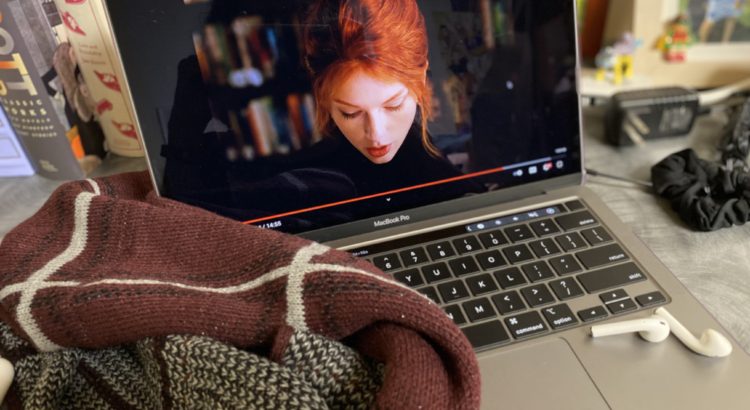
Laying on the bed, when Sadie Sink’s character of Her dazedly asks “Are you for real?” she is entwined with Dylan O’Brien’s character of Him. Him and Her appear enclosed in their own clandestine haven.

I already looked up the ages of the actors once the short film was announced. Sink is nineteen and O’Brien is thirty and even entwined together I cannot be fooled that their characters are closer in age. I’m just a year younger than Sink, so her being so intimately held by someone a decade older makes me a bit uncomfortable.

But that’s the point.

If you’ve listened to the original shorter version of Taylor Swift’s “All Too Well,” you would know a story about a woman whose lover left them broken and inadequate. Now, if you’ve listened to the recent “All Too Well (10 Minute Version) (Taylor’s Version) (From The Vault)” you would notice the established narrative unfurl further: a woman — who still feels like a girl — left feeling insecure in the presence of her older lover.

In that first scene, you can already tell so much. Her is sweet-faced with a young flush, her eyes are alert because being there with Him is so new and thrilling for her. Him has a dark beard, betraying his mature age and his eyes are softer — he seems content but doesn’t appear to entertain her same thrill. Sink and O’Brien portray this wonderfully in those first few seconds.

“Are you for real?”

Her asks him initially because when it’s just the two of them everything is enthralling and heavenly.

You kept me like a secret, but I kept you like an oath.

This line from the song is important to the film because it shows how when the relationship was treated as a secret just for the two lovers everything was tender and loving. However, as the film will proceed to show, once others are let in that loving foundation will begin to crumble.

Soon enough, the song’s ten-minute version begins to play in the background, and scenes between the lovers run by in coherence with the lyrics. They start out playful, happy, and in love — intensely in love — as they drive through pretty autumn trees. The camera always makes sure to focus on their faces; there is the fall scenery, yes, but mostly it is just them — Her and Him. But then, we see them transition into the plummet of downfall when the music abruptly stops and we hear the actors talk again.

They have an argument. It’s tense. It’s gripping. 

At that moment I cannot help but somehow picture myself in the shoes of Sadie’s character. She feels insecure about something her partner never noticed he did. To him, it’s a small thing and he tells her to stop obsessing. Stop looking for things where there’s no meaning. I’ve looked for such things before, but in my place, I do find meaning, so I understand what Her is going through. She’s hurt because Him doesn’t get her. Soon enough, O’ Brien’s character begins to placate her in a way that almost seems like he’s placating a child, and Sadie’s character seems very much like a child at that moment in her distress and sadness.

The film continues with moments of happiness laced with desperation as the lovers try to clutch onto what they have, moments of hardship where they find that they cannot take it any longer, and moments in the aftermath of their downfall. 

Swift has split the video into sections with titles that enunciate the story behind each part of the video. It’s especially useful so that viewers understand the story she’s trying to convey through her song even better.

It is interesting to notice that Sink’s character is reflective of Swift’s own personality. We see her take to a typewriter after the breakup, much like Swift takes to her songwriting. Then in the final scene, when it cuts to thirteen years in the future, Sink’s character is all grown and played by Swift herself. She’s a famous author in this reality with a novel titled All Too Well. It’s a fun easter egg, and fascinating to imagine where else Swift’s writing prowess might have taken her. 

So far I’ve spoken solely about the experience of Sink’s character. However, O’ Brien did especially well in his part too. He does not make himself seem like a complete jerk, ignorant to his young lover’s feelings. He shows his own moments of regret and remembrance after the break-up. I also do like that the film showed Him’s side of the story as well. Often in Swift’s songs, the heartbreak is all from the woman’s perspective, because Taylor writes through her own eyes. It was refreshing to see the man’s viewpoint, to see how he also valued the relationship.

Taylor Swift has done stunningly in the writing and directing of All Too Well: The Short Film, and I’m sure many fans like myself are pleased with the result of one of their most beloved songs getting the music video it deserved. You all should definitely take the time to listen to “All Too Well (10 Minute Version) (Taylor’s Version) (From The Vault)” and the rest of RED (Taylor’s Version). I’m sure you’ll love it.

REVIEW: My Hero Academia: World Heroes’ Mission

I have to say, I was disappointed by My Hero Academia’s latest plunge into the film industry. My hopes were especially high for the film after recently re-watching the second installment: My Hero Academia: Heroes Rising. That was a film that truly amazed. The quality of animation and the intensity of the battles between our beloved characters and the hated villains was on a level of mastery that I hadn’t seen before in an anime film. Besides that, the development of character relationship between Deku and Bakugo ( which are two of the most prominent characters of the anime series if you aren’t familiar) brought an immense amount of satisfaction.

I had expected for that character relationship  growth to continue in World Heroes’ Mission. However, this wasn’t the case. In fact, I’d say that Bakugo’s character might even have regressed, though that might have been due to how little screen time he had during the film. Nevertheless, Bakugo’s dialogue mostly consisted of variations of the phrases “shut up” and “don’t tell me what to do”, which is fine I suppose. It does align with his character, but I couldn’t help but want more. Bakugo has evolved so much over time that his character deserves better than to be handed irritated one liners for the majority of the film.  Though again, there’s only so much to be done when the majority of the plot doesn’t revolve around him.

What the plot does revolve around is the budding relationship between Deku and a new character named  Rody Soul as they make their way across the country in an effort to escape both the  local authorities and the villain group known as Humarise; a terrorist group bent on ridding the world of any and all quirk users. Both Deku and Rody slowly get to know one another as they race to save the world. It’s a unique relationship in the fact that Rody is a morally grey character, used to doing whatever he can to survive in order to provide for his two younger siblings. Seeing him challenge Deku’s selfless motives while struggling with his own inner conflicts was very endearing to watch. It was also hilarious to see how Deku responded to Rody’s poor life decisions. In that way, Rody quickly became a favorite of mine. And his quirk  is one of the most unique and utterly adorable abilities that I’ve seen yet.

In fact, I almost forgot how disappointed in the movie I was while watching Deku and Rody grow into fast friends.  But I was quickly reminded of my disappointment when Bakugo and Todoroki rejoined the main plot. It was time for the final fight scenes after all. And yet, the battle sequences fell flat. There was a messiness to them and a lack of climactic build that just seemed to make them drag on and on and on. It was the complete opposite of the emotionally engaging battles that are in Heroes Rising.

Despite that, the film is still worth watching, just for the sake of Rody and Deku’s friendship.