REVIEW: The Boys, Season 2

The Boys is a fascinating series that flips the superhero film industry on its head. If you’re a fan of Marvel’s witty humor and exciting plotlines but are ready for a radical shake-up, The Boys is for you. In an action-filled and suspenseful season, The Boys exposes the distrust and capitalism in our media institutions and questions the very basis of how we define a “hero.” 

The Boys begins like any other superhero story: Superheroes are real, they protect the people, they act for the good of society, blah blah blah. Very soon, however, we learn that instead of being “freelance” superheroes, most well-known and respected superheroes are managed by a company. From here, viewers are brought on a twisted journey of political satire, ludicrous violence, and emotional complexity. 

If Season 1 touches on the ills of society, Season 2 dives into them. It shows us how gruesome stories are strategically perverted into heartwarming publicity stunts. These disturbing events feel morally awkward, and moreover, they prompt me to think about the trust we afford big business and mainstream news outlets. What remains unseen? 

How many episodes does 'The Boys' season 2 have? Read all details

Season 2 also asks us to consider the hidden ways that our institutions and public figures uphold racial hierarchies. Some of the portrayals of racism in The Boys unfold slowly and subtly , suggesting that white supremacy has not disappeared, but rather has cryptically evolved into less transparent forms. Season 1, and especially Season 2, encourage viewers to take a critical approach to how we interpret information, and furthermore, to how we evaluate forces in society that perpetuate racist ideals without using explicitly racist language. 

The Boys takes place in a made-up world, but it mirrors our own in ways that feel eerily on point. We don’t have superheroes, but we do have public heroes that we view as emblems of morality. The Boys asks us to consider the validity of our public hero worship; especially when corruption, profit-seeking, and racism often remain behind closed doors and out of the public eye. 

Just when you think you’ve figured something out, a new secret is revealed and the plot takes an unexpected turn. This pattern of last-minute plot twists made me contemplate how we think of absolutes. Think about the stories you grew up hearing as a kid: there are heroes and there are enemies. We romanticize heroes and we condemn enemies. But are they really binaries? The Boys blurs these lines, and by doing so, perhaps brings us closer to reality.

Amazon Prime's new superhero show The Boys leaves viewers shocked with full frontal flashing and 'weird' sex scenes

All seasons of The Boys are available on Amazon Prime. I would recommend watching Season 1 before starting Season 2, as many of the characters’ backstories develop intricately before the start of the new season. Fair warning, Season 2 ends on a wild cliffhanger, so it’s looking like a Season 3 might be coming soon.

Content warning: The Boys includes graphic violence, refers to (but does not explicitly show) rape, and includes strong language.

REVIEW: Sheku Kanneh-Mason & Isata Kanneh-Mason Digital Recital

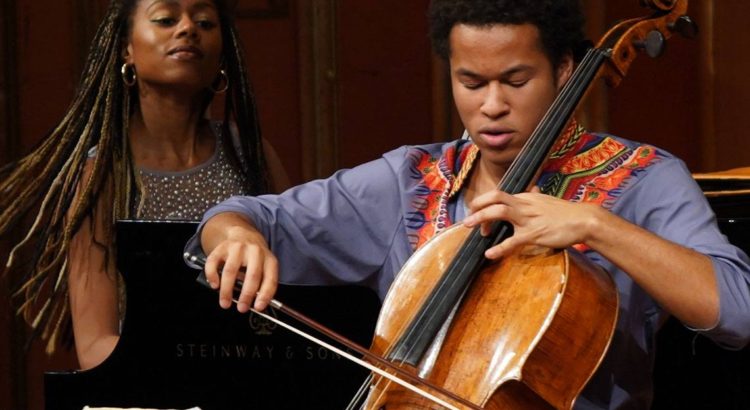
Amid a crazy week, Sheku and Isata Kanneh-Mason’s joint recital was a respite from the turmoil of the news. Streamed especially for UMS audiences, the Kanneh-Mason siblings brought audience members into their Nottingham, U.K. home for an intimate and well-produced performance, and it gave me the opportunity to take time away from other distractions.

First, I was very impressed with the production of the recital. Though it was filmed from the Kanneh-Mason’s home, it still included multiple camera angles, allowing viewers a front-row seat to their superb technique. Unfortunately, video buffering (yay internet!) prevented me from enjoying the full experience, but I nevertheless was able to appreciate the camerawork.

When it came to the music, Sheku (cello) and Isata (piano) were even more impressive. Fortunately for me, the buffering on my computer did not affect the sound, and I was able to enjoy the rich sound of Sheku Kanneh-Mason’s cello entwined with Isata’s flexible and virtuosic piano playing without interruption. The recital program included two pieces: the first movement of Ludwig van Beethoven’s Cello Sonata No. 4 in C major, Op. 102, No. 1, followed by Sergei Rachmaninoff’s Sonata for Cello and Piano in g minor, Op. 19. Throughout both pieces, the musical connection between Sheku and Isata was evident, both visually and aurally. Their eye contact and movement were perfectly in sync as they took cues from one another, and this could be heard in the balance and interplay of their parts. The Beethoven caught my attention with its solo cello opening which melts into the piano part, and its boldness later in the movement. However, it was the Rachmaninoff Sonata for Cello and Piano that especially drew me. It has a wide emotional range, including an intensity that the Kanneh-Masons conveyed impeccably. I particularly enjoyed the final movement (Allegro Mosso) for its freedom – after the tension of the earlier movements, it feels like a celebration and a release, while also being tender and delicate at times. It was a fitting end to the program.

However, lucky for UMS audiences, it was not the end of the program – Sheku and Isata Kanneh-Mason also included an encore in their recital recording! Though some of the excitement of an encore is lost in a virtual setting (no thunderous applause echoing across the concert hall), the surprise of additional music was still very much enjoyable. For the encore, the Kanneh-Masons performed “The Swan” from Saint-Saëns’s The Carnival of the Animals. It was quite the contrast from the final movement of the Rachmaninoff, and I was able to revel in its peacefulness, made even better by Sheku’s and Isata’s gorgeous sound.

Even across the internet and the Atlantic Ocean, Sheku and Isata Kanneh-Mason’s artistry was not something to be missed.

Review: The Queen’s Gambit

If you are looking for a quick, compelling and engaging show to watch over this Thanksgiving break, The Queen’s Gambit is a perfect choice. The show follows a young woman who is orphaned around age 8, and finds her calling as a prodigy chess player. She also discovers her addiction to drugs and alcohol, and tries her hardest to become the best chess player in the world, while struggling with her addictions and other personal issues.

First of all, this show was so good that, after the first two episodes, I couldn’t stop thinking about it and had to finish the entire thing in one day. I was so impressed by main character Beth’s struggles of breaking into an almost entirely male game, and making waves in a way that no one expected. It was so exciting each time she won a game against an opponent who underestimated her skill, as almost all of her male competitors did. It was also a bit disheartening seeing the way some people treated her just because of her gender, and also how much the media focused on her gender as an important piece in her rise to fame. I thought the show did a really good job at showing the gender disparities during that time period, and the real issues she would have faced as a woman in the chess world.

Speaking of showing the time period, the integration of small details really helped immerse you in the 1950s and 1960s. I love how Beth has great fashion taste, and so we got to see so much of what the popular styles and dress was during that time. I especially appreciated that as she continued to compete and grow older, she slowly transitioned from long, ankle length dresses with frills and colors, to a more sleek look, including mostly pants and almost no skirts or dresses. This really helped to show both the passing of time and the emergence of some women’s freedoms, as well as Beth coming into her own personality and doing what she wanted.

It was also so inspiring, as it always is, to see someone go from having nothing to being internationally known and respected, as well as recognized for her incredible talent. I was riveted by her public face and her private one, in which she was a ruthless, confident talent to the world, and a lost, lonely drug addict when alone. There were several moments where we sort of saw this switch very quickly, and I applaud Anya Taylor-Joy for her talented acting in this difficult role.

I would recommend this show to anyone and everyone. I learned a lot more about chess than I will probably ever need to know, and the show was just the right amount of heart-wrenching, exciting, and interesting so that I couldn’t focus on anything else until I found out what happened to Beth and her chess career.

Review: Dream in Silence (2020)

Running time: 75 min

Director: Huang Xin / Bao Ye

Countries: USA, China

Genre: Documentary

Dream in Silence has all the qualities an engaging documentary should have: an immigrant story, set in NYC, about a man’s end-of-life dream, and a collision between young and old. Self-proclaimed as a dying man, the subject, Fang Sir, is a funny, sensitive, and unpredictable graybeard who is like someone out of fiction. Before he immigrated to the U.S., he was a promising director in Taiwan. After decades of being distant from creative business, he decides to remake what he calls a “western” version of his award-winning short film from 40 years ago. A dozen young Chinese filmmakers were on board to help Fang Sir fulfill his dream. However, if you think this story may be no different from the touching ones that happened in the home-renovation shows, you might want to hold that thought, because how Fang Sir’s film project started and how the shooting went through are just beyond bizarre. Fang Sir isn’t any ordinary guy. He is wacky. He has a young heart. He makes you love and hate him at the same time.

Fang Sir’s initial capital is $300 that is supposed to be used on fixing his teeth. He tries to convince his producer, whom he met while waiting in the line for the restroom, to ask Ang Lee for financial support. The only thing that crossed their paths was that Lee had won the same Golden Harvest Award as Fang Sir did 30 years ago. He joked about the possibility of getting hit by a car and then using the insurance money to make his film, but it seems odd that he often positions himself not as the point person solving problems but more like a demanding customer. People on his team seem to be mostly film school graduates and professionals in the industry. By contrast, Fang Sir is laughed at as an amateur and is not on the same page with his young teammates.

Dream in Silence follows Fang Sir and his team’s preparation and official filming. The original short film, Silence (缄默), was directed by Fang Sir and shot by Christopher Doyle in 1979. Unsatisfied with Doyle’s cinematography, Fang Sir reshot the film in 1989. The 2020 version is the second-time remake. Fang Sir is currently consulting another film crew to make his third remake because he wasn’t happy with their collaboration. It is questionable why Fang Sir is so obsessed with this one story and yet has not developed anything new to give it a new life after 40 years.

The fast-paced editing in Dream in Silence is a successful hook and makes Fang Sir’s filmmaking journey incredibly entertaining to watch. The documentary not only truthfully documents Fang Sir’s over-excitement and adorable statements, but also his insecurity as an artist, his panic moments, and self-contradiction. For better or for worse, Dream in Silence does not pity Fang Sir and does not track down the reasons behind his awkward and irresponsible behaviors. It seems to me that he relies more on the team’s help than the film crew ever needs him. Young filmmakers took it for granted that Fang Sir was lonely and much happier when they were together, but that might be too shallow of a conclusion to make. I can’t help to compare his life with the film he is remaking. Coming to the U.S. did not help him achieve his movie dream but rather became a thorn in him, for he could not stop thinking about what-ifs. The reality has poured cold water on his dream, and he gradually lost his voice.


Now playing at Philadelphia Asian American Film Festival till November 15.


Preview: The Queen’s Gambit

The Queen’s Gambit is a new miniseries on Netflix that came out on October 23rd and contains 7 episodes which are about 1 hour each. The series follows an orphaned girl named Beth who discovers prodigal skills in chess in the basement of her orphanage with the custodian. As she ages, she begins to gain notoriety in the chess world and improve her skills, while struggling with addiction and confusion about her place in the world and her connections to other people. The show is based on a book with the same name, and is unfortunately fiction. I am excited to watch this show because it stars a woman excelling in a man’s world, which is always empowering. I was also recommended to watch it by others, and I love to learn more about games and areas that I know nothing about (I have never played chess before!).

REVIEW: Sheku and Isata-Kanneh Mason UMS Digital Presentation

Last week I had the opportunity to watch Sheku and Isata-Kanneh Mason perform from their living room (while I sat in my dining room…!) Originally slated to come play with the City of Birmingham Orchestra, Sheku instead recorded a very intimate duo concert with his sister, specifically curated for UMS audiences. The show ran October 25th-November 4th. I chose to watch the concert in conjunction with a UMS student committee event: a “live” watch party for students that was a rerun of the concert through facebook. It was fun to have a specific time to tune into the performance, and to see people commenting and watching live with me.

The program performed was the first movement of Beethoven cell0 sonata no.4 in C major, op.102, and the entirety of Rachmaninoff’s cello sonata in g minor, op.19. The two pieces are so different and I thought it was very insightful that they chose to do only one movement of the Beethoven. The Beethoven served as an opener, a bright bubbly piece that set the tone for the rest of the performance. The Rachmaninoff was much more serious and lush and I thought it had a lot of darker moments in comparison. The duo played with passion and as an audience member I could tell that they had a deep connection as collaborators. Isata took the lead in many instances, controlling the color changes and tempos as they made their way through the piece.

I really enjoyed the encore they chose: The Swan from Saint-Saëns’ “Carnival of the Animals.” It was such a beautiful and sweet ending to the concert:) The duo has a new album along with the rest of the Kanneh-Mason’s called “Carnival,” that features this piece. Released on November 6, 2020, the album takes listeners through the entirety of Carnival of the animals, including narration from the family as well:) It is exciting for me to watch these two perform because as a musician, it is fun to see someone my own age performing and being recognized at such a high level. I am also amazed by how in sync the family plays together and the stories they tell through their music making.


Link to album on Spotify:

Apple Music:

https://music.apple.com/us/album/carnival/1529334526