
REVIEW: Mystic Nights at Zal Gaz Grotto Club

Certain situations seem to arise from mostly nothing, creating a sensation of mystery from mere sights and feelings and sounds. In the event room of the Zal Gaz Grotto Club, there was a heavy, though not unpleasant, smell of red wine; dimmed overhead lights, with strings of Christmas lights bordering the room; a quiet playlist of music going, ranging from the Doctor Who theme to classics from The Beatles; and a thickness to the warm air coming from the heaters.

I sat at table 8 before the show began, reading a science fiction novel. Though distracted by the book, I was aware of my surroundings. However, at some point Misha Tuesday just seemed to appear in front of the velvet curtain, gazing at the audience. I dog-eared the page, and the show began.

It was curious that the mystic’s performance was not based in the showy ways of magicians or mediums; there was no claim of celestial powers beyond that which anyone can obtain through study. He stood before us, a slightly short, unimposing man, and argued he was neither a mind-reader nor a psychic, but a well-read investigator of a world hidden by our need for simple order and logic. I had not been expecting a Ted talk, but it was a good speech.

He went through a whole lineup of what he called “experiments,” exercises where we were meant to allow our latent intuition and sight to come through. There were some card tricks, displays of mind reading, of predicting the future. Nothing quite made sense; he seemed to be able to see with people as they visualized names and places, stepping into their thoughts as one could step into a room. Everything should have had some explanation, but it laid a little ways beyond my reach.

I was called up towards the beginning, and though I had wished to be chosen, when it became reality I was nervous to stand before the audience. I was shown a paper with a list of objects for less than a second. One of the objects was inside of a closed box I held in my hands. With the blank side of the paper facing toward me, he moved a pair of scissors up and down, asking me to tell him where to cut so that he cut through the word of the object in the box. I stopped at a random point (or so I thought). He asked whether I wanted to move a word up, and, the spotlight seeming to beat down on me like an August sun, I said no. The word was uttered quietly; it seemed to slip out of my lips without meaning to. He asked if I wanted to move one down, and I said yes, again unsure why I was feeling so certain and yet maybe not in control, not quite.

The word he cut through was “keys,” and in box was a ring of them. Unsure of what had passed, and unsure of its importance, I walked back to table 8 as the audience applauded my participation.

Was it all the effect of exquisite slight of hand? The power of persuasion? Some passing of unspoken signals between the volunteer and the mystic that allowed Misha Tuesday to command thoughts? I have no idea.

But that was the point of his performance, and of any performance that deals in mystic themes. To know the reasons for everything is to have failed at living meaningfully. Instead, as Tuesday preaches, we must ask questions, but not ask for their answers. There is a certain amount of mystery in the world, and it should be considered, but not attempted to be arranged into the static patterns that dominate society. Wonder is precious in the way it takes us away from the oppressive structure of the rest of our lives, and allows us to imagine, if just for a second, that the things we hold as fact may have many forms.

PREVIEW: 21 Chump Street

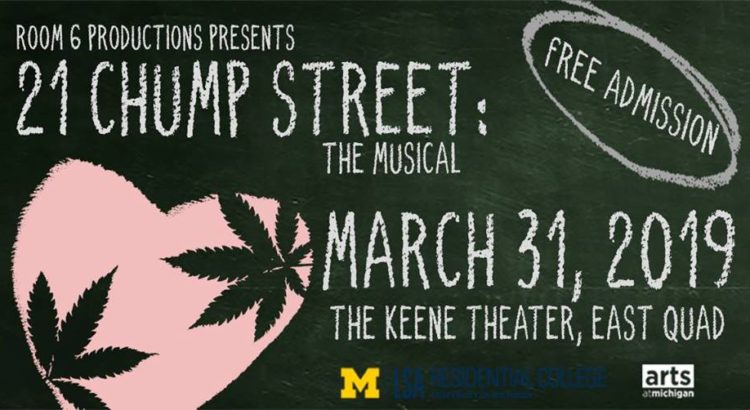
If you’re a fan of 21 Jump Street and Lin-Manuel Miranda, this mini musical is for you. Even better, it’s only 15 minutes long, so even if you’re drowning in midterms and papers and stress, you can make the time for this refreshing and entertaining break. There’s love, drugs, and deceptions…think 21 Jump Street set to music and shortened. This free Room 6 Productions is taking place on Sunday, March 31 at 8pm in the Keene Theater in East Quad.

PREVIEW: Roulette

This a Basement Arts Show, which means it is completely directed, performed, and ran by Students. It also means that this show is FREE!!!! What is even more special about this basement arts show is that it was written by Michigan Students, Kyle Prue and Kathleen Taylor. So it is a special opportunity to see this play, at the place it was created, before it becomes famous.

This show is at the Newman Studio in Walgreen Drama Center. Watch it Friday (March 29) at 7pm and 11pm or on Saturday (March 30) at 7pm.

This is the description from BA facebook:   Preston returns home one night to Emma. The conversation they have opens up the floodgates of every problem between them; all of the secrets they’ve kept from one another, everything they are too afraid to say. Preston suggests a solution—a drinking game. The rules of the game dictate that they pour six shots and ask each other honest, essential questions about the nature of their relationship. At any time, if someone wants to kill a topic or doesn’t want to answer the question, they take a shot. If they finish all six shots, it means their relationship is beyond saving and they have to break up. Roulette asks us to consider whether human relationships are built on mutual effort or some uncontrollable, cosmic force.

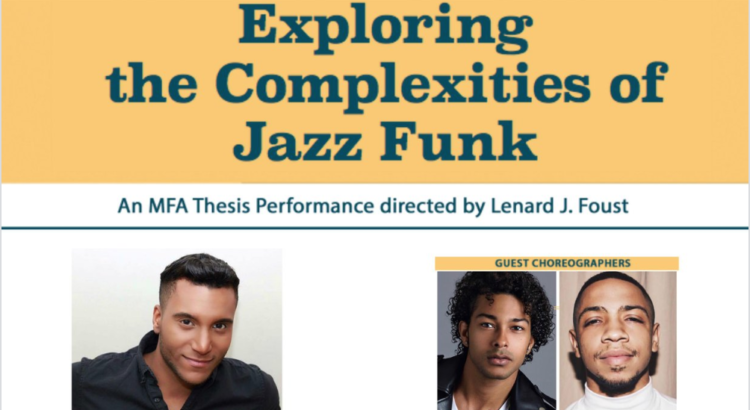
PREVIEW: Exploring the Complexities of Jazz Funk

It’s that time of year again when thesis performances are in abundance. Tomorrow and Friday, Lenard J. Foust (Master of Fine Arts in Dance candidate), will present Exploring the Complexities of Jazz Funk.

What is Jazz Funk? It’s more than sharp movements and syncopated musicality. It blends traditional concepts of “masculine” and “feminine” movement. A jazz funk dancer isn’t just someone who embodies the movement, but also one who understands the historical and cultural contexts that led to the birth of jazz funk as a genre.

The thesis performance features twenty dancers, interactive projections, and choreography by Foust, Lando Coffy and Jose Tena (who are international jazz funk dance professionals). Audience members will experience behind-the-scenes production of a commercial dance video.

A panel discussion will follow each 8:30pm performance.


Price: Free

Show Times:

March 28th, 7pm and 8:30pm

March 29th, 7pm and 8:30pm

Location: Duderstadt Center Video Studio (Suite 3360), 2281 Bonisteel Blvd, Ann Arbor, MI 48109

More info: smtd.umich.edu/dance/#events & https://www.facebook.com/events/217873582492656/

Dancers

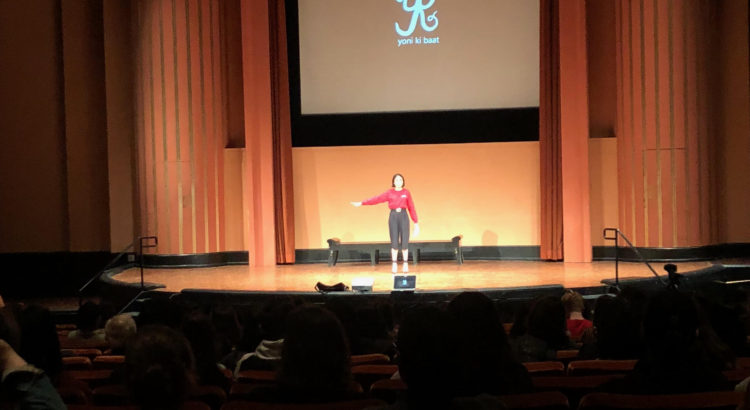
REVIEW: Yoni Ki Baat

It is unique to have a space centered around women of color and only women of color. It is a space to be vulnerable, powerful, and truthful.

Yoni Ki Baat– which loosely translates from Hindi as “Talks of the Vagina”– is a show that centers around these women, whose voices are often stifled. 

Inspired by The Vagina Monologues, YKB started off for South Asian women. At the University of Michigan branch, the organization expanded to a larger array of diverse performers.

Before the monologues kicked off, there was an art gallery for audiences to observe. Artists were able to talk about their work and explain what inspired them, which added another layer to the gallery. The artwork was presented through a slideshow in Rackham auditorium, but I found it much more effective to view it in person and actually seen the work up close.

The monologues themselves ranged from deeply heart-wrenching to thought-provoking to humorous. The topics varied: stories about first love, war, objectification of women— all specifically tailored to how it affected their lives as well as perceptions of women of color. The performers of Yoni Ki Baat approached their stories with a nuance that is demanded of the space and the topic at hand.

In return, Yoni Ki Baat demands you to be empathetic, kind, thoughtful, comfortable, uncomfortable, and reflective. I was struck by the emotion that came from the performers and the hours of love and work that clearly went into the presentation. Yoni Ki Baat is a crucial organization that fulfill a vital role on this campus and you should absolutely head out to their next production!

Two people dancing the yonna

REVIEW: Birds of Passage

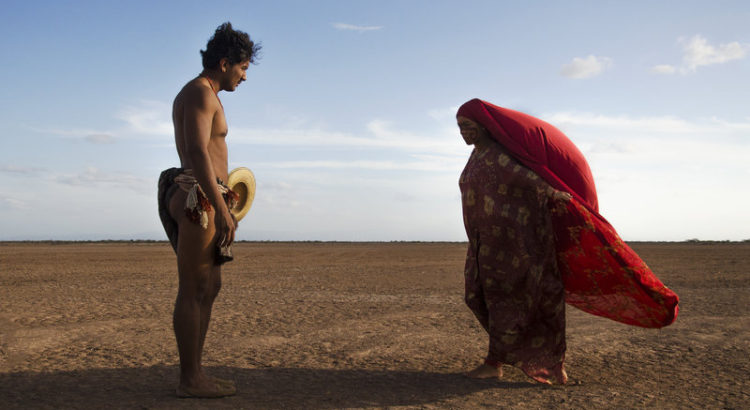
The beginning of Ciro Guerra and Cristina Gallego’s Birds of Passage opens with a symbolism-laden new beginning: a young girl’s transition into adulthood. The Wayuu people at the center of the film celebrate this occasion with a festival of family, friends and dancing. But it is the dancing that provides the clearest window into the future of this sprawling clan. The daughter on the brink of womanhood, Zaida, is dancing the Yonna, a fast-paced give-and-take between her and another man. She is dressed in a flowing red garment, racing back and forth to the beat of a drum, the camera closely following their faces and imparting the dramatic feeling that you too are being chased in the circle, racing around and around in the ambiguous fear of what might happen if you stop. Her first partner, a young boy named Leonidas, eventually trips and falls to the ground. The dance stops, but not for long, as an outsider to the clan named Rapayet steps up and enters the fray, outlasting the drum, and making his first mark on the clan he will eventually join.

The clan is led by a powerful matriarch, Úrsula, who makes clear from the start that her power lies in her willingness to do anything to protect her family. Rapayet, a suitor intent on marrying Zaida, strikes Úrsula as a danger, but possibly even she does not realize the depth to which he will uproot her family and her culture. The Wayuu of northern Colombia had persevered through the rise of the modern nation by their adherence to their traditional practices that Úrsula is determined to protect. As Rapayet ventures into the marijuana trade to finance his dowry for Zaida, he finds himself sucked into a whirlpool of greed and desperation despite his best efforts to preserve the culture of honor. It is only a matter of time before the consequences manifest themselves.

Rapayet, Zaida, and their two children eventually move into a grand stucco villa in the middle of the barren desert, a visual metaphor for the isolation their wealth has granted them. The film is a deliberate exploration of the fine line between providing for your family and sacrificing them in pursuit of these provisions. It showcases the delicate tension between the traditional ways and the allure of 20thcentury wealth and luxury, and the mythic power of the dollar, propelling business and violence across the Colombian desert in an ancient blue Jeep.

Now showing at the State Theatre. In Wayuu, Spanish, and Wiwa with English subtitles.