REVIEW: Too Many Zooz

In my musical experience, it doesn’t get much more obscure than a Monday night concert at the Bling Pig with a band that got its start on the New York subway. Lately, I’ve been finding myself going to concerts and events without much in the way of expectations or preconceptions. Blame it on the sentimentality of second semester senior year, because I’m suddenly desperate to soak in all the experiences I haven’t yet had during my time here at Umich. So, when my boyfriend invited me along to go see a show at the Bling Pig with his friends, I said yes. I grew up hearing my dad rave about the Bling Pig as a landmark venue for the region where he spent much of his raucous, hippy youth. Sadly, I’d just never made a point of going to see a show there. When the opportunity presented itself, I knew that it was my chance. That’s how I ended up at the Blind Pig on a Monday night for a performance by a band whose name I didn’t know, and man, am I glad I went.
The Bling Pig has that sort of grimy, hole-in-the-wall feeling that all the best venues have. Apparently, they usually serve free popcorn but that was not the case Monday night, to my boyfriend’s chagrin. We grabbed a hightop chair and section of counter along the side of the room so that this fun sized individual could actually see the stage. The opening act was The Essentials which seems a bit presumptuous, if you ask me. A small band from Toledo, The Essentials classify themselves as reggae/surf/punk. I would classify them as knock-off Sublime. If you can’t tell, I wasn’t particularly enamored with their set; it just brought back too many memories from my middle school girlfriend’s house in the summer.
Despite, this subpar opening act (it can’t be disappointing if you don’t have expectations) I was pleasantly surprised when Too Many Zooz took the stage and a neon-clad man started belting out a catchy tune on baritone sax. Too Many Zooz is probably one of the strangest groups I’ve ever seen perform both in appearance and sound. The members, Matt Doe, Leo P, and the King of Sludge definitely look like they started out playing on the subway. Each of them has a distinct style which does not mesh with the others creating a slightly confusing visual experience that makes it nearly impossible to look away. The saxophone player was the clear highlight of the performance as Matt Doe climbed on speakers in his neon rave outfit and expressed the full range of the bari sax. Their self-described music genre, brass house, is just as wild as the appearance and incredibly accurate. I couldn’t help but think “if they played this kind of music at Rick’s I would probably go a lot more often”. The performance was lively and fun, never allowing the energy to decline. I found myself wishing Leo P’s theory of our sweat condensing into clouds which would then rain down on us and provide some relief from the temperature of the room would come true. I know that I can’t always be this lucky, but this chance definitely payed off.


Image courtesy of Too Many Zooz’s official Facebook page

PREVIEW: Jazz + Chocolate

This Thursday, aka Valentine’s Day, my man is taking me out for some Jazz + Chocolate at Cultivate Coffee and Tap House in Ypsilanti. Cultivate is a hipster coffee shop meets brewery meets venue meets community center. If there’s something you want to do, you can probably do it at Cultivate. I first visited Cultivate a couple weeks ago to get some work done and found a dynamic, inviting space. The main room is full of long picnic tables but, unlike most spots on campus, no one gives you a dirty look if you sit next to them. There were students getting homework done while sipping coffee, folks meeting up for lunch and a beer, and teachers tutoring high school students. In addition to this awesome space and atmosphere, Cultivate also provides support for local businesses and runs a community garden behind their converted auto shop. One of the best things about Cultivate is that it’s actually super accessible from campus, just hop on the number 4 bus to Ypsi!
This Thursday, Cultivate will be transforming into a romantic spot for lovey dovey couples to drink wine, eat cake, and listen to jazz. Josef Deas will be performing, though I’m not entirely sure what that will look or sound like. He’s a local artist that has been on the scene for over five years and has performed at the Blind Pig in the past, so he must be pretty legit. One of my favorite things about jazz is how diverse the genre can be, so I’m always up for a jazz fusion-y surprise. And, if nothing else, there’s always the cake.


Graphic courtesy of the Cultivate Facebook page

REVIEW: Frances Luke Accord and The Western Den

As I entered the building on Main Street after a long day of academic obligations, I rushed in to escape the wintry air, feeling hesitant to enter completely as I was surrounded by scaffolding. After learning that the Ark was having construction done on its box office, I understood why I was greeted upstairs by a polite woman who was a designated volunteer for the event. Despite the initial impression of it being run-down and unprofessional, I was quickly reassured that this was a venue for legends as I walked down the long hallway that was at the top of the stairs, gazing at the professional photos taken of every musician that had performed there. After buying concessions, I took my seat in the dark performance room; the room housed a small stage that was glowing in violet lights and seats for the public at tables near the stage and in rows throughout the room. This was the Ark, and I couldn’t wait for the intimate performance to begin.

The night began with an opening by The Western Den, a contemporary folk group based in Massachusetts whose first collaborative performance with the main musical act had been that night, I would come to learn. She was a singer and keyboardist, he was a singer and guitarist, she was a violinist and bassist, he was a trumpeter, and he was a drummer. I failed to remember their names, but I remembered their images, their personas. All five members of the group suited the instruments they played strikingly well, and I was emotionally intact with the way they had orchestrated themselves even before they started playing. The music they shared was eccentric and refreshing; they played unpopular chords almost in a melancholic way, but with a rich tone and heavy bearing that came off as passionate rather than temperamental. I was completely relaxed during their performance, taken aback by the impressive compositions that this small, relatively unknown group had to offer.

This performance was followed by a short intermission, during which I acquired more tea from the concessions, and then the main musical act. Unlike how the name suggests, Frances Luke Accord is a group of two men; however, they were able to convey a solitary essence as they merely used their voices and a few of their instruments to create their music. Both of the men transitioned between their several acoustic guitars between their songs, all while using their sole two voices to successfully create vocal layerings that are more often achieved by groups with several members. Since we were able to focus only on their voices and their guitars, I was able to follow the mood that they wanted to convey for each of their songs. I noticed when they would play more percussively to portray a chorus or other musical release, when they would take long strums of their guitars to fill up the room, and when they would quietly pluck the guitar strings to create a soft, mellow mood as the end. I was on edge throughout most of the performance, eager to see what new direction they would take us in with each second that passed.

Overall, I left this event very pleased and I felt like I wanted to stay in the Ark forever. While I was unsure what the outcome of my experience at this event would be, I am happy to say that I can trust my curiosity in new experiences to lead me towards the things in life that bring me true joy.

REVIEW: Israel Philharmonic Orchestra

It’s been some time since I last attended a Western classical music concert. I was excited to see the programme, which included a Concertino for Strings, Schubert’s Symphony No. 3, and Tchaikovsky’s Symphony 6, Pathetique. The Concertino I thought was a pleasing piece but lacked a storyline to give the music direction. I wasn’t too familiar with Schubert beforehand, so I enjoyed hearing his 3rd symphony, finding it more elegant and a little less thunderous than Beethoven. Being a fan of Sleeping Beauty and Swan Lake, however, I was most excited to hear Pathetique for the first time. I am not a particularly emotional or vividly imaginative thinker, so I was surprised to find myself with incredibly clear mental images for each movement of the symphony. The first movement, for example, evoked the feeling of someone in such deep despair that they were almost angry, and even I found it incredibly moving.

I knew the Israel Philharmonic would be good, but I was completely unprepared for how good. Even their tuning sounded like music. I loved watching the musicians move; in the first piece particularly, the orchestra was so in tune with each other that their instruments and bodies moved not just at the same times but at the same angles. While this is something that does occur in other professional orchestras I’ve seen perform, the synchrony was especially marked here. And, of course, they were perfectly aurally synchronized as well. I’ve been told before that when instruments are perfectly in tune with each other, you can hear the note vibrating in your ear. That comment referred to instruments playing the same note. The Israel Philharmonic, meanwhile, at one point played a set of different notes that were so perfectly dissonant it caused my ear to thrum in an oddly comforting way. I was floored. The musicians created a more nuanced interpretation of the music than I’ve ever heard. For example, Pathetique began with the double basses fading in, and ended with the double basses fading out. Normally, it’s easy to tell when instruments stop and start, since it’s almost impossible to go from the absence of sound to sound without that transition being obvious, but the Israel Philharmonic managed this almost-impossible feat with deceptive ease.

And then came the encores. I was almost disappointed when Yoel Levi, the conductor, stepped back onto his podium, because how could anything be adequate to follow Tchaikovsky? And then they began to play a piece I didn’t recognize (I later learned it was Elgar’s Nimrod), and I immediately realized they’d found something that was not only adequate but perfect to follow Tchaikovsky. I look forward to listening to Nimrod again soon, but I’m afraid a recording of the piece will not do it the justice that the Israel Philharmonic did. And then Levi came out for a second encore, and I was again disappointed, but once again, that disappointment dissipated into a sort of melting sensation as they began to play the waltz from Swan Lake. Gazing at Hill Auditorium’s intricate ceiling as one of my favorite pieces of music washed through me, I wondered why I had bothered to wear makeup that night, as this music was bringing all my usually-docile emotions and stirring them up, leaving me feeling exposed in a way no makeup could adequately cover.

REVIEW: Ice Carving Festival

There are far too few true delights in this world, especially when living in Michigan in the middle of winter. Most things are dead, either outwardly or inwardly. Going gloveless to text a friend back could invite frostbite in minutes, and the threat of entire sunless weeks is omnipresent.

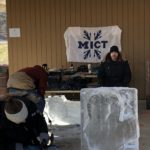
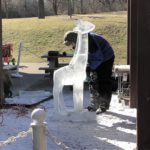
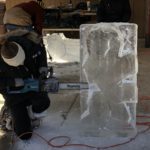
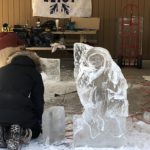
Luckily, we’ve identified one of the handful of things that the cold preserves, rather than kills: ice! Beautiful, wooded County Farm Park was the perfect backdrop for a wintry festival, with a playground for kids, a pavillion for the artists, and a rec building for arts and crafts. The ice carving teams from Washtenaw Community College, Macomb Community College, and the University of Michigan supplied the Ann Arbor area with a Saturday full of joy with their astounding skills. The sun even stayed out for the day, reflecting off the sculptures, glittering off smooth curves and edges.

There seemed to be an animal theme: a giraffe, rabbit, and salamander emerged from three blocks of ice, while U of M also constructed a vintage-style camera.

The audience was mostly families with small children, and the outdoor environment thankfully allowed for a great many adorable dogs to walk amongst the crowd. My girlfriend and I were probably the only childless adults to make pipecleaner snowflakes in the craft room, but we received no criticism, even when mine turned out looking like a deformed spiderweb.

Children below the age of ten did appear to be the festival’s sole target audience, which felt like a bit of a mistake. In future years, they could decide to open it up to older children and childless adults, perhaps with a musical guest or a few local food trucks. There could be a reception that goes later into the evening after the carvings are completed, adding in an element of colorful lights, during which the artists can explain their pieces and process. There is only so much an event with no admission fee can add in, but there is a variety of routes planners could take to expand the festival that involve little cost.

But the place they are at now is wonderful already; they had secured a sponsor (an living community with new apartment buildings opening nearby), which allowed them to serve hot chocolate and popcorn, as well as to supply several crafts.

I am always thankful for free stuff. The sponsor gave out hot chocolate mugs to keep, which is a beautiful thing for any college kid (I, for instance, am the proud owner of exactly two $1 plastic plates from Target). Despite the cold, the day was made infinitely more joyful with a little sweetness, and some cool art.


REVIEW: The Painted Face Artistry, Design and Voice in Chinese Opera

This performance was by Li Yang, a member of the National Peking Opera Troupe. Peking Opera is also known as Beijing Opera and is a regional style of traditional Chinese opera. It is said that one good second of Peking Opera requires 10 years of training. This was true of Li Yang who left his home at seven years old to train in an opera school. Since then his whole life has been dedicated to practicing and performing Beijing Opera.

Before the performance began, we heard a history and background of Chinese opera, with an emphasis on Beijing Opera, which was given by Professor David Rolston. It’s a very interesting subject and I encourage you to do some research before watching a Chinese Opera. At least to learn about the main characters that will be performing and a summary of the plot. The face painting is important in Chinese opera because it can be very difficult to understand what is being said, even for native Chinese speakers. So the face paint tells a lot about the character. The color of the face paint is very important: red indicates loyalty, black indicates integrity, purple and pink indicate honesty, white indicates conceit and trickery, yellow indicates an aggressive nature, etc.

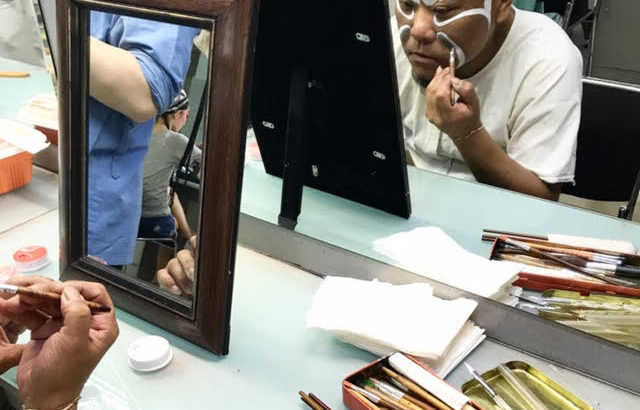
Li Yang performed two different songs for us, each song from a different character and therefore with different face paint.  The first character was Cao Cao which is an evil character from the Romance of the Three Kingdoms, and the second character was Li Kui, from Water Margin,  which is one of the four great classical Chinese novels. He performed each song twice, the first time without any face paint and the second time with the full face paint. Li Yang paints his face himself. Actors in the U.S. don’t do their own makeup, but in Chinese Opera they do because this allows actors to create their own distinguishing features to their face paint.

I actually enjoyed watching Li Yang perform the songs without any face paint more because I could see the expressions on his face more clearly. I thought his facial expressions were comical, especially when he would fully open his eyes and dart around his eyeballs. I really enjoyed watching his movements while he sang which reminded me of Tai-chi.

The songs he performed for us usually have an orchestra accompaniment. Li Yang would mimic the sounds of the orchestra with his voice while he performed. It was very interesting to hear, the best way to describe it is with “tutt tutt tut, putt putt put” sounds.

Afterwards, they had a raffle. I wanted to win the grand prize of getting my face painted by Li Yang, but instead, I got a bottle opener in the shape of a painted face. Which was still nice.

I attached three images below, the first two images are of Cao Cao, the second image is Li Kui.