PREVIEW: 6th Annual Multicultural Yardshow

This Saturday, October 22nd at 8:06pm, music will be heard all throughout The Diag. Sigma Lambda Beta Fraternity Inc. will be hosting their 6th annual Multicultural Yardshow at the Block M, and a total of 9 greek organizations will be participating, each performing their own choreographies with their own music mixes.

I’m super excited to witness the lively atmosphere this Saturday night, and I’m most looking forward to the organizations performing a stroll. A stroll is a rhythmic dance performed in a line with chants, and it’s a cultural tradition started by Black greek organizations. If you haven’t seen a stroll yet, this will be a great opportunity to see them, especially since each stroll is unique to their organization.

If you’re looking for something to do Saturday night, consider coming to The Diag even just for a short moment!

PREVIEW: Pressed Against My Own Glass

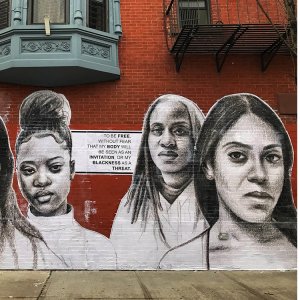
The last day to see Tatyana Fazlalizadeh’s art exhibition is this Friday, October 21st!

Pressed Against My Own Glass is a multimedia installation on Black womanhood within domestic spaces. “Fazlalizadeh explores her childhood and adulthood within the domestic space and how it connects to the experiences of other Black women and those who had a girlhood… While doing so, she makes connections to her Black women peers, even those like Breonna Taylor and Atatiana Jefferson who show how racist violence is a threat to Black women even in their homes.”

I’ve seen sneak peaks of Tatyana’s exhibit around campus, whether on a building on my way to my class at north quad, or the cardboard cutouts sitting on the grassy patches of the diag. I like the bluntness of her one-liner, accompanying statements with each portrait that point out flaws of the university and of her college experience. Each time I pass them, they feel like reminders to go to the exhibit, which I’ve been meaning to go to. I’m excited to see more of Tatyana’s art in the form of paintings, drawings, video, and reappropriated home objects, and the way she examines “her experiences of joy, rest, sadness, and fellowship in the home” through her art.

The exhibition is located at the Institute for the Humanities Gallery (202 S. Thayer Street). The gallery is open from Monday through Friday from 9am-5pm, and free and open to the public!

REVIEW: Bros (2022)

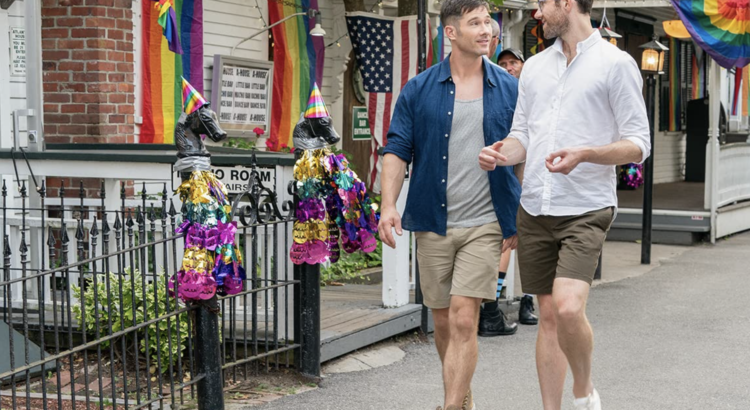
On Tuesday, a free advance screening of the film “Bros” was showing at the State Theater! As soon as I saw the trailer for this movie I was intrigued. A tropey gay rom com? Set in NYC? Billy Eichner?? I went in expecting a good time and this movie delivered.

This movie knew what it was trying to be and made it obvious from the start. A movie for the masses, that could portray a romance beween two white cis gay men with levity and humor while acknowledging the history of gay trauma that precedes it. So often, queer cinema centers stories of queer oppression, grief, and crisis. These stories are important, but where is the room for joy and lightheartedness? To me, this film was trying to say: “Despite the weight of this trauma, we have joy, too! We have sweet and ordinary and non-history-making moments too! Let’s revel in it!”

And so it does: this film is laugh-out-loud funny. There were very few moments, sitting in the darkened theater, that I did not have a ridiculous grin on my face. Eichner, who readers may know from his role as Craig Middlebrooks in the television sitcom Parks and Recreation, both wrote and starred in this movie. He nails his role as Bobby, a stubborn and endearing podcaster who is opening the first LGBTQ+ museum in NYC. His comedy is whip-smart, meta, full of delightful irony. His chemistry with Aaron (played by Luke Macfarlane), a “gym bro” lawyer with commitment issues, is electric and real. This film includes some of the most realistic portrayals of romantic intimacy I’ve ever seen. Yes there are charged, steamy moments, but there’s also a healthy amount of awkwardness and silly hijinks. Sometimes you just want to have a pillow fight!

Bros is also a movie that is very self-aware of itself. It celebrates its significance – after all it’s an adult-oriented LGBTQ+ movie produced by a mainstream film studio, and it features an openly queer principal cast. However, it also constantly references its own shortcomings. This movie knows that it is only representing a small slice of queer identity (namely that belonging to cis white men), that it is leaving countless other stories out of the picture. When it celebrates pieces of important queer history, it simultaneously pays homage to the progress that the world still needs to make for the LGBTQ+ community. About being the first openly gay man to write and star in a romantic comedy for a major Hollywood studio, Billy Eichner said:

“I’m honored that it’s me, but it should have been someone else 30 or 40 years ago.”

This kind of movie is definitely late in making its way into the world, but I think it’s better late than never.

TL;DR – I would highly recommend catching Bros while it’s still showing at the State Theater. It is fresh and funny and put a big ol’ smile on my face throughout.

REVIEW: Parable of the Sower

Parable of the Sower… Where do I start?

I believe this was the first opera I’ve ever seen. And I was not disappointed. I laughed, cried, and even had the privilege to sing along. After the show, my friend Anna described Parable of the Sower as the best play she’d ever seen in her life. “I was tearing up basically the entire time… the music was consuming. It was so so fantastic,” she remarked. 

The opera is based on the post-apocalyptic novel written by Octavia E. Butler, written by Toshi Reagon and Bernice Johnson Reagon. Despite being published in 1993, the story is set in 2024, eerily close to this year. Already, Butler starts to draw parallels. The play deals with a Christian-esque group in a world that faces environmental degradation on a grand, terrifying scale. The church members essentially live in Noah’s ark – their walled city is safe, while the outside world is gonna end. The Reverend – the main character’s father – is the only one who is allowed to leave the walls and see the city.

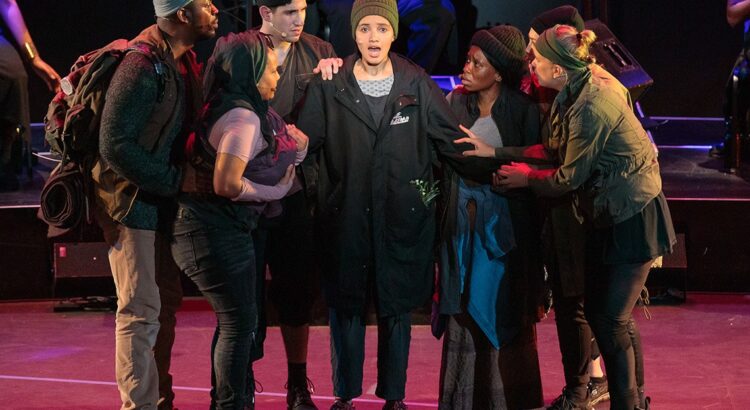
Up on the balcony, people chat as the clock ticks down to 4pm. There is a person onstage, already in character; the audience is left unsure of whether the show has already started or not. The lights don’t go down, the cast strolls in, unannounced, and the start just sort of happens.

Opening the play, Toshi Reagon tells us that Butler “burned [Lauren] with hyper empathy.” An element that I missed – until my fantasy worldbuilding class’ post-opera discussion – were Lauren’s magical powers. She feels others’ pain, and there are subtle cues – like a flash of purple when her brother stabs his hand with a pencil to get her attention, or her falling down as other people get shot – that several of my classmates pointed out.  “If I can feel your pain, do I know you better, if I can fly in your joy?” Lauren asks.

The first scene is all auditory: two news channels chirp out overwhelming news, lapping over each other, in a volume-too-loud, ear-assaulting amalgam. This launches into a song, where the talents crooned at different directions of the audience, “What you gon’ do?” Even though I sat all the way up on the balcony, it felt like they were staring, arch-eyebrowed, right at us, and I felt a pang in my stomach. “The world’s on fire, you can’t hide.” The line between fiction and reality blurred once more.

In their situation: a “dystopian America wracked by the violence brought on by unrelenting greed and systemic injustice” (UMS blog), it all boils down to us versus them. There exists a religious dispute between Lauren and her father, the reverend, exploring the scale of beliefs ranging from God is good, God is change, to God have mercy. Lauren devises her own truth while others present the fixed truth that most of her family is invested in. She believes in the need to embrace change and do something different, because it’s only a matter of time before their safety crumbles down. “There’s a new world coming, everything gon’ be turning over,” Lauren sings. While others sing back, “do you really think the world gon’ end?”

I enjoyed how the cast encouraged audience interaction. I didn’t feel shy about bobbing my head, or tapping a foot. When a person in the audience clapped at the words being exchanged onstage, Toshi stopped mid-speech to say, “Hey, I won’t stop you.” Many times, a few people would let out whoops that soon launched the whole audience into applause. The actors had such a commanding presence; they were able to start the theater into a clap, with ease. They also played with breaking the fourth wall. “Octavia Butler is not playing with us,” Toshi remarked, after the first act. She directly asked the audience to naturally join into the chorus of the song – “Don’t let your baby go, don’t let your baby go to Olivar – ” and it was really beautiful to hear the audience participating. Everyone in that large room – those onstage and those spectating – felt more connected. I could feel them sowing the seeds of community with these little moments. 

Every person onstage flaunted their flawless vocals, and the opera doesn’t feature one person too heavily; it feels like each character gets their own moment in the spotlight. I especially loved the electric guitar riffs, or when the guitarist would back a singer’s vocals, perfectly in sync with their inflections.

In the song with the chorus, “Are we supposed to live like this?”, the strings are beautiful and psychedelic; warpy, wonky. I appreciated how this broke my expectation of what an opera had to be: very classical, prim, and proper, with a soprano hitting notes that could break glass. 

The songs that struck me the most were Lauren’s “Has anybody seen my father?” a heartbreaking, repeated chorus where her voice gradually breaks with each repetition, and the more mellow, emotional solo by Lauren’s mom. Both had such intimate lyrics that the theater flooded with it. It felt too heavy to move, or in any way disrupt this moment. I’ll admit that tears bubbled from my eyes, and I stiffly let them run, not even lifting a hand to break the mood.

True to an opera, the second act made me fall asleep. This isn’t to say that the show fell off, or that I was the only one slightly sleep-deprived. While the first half of the show had lights that never dimmed, the lighting was all of a sudden pitch-black dark, spotlights lightly glazing the characters as they entered the hellscape outside, complete with dangerous people and violent criminal elements. Because of the lighting, I couldn’t help feeling that maybe my ensuing drowsiness was purposeful, intentional. When I woke up, I realized we’d all been asleep while the characters were still fighting for their lives – belting through, by far, the most grueling song – through this continuous struggle outside of the wall. But for me, it all kind of turned to background noise, in the dark. As I took care not to wake up on my neighbor’s shoulder, UMS was playing with genre. At the end of the story, the troupe stands clustered together, in a haunting formation. Smoke floats over their heads, like angels, as they stand in ruin. After resting for a long while, the electric started back up, with gusto, and served as a wake-up alarm as multiple neighbors startled awake.

What I saw when I woke up

To finish, every seat in the house was in standing ovation. I was in awe of the amount of talent in the room, trying to digest it all. On the walk back, Toshi’s closing words circled through my head: “We have to fall away from the limitations billionaires have put on us. It will only happen if you give up the lives they have assigned us.” My friend Isabelle pointed out the liminality of how parables are passed – to my point about sleeping, there is a presence through absence. “Their words are gonna fall on people, stick with some, take hold, grow, and spread.” That is the power of the parable.

Read more about the performance here: https://ums.org/performance/parable-of-the-sower/

REVIEW: Holi Festival

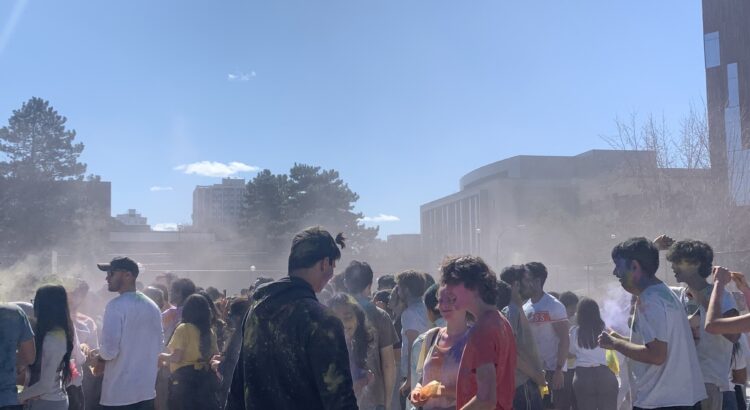
Unlike today’s chilly temperatures, the weather for the annual Holi Festival at Palmer Field was warm and welcoming, mirroring the celebratory nature of the holiday. Although there is debate about the mythological origins of the festival, Holi is traditional Hindu festival, meant to honor the arrival of spring while also commemorating the triumph of good over evil. Though there are regional variations of Holi celebrations in India, the practice of playing with colored powders and water is common.

The event was hosted by the Indian American Student Association, Hindu Students Council, and Indian Student Association. They did a wonderful job of creating a fun festival, complete with music, dancing, and delicious Indian snacks. This was my first time celebrating Holi at the university, and it was amazing to see the community come together for a fun-filled afternoon. Strangers and friends alike stood shoulder to shoulder and slowly became more and more colorful as the event went on. It truly was entertaining to witness the multi-colored clothes and shoes of people walking around the grounds.

Being a member of such a large university can make it hard to connect with others, especially given the recent pandemic. Events like these allow students to meet others who share the same experiences and interests (alongside students just interested in learning about other cultures) to help build a sense of community and belonging. I’m very glad that Holi at Michigan returned after pausing for COVID, and I look forward to participating in the festival again next year!

REVIEW: Perspectives: An Exhibition of AAPI Expression

I came to the exhibition severely underdressed. Upon entering the gallery, I was greeted with warm lighting, a spaced out selection of art – giving most pieces their own living space to breathe – and a room full of artists and patrons of the arts. Most are dressed well, not to the nines, but in knee-length black dresses or cardigans, getting semi-formal down to a tee. That label was always a bit confusing for me– what constitutes semi, and how much is too formal? Either way, it didn’t matter. What everyone really came here to see was the art.

Placed in each corner of the room, projectors loop videos, rerunning the media art. For the photography, there are display boards that MA:E and the photographers hammered in themselves. Most of the paintings and fine art span the walls, a couple placed in the center of the room.

After the opening remarks and an acknowledgement about the term AAPI and how it generalizes an incredibly diverse community, especially for Pasifika communities, the gallery tour begins. We roam like sheep, tranced by each new work. Everyone cranes their necks to get a better look, arching around one another to see fit. As much as I enjoy how art is in the eye of the beholder, I like hearing directly from each artist. They explain their intentions specific to each piece and the personal meaning behind their art. The distinctness of each artist’s style and voice, and the unique experiences that shape them, are especially apparent.

Some of the pieces that stood out to me:

Riya Aggarwal’s highly-detailed, depthy paintings immediately caught my attention. Each piece flaunts a deliberate to-the-brim intricacy, yet deftly skirts around appearing too busy. I liked how the content of Riya’s paintings were neither black nor white: she specifically explores the cultural tension between “following in the footsteps of my ancestors and creating my own path.” I admired how her artwork elicits feelings of both pride, celebration, and conflict. In True to My Roots, the dark background, body language, and facial expression of the subject evoke a gripping emotionality. 

True to My Roots (2020)

Keri Yang’s paintings pop off the page. I like how even the non-3D elements push the limits of their dimension and create visual allusion. Soulmates plays with border, as the subject encroaches outside of its backdrop.

Soulmates (2021)

Perched high up on the wall, taller than the artist herself, is Michelle Ha’s The Girl with the Iron Fist. With her art, Michelle hopes to “represent Asian American experiences by focusing on representing true narratives rather than focusing on the suffering that prejudices bring.” The lighting in the bathroom of the painting is synonymous to the ballroom’s dim ivory brilliance. “With oil paintings historically being about possession and male pleasure in the western context, I bathed my subject in the light of reclaiming that gaze.” I like how the subject looks half taken off-guard, half-bored yet unwavering. Through peering at the audience, this subject, performing the mundane task of brushing her teeth, confronts “the biases the audience has about East Asian American Women. On another layer, by showing the subject doing an activity anyone may do, I make the experience of being an East Asian American woman more accessible to those that find it hard to find empathy with those different than themselves.”


The Girl with the Iron Fist (2021)

Dorothy’s Masked is striking, from both afar and up close. From across the room, at first I thought the aquamarine on the girl’s face looked like tears. The painting emphasizes the importance of masks, and Dorothy chose her subject, her friend Angela, “because of the increase in racism against Asians at the time since the AAPIA community was being blamed for the virus.”

Masked (2020)

Angeline Tran’s Missing Eye, “an experimental top made of denim, selvage, and buttons sewn together both by machine and hand,” was my personal favorite. The material is sewn “to overlap itself and create the illusion of an eye socket and the buttons are placed in the middle, depicting the pupil.” With one eye lying on the breast, and the other at the belly, the garment represents heart and gut instinct. I loved this piece because of its visual attractiveness, message, and frankly, because it’s just so cool. It was also one of the only 3D, sculptural works in the gallery. I am just starting to take a STAMPS sewing mini-course, and hope to take a garment construction class in the future. As someone who expresses creativity largely through writing, exploring visual mediums has been a therapeutic, refreshing process. Angeline’s inventiveness and utilization of scrap material and selvage inspires me to create with intention and take risks with garment sculpture!

Missing Eye (2021)

Event Program: https://www.yumpu.com/en/document/read/66499721/perspectives-gallery-digital-program