REVIEW: Ovid’s Metamorphoses in a Modern Theatrical Adaptation by Mary Zimmerman

It’s always a pleasure to enjoy something you weren’t certain you would. I am usually unmoved by the classics, from Shakespeare to Homer to Woolf. They don’t translate to modern day values and speech, and they always seem to be written as densely as possible. Besides the lack of ease I face understanding these texts, their baffling popularity throughout great lengths of time–even millennia–is personally upsetting to me, and makes my annoyance all the more overpowering.

While adaptations of old texts usually fall short of capturing a modern audience’s interest, this one was well done. Where typically the author relies on flat jokes and cheesy costumes, Zimmerman simultaneously honored the poetry of Ovid’s great work and subtly brought it into the now with small script changes and stage directions that shone through to the present. The cast were careful not to overdo it, understanding that the purpose of the adaptation was not solely cheap comedy, but should reflect the philosopher’s original, complex ideas. When the stage light reflected in Sophie Thurschwell’s eyes as she gave a soliloquy for her dear lost Orpheus, I was struck by the raw drama she could call upon to recite her ancient lines. Both she and Maria Garcia Reyna were excellent in adding a high degree of emotion into their acting, and paired with their alto-range voices, they had the power to truly resonate beneath the skin.

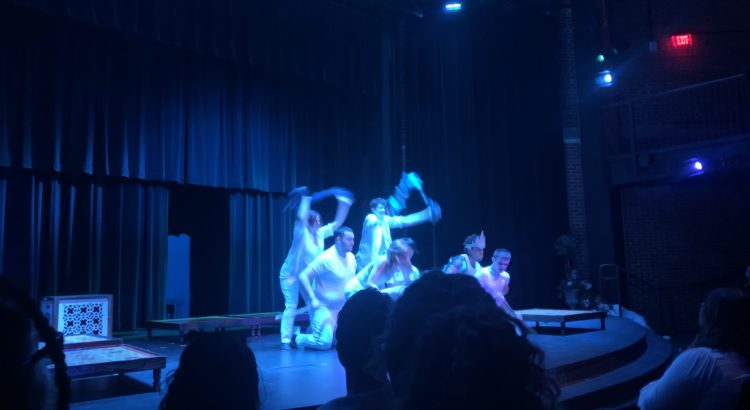
Bryce Foley and Maria Garcia Reyna in “Pomona and Vertumnus”

I was especially impressed with the success of the myths that were on the more humorous side. Like I said, it’s so easy to get this wrong through overacting, or an overly modernized version of the original text. Bryce Foley was my favorite in this respect, remaining fully deadpan when acting as Hermes, spinning Eurydice over and over. His best myth was Pomona and Vertumnus, where he played a slew of different characters including a solider, farmer, fisher, and grandmother. While the opportunity for overacting here was present, he gracefully avoided doing so, instead allowing lower-key body movements to elaborate on his range of costumes.

The entire crew was excellent in incorporating an array of fabrics as props, which mesmerized under the lights. Iris’ glittering golden wings seemed to reflect and hide at the same time. The motion of the fabric waves dragged me into the stage like the physical tide, a rip current of blue organza. A ruffling cape was able to flip from black to red with each minute movement. I only wish they had used more fabrics in the choreographed sections, as Iris’ jaunt across the stage was enough evidence alone to support that endeavor.

My only real critique of the show has nothing to do with the script or acting, but the music played in the background of each myth. Most were surprisingly tacky considering the quality of the rest of the production, sounding like something out of a kids’ version of a King Arthur story. This sometimes distracted from the scene at hand, especially in the more emotional ones. Other than that, it was a first-rate performance, and I would encourage anyone to attend another of theirs in the future.

A few upcoming events for all interested in more great theatre:

RC Players’ Evening of Scenes–January 31 and February 1, 8PM Keene Theatre

We the PROUD’s “What Was and May Be”–February 14, Keene Theatre


PREVIEW: It’s TAPpening

The last time I saw It’s TAPpening, the winter showcase from the RhythM Tap Ensemble, my review included quite possibly the worst lede I have ever written. Included here for posterity:

“That tappened. And it was, well, fanTAPstic.”

And though my puns were terrible, I enjoyed the 2018 show and it stuck with me. RhythM is the only group of its kind on campus; a dance company that focuses specifically on tap. While there are several contemporary, jazz and hip-hop troupes, RhythM is one of a kind.

So when I saw that RhythM was having its winter show this week, there was no question that I wanted to go.

If you’ve never seen a tap show, it’s a rhythmic, energetic and highly technical style of dance. While other types of dance emphasize primarily aesthetics, tap combines that with the sound of the taps on the shoes and how those sounds fit with the music. Though tap dancing is typically associated with Broadway musicals and old-time jazz standards, the last time I saw RhythM, they performed most of their numbers to current pop songs, with a few twists. You can watch videos of RhythM’s previous performances on their YouTube channel.

If you’re looking for a high-energy dance performance that showcases impressive musicality, rhythm and style — and a show you won’t see anywhere else — It’s TAPpening is for you.

It’s TAPpening is on Friday, January 24 at 7 p.m. at the Mendelssohn Theatre at the Michigan League. Tickets can be purchased online at $5 for students and $10 for nonstudents. The event is free with a Passport to the Arts. Doors open at 6:30 p.m.

REVIEW: Weathering with You

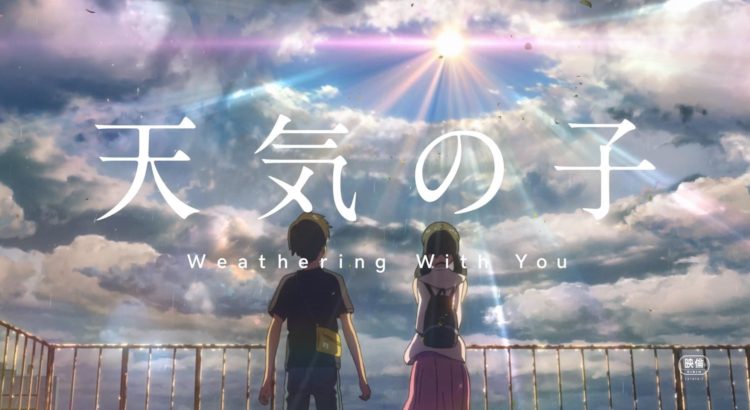
Makoto Shinkai’s Weathering with You tasted like something akin to cilantro: soapy, spritely, sometimes confusing, and ultimately, edible. The Japanese animated romance-natural disaster-fantasy film weaves an aesthetically compelling yet narratively lacking film about two young lovers brought together by the power of sunshine amidst Tokyo’s endlessly dreary summer rains. Hodaka, the male protagonist, is presented as an impulsive high school runaway who leaves the vaguely depicted discomfort of his hometown to chase a more unrestrained lifestyle in Tokyo. His story thus becomes entwined with that of Hina, a cheery “sunshine girl” whose prayers cause the city’s clouds to part for minutes of sunlight.

“I want you more than any blue sky.” – Hodaka Morishima, Weathering with You

The film motions towards gritty themes through the pair’s struggles with homelessness, the sex trade, and armed terror – which at times seem like decorative attempts to add dimension rather than gripping allusions to reality. Due to the sheer number of unresolved issues added to flavor the narrative, the film’s ending felt incomplete and soapy. I questioned the importance of certain ‘gritty’ motifs such as Hodaka’s recurring gun stint, and the development of his savior complex in response to Hina’s woes. I found Hina’s character, an orphaned “sunshine girl” fatefully burdened by dramatic choice, emotionally strong yet ultimately stifled by Hodaka at every twist and turn in the film’s plot. Though Hina braves mature duties to her brother, the eternal fate of Tokyo’s weather, and herself, Hodaka continuously leaps in to save his magical “sunshine girl” – most of the time without her consent. Hina’s acts of sacrifice exhibit both mental strength and a keen understanding of her fate with cumulonimbus clouds; however, they are selfishly averted by the ever-spontaneous Hodaka. Indeed, Hodaka’s character does not seem to view Hina’s personal decisions with the autonomous power that they deserve – eventually, Hodaka’s failure to recognize such leads to Tokyo’s partial submergence in water. I found this plot decision to be the most confusing and also the most inconsistent with the traditional collectivist views perpetuated in many East Asian countries like Japan – why value Hina’s corporeal existence over the entire wellbeing of Tokyo and its citizens? Is Hodaka’s intervention representative of the foolish nature of young love? Or perhaps, the stubborn inaction over climate change concerning Earth as we know it? 

Climate change and its ominous effects on the human spirit are central to Weathering with You; beyond the film’s narrative soapiness, the animation direction does a beautiful job of capturing the nuances of weather and mood. Hina’s characteristic hand movement of reaching up towards the sky, the newfound sunlight filtering through her fingers, is so distinctly human, and touching within the context of Tokyo’s depressing weather. The animations carry the same underlying thread of childlike wonder and curiosity throughout the film, transporting the viewer into a parallel universe set aglow with fantasy with every sunshine prayer Hina wills unto the clouds.

REVIEW: Weathering With You

I have to say, Weathering With You is the best anime I have seen  thus far. I absolutely loved this film. Makoto Shinkai has a way of writing truly original stories that take hold of a viewer’s imagination and immerses them so fully into the film that by the time the credits start to roll, you’re already making plans to see the film as many times as you can while it’s still on the big screen.

You may be rolling your eyes right now, but what I’ve just said isn’t an exaggeration. Makoto Shinkai is a genius and his work is so precious. There was a line out the door of the Michigan Theater an hour before the show started; a massive crowd of college kids huddling together in the cold, eyes shining, so excited to be there and I was obviously one of them. When we finally were able to shuffle our way inside, we were greeted by a slightly frazzled theater employee who announced that over a hundred tickets had been sold for the show.

The excitement for this film was a palpable thing that cruised throughout the theater as we all scrambled to get the best seats. The room was a roaring frenzy of voices and then, like magic, everyone fell silent as the screen came to life.

Weathering With You is at it’s heart, a love story. However, Makoto Shinkai is not one for cliches. So when I say ‘love story’, I don’t mean the various love triangles, hexagons, and octagons that you would normally think of. Weathering With You is something pure. It’s about a growing relationship between two young people, the love of father and daughter, the bond of a sister and brother, and the love for people who’ve been lost. All of these relationships are woven together throughout the movie, each one connecting and affecting the other. There is just a beauty to what Shinkai is able to do through anime.


The icing on the cake of course is the aspects of magic that Shinkai brought to Weathering With You, highlighting Japanese legends surrounding weather maidens, women who have the ability control the world of weather. Shinkai brought this magic to life with meadows that floated on the tops of rain clouds, fish made of raindrops and a girl who prayed for sunshine.

I’ve been careful not to give any spoilers because I really believe you should take a moment to watch this film, even if you aren’t the least bit interested in anime.

You won’t regret it!


PREVIEW: Minnesota Orchestra

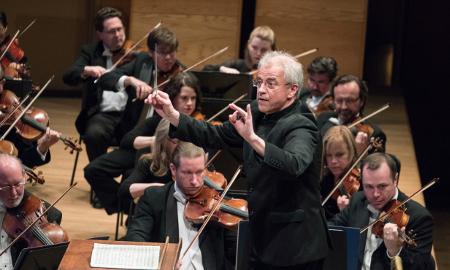
On Saturday, January 25th at 8:00 PM, join the Minnesota Orchestra at the Hill Auditorium as it returns for its first UMS performance since its 1972 debut in an all-Sibelius program, including the stunning and rarely heard  Snöfrid accompanied by the UMS Choral Union.

US-born Finnish Violinist Elina Vähälä will be making her UMS debut with Sibelius’s Violin Concerto, which features stunning technique and uncommonly beautiful melodies. The music of a melancholic winter makes this program a perfect concert for the end of January!

PREVIEW: NT Live: All My Sons

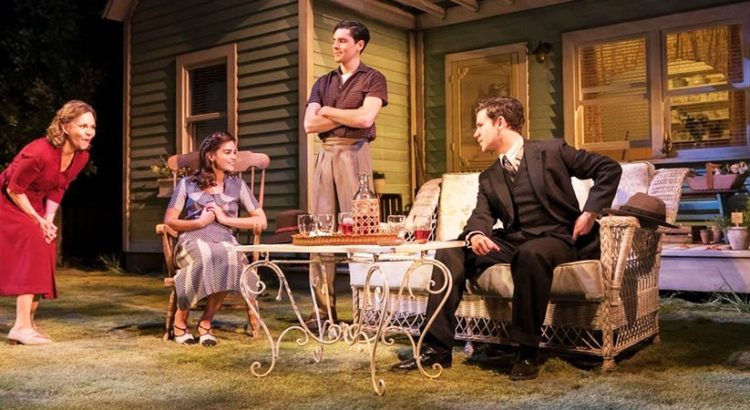
This Sunday, get ready to attend the Michigan Theatre’s presentation of Arthur Miller’s captivating drama, “All My Sons,” broadcast live in HD from the National Theatre in London.

Featuring Academy Award-winner Sally Field, “All My Sons” tells the story of a family’s secrets being laid bare, and the true cost of the American Dream.

This one-time screening event is taking place on January 19th at 7:00 PM. Be sure to take advantage of this unique opportunity to enjoy one of Arthur Miller’s most beloved plays!