
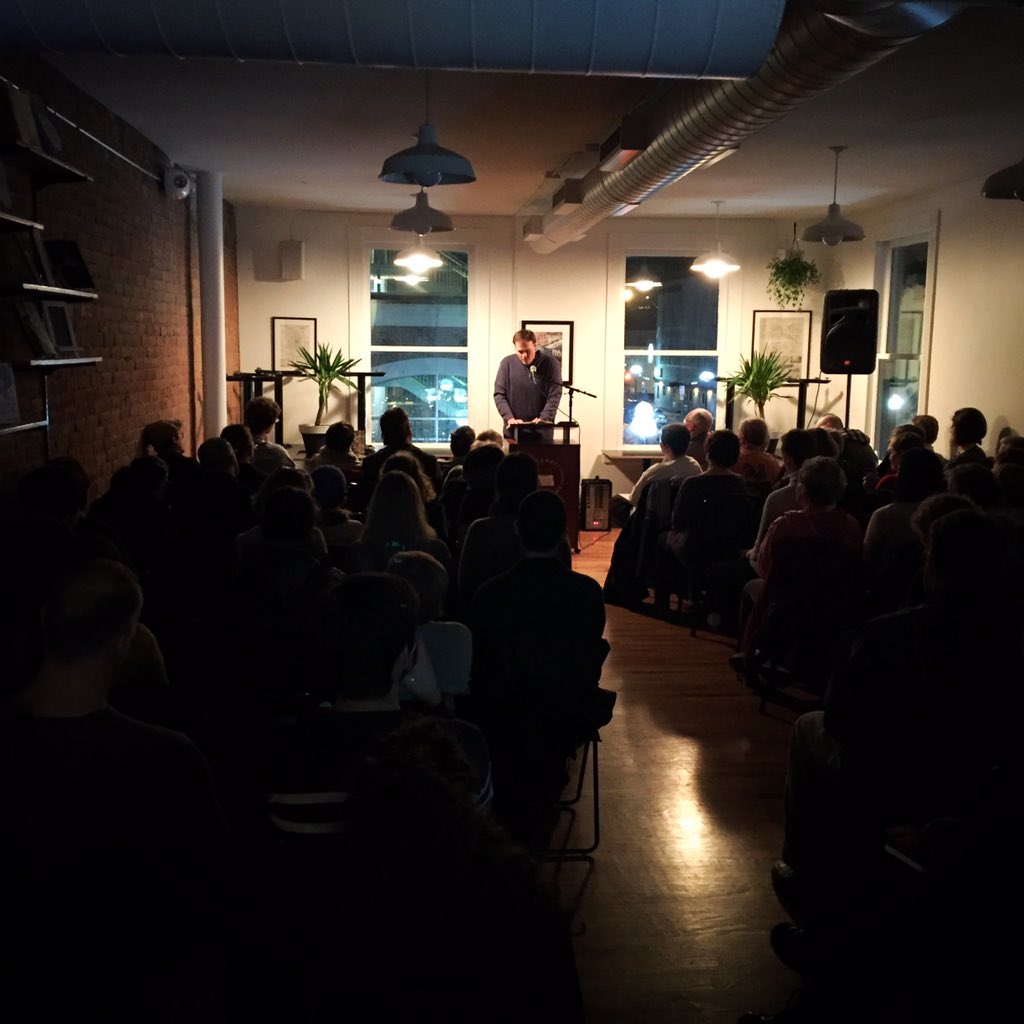
REVIEW: Garth Greenwell @ Literati

Photo Credit: Literati

“A city without a bookstore is a city without a soul.” Garth Greenwell used to teach in Ann Arbor, several years ago, during the unfortunate period between the closing of Borders and the opening of Literati, when there was no place for to buy new books in Ann Arbor and even in the rest of the country, it seemed a desperate time for the bookstore. He started his reading by talking a bit about coming back here (including a shout-out to his former students in the audience) and expressing his joy that a place like Literati had sprung up in the city.

The reading was underway shortly. He opened with a scene between Mitko and the main character, the latter asking questions about the former, attempting to shift his way through Mitko’s past. There was Bulgarian vocabulary here and there, which Greenwell would stop to expand upon the word and why it was used. There was something jilted in the way he would pause to explain, as if the word had caught him off-guard, like someone else had slipped it in there. Although this was obviously not his first reading (he had previously done rounds for his novella Mitko), there was still something in these stops and in his demeanor that made it seem like he was still getting used to this. It’s most noticeable in his body language–and perhaps it is just how he always is–but he has this way of folding in on himself. There’s a hunch in the back, a slope to the shoulders, a tucking in of the chin, and not to mention the slightest of sways–it might be nervousness, or maybe it’s just a general anxious energy, it’s hard to discern the difference here.

But, whatever it is, whatever we choose to call it, it doesn’t detract from the reading. This is largely because Garthwell has a rather evocative reading voice. Many authors can read their work sufficiently–they can read it in pleasing voices that hit all the right notes, read it as it was intended–but few can really take you into the story, the moment. When Garthwell read, there was a sense of urgency, a rising panic that propelled one through the words and along the path of the story. It wasn’t the typical soft-spoken lullaby that many authors fall into, yet, it also didn’t sting or hurt to hear.  The fact that the words he was reading were beautiful (“in that foul air, I felt him identify me as foulness”) probably also helped. This was particularly noticeable in the last two sections he read (one about an experience with a boyhood friend and the other about the narrator’s sexual encounter with Mitko after a period of separation).

Greenwell took a few questions after the reading and they primarily revolved around homosexuality and literature. He talked about his experience as a closeted gay boy growing up in Kentucky and later as an openly gay teacher in Bulgaria–and how, because of these experiences, Greenwell emphasizes the importance of waiting to come out. Many people, both past and present, have taken a militant stance towards this issue: if you are gay, it is not your right but your duty to come out. However, Greenwell is more of a realist on the matter and he recognizes the issue of safety–for many, young people in particular, in can be quite a dangerous thing to admit to their world, their culture, their people that they are gay. According to Greenwell, being gay means that your life has “no value, no dignity.” This is one of the reasons that he writes books like What Belongs to You and identifies as a gay writer; when he was closeted and alone and unsure of the world and himself, discovering books like Querelle of Brest and Giovanni’s Room and witnessing homosexuality written as not something vile but real, things like this “saved his life.” Being a “gay writer” does not limit him or put him in some box and as he stated quite wonderfully, “to turn something into art is to make a claim about it, to claim it has value.”

My only real qualms about this reading and question section afterwards is that it was much, much too short.

Preview for The Big Short

We as a society often discuss the lingering effects of The Economic Downtown (a friend’s mother started calling it Ted) or the Global Recession of 2008. More specifically: That the middle class is now disappearing because of it; that regulation is now needed otherwise 2008 will be a repeat, that the housing industry is back, and yet that the recession is over but is the economy is not well. But do you know how it happened? Perhaps you have had a class where there was a discussion of mortgage backed-securities, ratings agencies, bank bailouts, but you yourself are still a bit fuzzy on what all these terms mean?

Well, truth be told, I took a class on an economic sociology class entitled “Economic Crisis” focusing a bit on the housing market, and on the 2008 recession. And as someone who is at times fascinated by economics and particularly the economics behind the Great Recession, I always seem to be watching something on it. For instance, I saw Capitalism, a Love Story when it came out in theaters, then on DVD again, and then I saw Inside Job, Queen of Versailles, and the Madoff Mini Series etc.

Well for those of us who would like a low-down on the economics behind the Great Meltdown, then this is the movie for you!!! This movie brings about famous guests (Spoiler: Selena Gomez and Margot Robbie) to explain economics of the mortgage crisis. But, it is a comedy and showcases different types of comedic acting and characters who not only understand economics but have interesting and at times head-shaking quirks. The narration and vibrant settings make this film even more appealing. But the most unique aspect of this film is that unlike the other films on the same subject matter- this one showcases the main characters as people who foreshadowed the recession and tried to warn others. How they figured this out and went about this, needs to be seen. Go see it.

REVIEW: Taylor Mac

Photo courtesy of the artist.

For three hours, two nights in a row, Taylor Mac captivated audience with some “Radical Faerie Rituals” — where judy takes the lead and “controls” the audience. The result was a room full of people being uncomfortable, challenged, and educated. (Taylor Mac uses “judy” as a pronoun.) Taylor’s superb theatrical and musical talent, as well as the band’s virtuosity and the design team’s impressive creation of visual elements, made these nights very memorable and enjoyable.

On February 5 and 6, Taylor Mac presented “A 24-Decade History of Popular Music: 1956–1986” at the Mendelssohn Theater. This project looks at music popular in the United States from 1776 to 2016, and with each of these 24 decades, Taylor features stories of various marginalized communities. In October, this project culminates in a 24-hour long concert (or “ex-tra-va-gan-za” as Taylor would say), one hour per decade.These performances comprise of many things: history, activism, identity politics, drag, Elizabethan fool, glitters, and of course, popular music. Ann Arbor audiences enjoyed the workshop version of Act VII, consisting of three decades: 1956-66, 1966-76, and 1976-86. In addition to that, Taylor Mac, musical director Matt Ray, and designer Machine Dazzle did a residency for a week, where they visited various U-M classes, served in panel discussions, and facilitated workshops.

I must admit that I might be just a little biased about Taylor. I had an internship with UMS and SMTD, with which I was able to work with judy and Pomegranate Arts, an independent arts production group. During my two months there, I observed five shows and a couple of rehearsals. Because of this, the visit to Ann Arbor by the band members and production team felt like a reunion. (Read about my experience here.)

I also experienced these performances a bit differently from the regular audience members; I was one of the four “Dandy Minions” — I guess you could call us stage hands with lots of costume and makeups, offering some dandy help to Taylor. We were part of the visual element to the show, with our own “drag.” It was SO much fun to make a fool out of myself with three of my wonderful co-Minions.

Ann Arbor Dandy Minions!

When you walk into Taylor’s performance, you realize it’s not a typical performance. You’re walking into Taylor’s church. And in a church, you listen to the preacher — because the preacher has pretty darn good things to say about identities, activism, and history through music. Also, it’s much more fun if you challenge yourself to get out of your shell and let yourself do whatever is being asked. I remembered the excitement that I first felt with Taylor’s performance back in June 2015; I believe and hope that the audience members from those two nights got the same chills I got.

PREVIEW: Garth Greenwell @ Literati

Garth Greenwell’s debut novel, What Belongs to You, since its release last month has had countless reviews lauding it. For a debut novel by an author with only a novella and some short fiction here and there under his belt, to be talked about as much as it has is something special. Some critics are even going so far as to call it “The Next Great Gay Novel.” The book tells the story of a man’s relationship with a young “hustler” named Mitko, and how their pasts, their cultures, and their fates intertwine.

Tonight, Garth Greenwell will read from What Belongs to You at the cafe above Literati. The event will start at 7 pm, but as always, get there early if you want a seat.

REVIEW: Momentum

Momentum, which showed Thursday through Sunday of last week, was a showcase concert from the University of Michigan’s dance department. The program consisted of four works: Big Weather, Cheating, Lying, Stealing, Goodbye to Wayward Flesh, and City of Rain, choreographed by various members of the Department of Dance faculty and guest choreographer Camille A. Brown.

The first piece, Big Weather by choreographer Peter Sparling, was a commentary on climate change. It was urgent, compact, and intense, much like its soundtrack: Michael Gordon’s “Timber,” a heavily-layered percussion piece. Onstage, the dancers were in a constant state of emergency and scrambling to find their way out. The stage was busy with groups of dancers in different sections of the stage delivering expansive, synchronized movements, occasionally crossing through each other’s space with frantic energy. The choreography and accompanying video was geometric and entrancing.

The earthy color scheme of this piece contrasted starkly with the bright lights and grey suits of the next piece, Bill DeYoung’s Cheating, Lying, Stealing, which explored toxic office dynamics. The soundtrack was David Lang’s forceful, jolting composition of the same title. This choreography had more of a narrative, with cliques of dancers interacting with each other in derogatory gestures. Their movements were swooping and aggressive. I admired the consistent, fiery energy with which they portrayed the narrative.

The quirkiest piece on the program was Amy Chavasse’s Goodbye to Wayward Flesh. The stage was set up with a mannequin duct-taped to a wall, a bright red, winding staircase, and a life-sized llama watching a TV with static. The costumes (Jean Luc Deladurantaye) and soundtrack (Simon Alexander-Adams)  both effectively reflected the choreography’s playfulness. For the majority of the piece, a large ensemble of dancers were onstage and interacting with each other with unpredictable, whimsical movements. The piece closed with a lone dancer (Paula Modafferi) jumping up and down, eventually realizing she had been abandoned by the rest of the dancers, and then climbing up the red staircase while removing her costume.

The show ended on a hopeful note with Camille A. Brown’s City of Rain. The work featured a blue color scheme, an evocative soundtrack by John Melville Pratt, and costumes with soft outlines. The dancers bloomed with the music, slowly emerging and increasing the scale of their movement. The choreography flowed seamlessly from a timid beginning to a triumphant finale.

The diversity of Momentum was remarkable; a wide variety of colors, music, and themes were represented, and the intricate choreography was performed with strong conviction by the students of the dance department.


REVIEW: “Closer”

This weekend I attended Basement Arts’ production of “Closer”. Settling into my straight black plastic chair in the Walgreen Drama Center’s Acting for the Camera Studio, I looked around at the set. It was sparse and had a minimalist vibe that fit my expectations for an edgy, content driven play.There were two projectors (admittedly sitting rather awkwardly at the front of the stage, dead center), two screens, a couple chairs, a few square stools, one table, and some odd and end filler pieces.

12670080_10153954729367139_3062274820129600491_n
Photo courtesy of Basement Arts CLOSER event page

Considering the intimacy of the small studio, a minimalist set was a practical option. The space contained only 40 seats total, lining three of the four walls so the play was almost in-the-round. This venue worked for the story, which had only 4 characters whose lives interconnected more and more intricately as the play went on. Certain scenes had all characters on at once, usually acting out two separate scenes within the same space. As an audience member I felt and saw for myself how trapped the characters felt. My favorite scene, and use of space in the show, was when Anna is telling Larry she’s leaving him for Dan. Dan is simultaneously telling Alice he’s leaving her for Anna. Alice runs from the room and Dan dashes after her right between the argument Anna and Larry are having; he was both physically and figuratively coming between the couple. It was a moment of symbolic genius.

Throughout the show props were brought on and off by the actors as they sat unobtrusively in seats at the corners of the stage when not performing. As there were no wings, they occasionally changed clothes discreetly in their sideline seats for the next scene. They also played an important role in setting lighting for the show. Between scenes they quickly clicked on and off living room light fixtures, the mellow illumination adding to the intimate vibe.

Despite pictures being projected on the screens to give us a sense of place, it was often very confusing as to when they were. The play spans a significant length of time, with characters changing their romantic partners on a rotating basis, making it all the more complicated to gauge when a situation was occurring. There would occasionally be line references but at that point in a scene I was usually too far into the dialogue and lost as to how much time had passed. While the previous scene might have taken place within a day, the next might not be until a year later. A simple fix, I believe, would have been to use the projectors a bit more and add a date in the corner of the scene’s image.

This difficulty with the conception of time also made the few flashback scenes in the show doubly difficult. There was no change in the actors’ personas when a flashback occurred and with the already ambiguous time frame, it was a game of guess work with the audience as to what made up the flashback and what was happening in “real” time.

12657980_10153941288382139_1049065090038255267_o
Photo courtesy of Basement Arts CLOSER event page

As to the show’s actual content, I wanted it to be more feminist than it was. Women were treated, as Larry stated in the show, as the valued “territory”. The women pursued the men just as avidly as the men pursued the women but there was a sense of uneven power (weighted in the men’s favor) that pervaded the play. While its depictions of sexuality, desire, and relationships were refreshingly frank, Patrick Marber, the playwright, looked only through the lens of heterosexuality. While one can’t expect a single play to do everything, I personally feel Marber’s message about love and sex could have benefited from some diversity.

Those, however valid, are script critiques and not matters of performance choices. This show did give both women and men some agency and freedom to express sexual desire. Though it cast a slightly ghastly portrayal of humanity’s carnal nature, there was also a lot of humor splashed throughout the play. The cast really capitalized on those moments, almost springing them on us with their casual delivery, and made them all the more surprising and delightful because of their unemphasized delivery. Some of the humor wasn’t even lewd or morbid.

It was not a happy play and by the end of it I was emotionally exhausted. Because of this, I consider the cast’s performance a success. There was chemistry among all four actors. The sex, betrayal, lies, frankness, and brutal honesty of the show were handled by an unflinching cast. They tackled the gritty nature of this play with an odd eagerness; perhaps because it allows us to voice and actually discuss some of the taboo subjects about life and love society has decided we shouldn’t.

Check out this video with some highlights from the show!