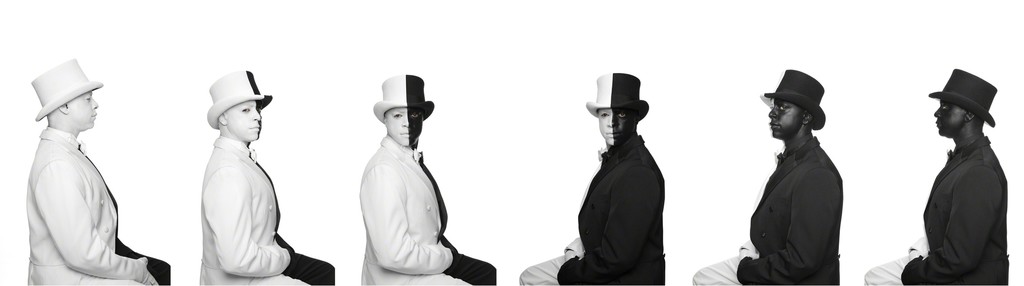
REVIEW: Stamps Speaker Series- Hank Willis Thomas

Prior to tonight’s lecture I knew little about Hank Willis Thomas aside from the fact I had seen and been particularly struck by one of his pieces in the Detroit Institute of Art.  I had no idea what a treat that night would be.

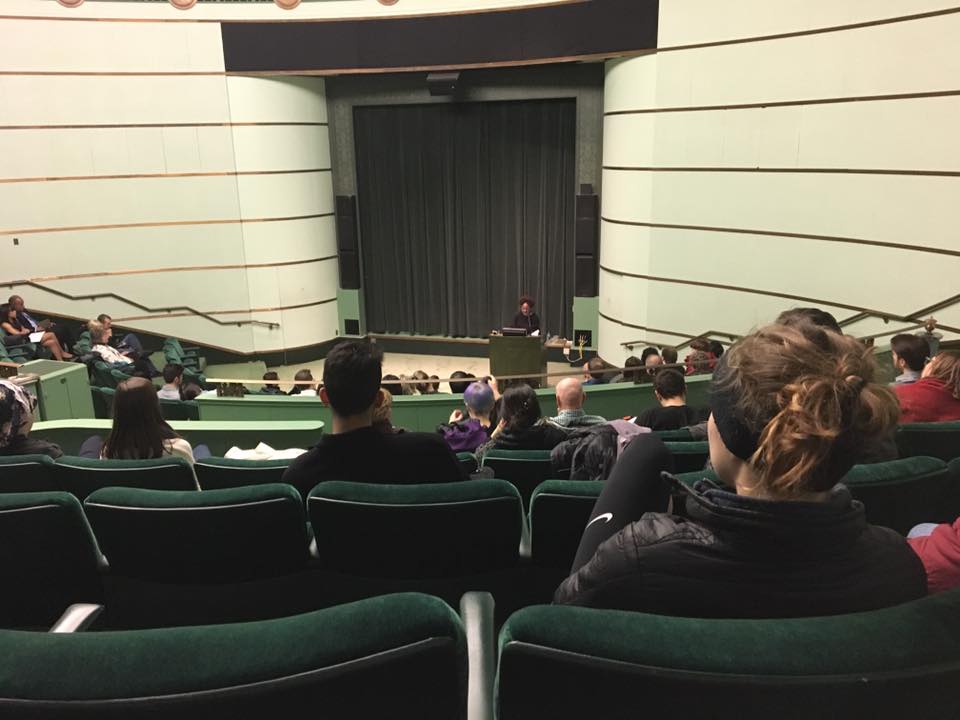
When Thomas walked out onto stage in a still brightly lit theater, phone clutched in hand, I’m sure many of us were unsure what to think. He said he then wanted us to start off the night with a collaborative project, to take a picture of a stranger or friend sitting nearby and post it on social media with the hashtag “#thetruthisIloveyou.”  You can find a smattering of these photos on his twitter account here.   This immediately set the tone for the overall optimistic and hopeful presentation, despite the dark subject matter.

Hank Willis Thomas and his Mother

After this brief activity, the lights were dimmed and Thomas started his presentation by introducing the audience to his mother, a talented photographer herself.  He told us about how his mother was once told by a college professor that she, as a woman, was taking up the space of a “good man.”  She carried those words with her for the rest of her life, but in spite of that professor, she has gone on to publish books well into the double digits and is currently a professor at NYU.

He then transitioned smoothly into talking about his own development as an artist.  Thomas said that he had not originally planned to become an artist, but rather fell into the role after his close cousin was murdered in 2000.  Finding himself lacking motivation and drive, Thomas eventually found his way into the artistic field.


An image from a sweater ad

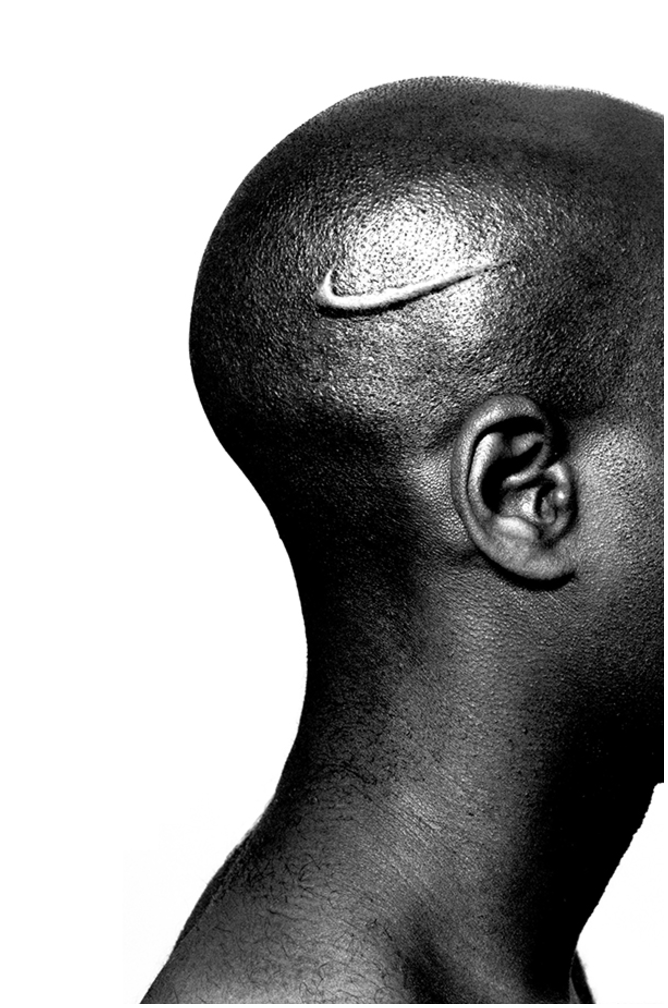
He then took us chronologically through the various pieces and series that he has done. He began to talk about his fascination with framing, and how the theme of frames showed up in many of his college works.  He also produced the B(r)anded Series in which he explored the African-American male body in relation to popular brands and advertisements.   He was particularly fascinated with taking advertisement and stripping away all of the words and identifying information to let the images speak for themselves.  He showed us the various depictions of women throughout the last century, first showing the image and then making his audience guess what the ad was actually for.  It was an eye-opening and sometimes chilling experience.


He then talked about this idea of reformatting images and advertisements so that they can be viewed in a new way.   He would find photos that particularly resonated with him, often of apartheid South Africa, and then find a different way to frame those events, often through cast sculptures where only parts of the original photograph will be shown, leaving the viewer to fill in the rest of the information.


Lastly, he finished up the speech by showing some of the video recording from people across the globe for the  “The Truth Is” traveling project.  This project involved a recording booth shaped like a giant speech bubble that simply says “truth” that was then placed in high traffic areas. Civilians were invited into the booth to record a short video telling what they believed “the truth is.”  One of the most touching and heart wrenching videos, especially because of the recent developments in the news, was of a little boy not even 8 years old who wanted to share the truth that Muslims, like him and his family, were good, peaceful people.
One of the most inspiring things about his presentation, was how captivating of a speaker Thomas managed to be.  He managed to be calm and yet passionate at the same time, providing a wonderful and entertaining balance that still remained informative.

When Thomas finally walked off the stage, there were whoops and cheers scattered among the fervent applause, making this the warmest and most enthusiastic sendoff of any speaker I’ve seen here yet. True to this reception, the Q&A session was the most well attended that I had seen so far, while still remaining fairly small and intimate in the Michigan Theater’s annex. Thomas got to answer questions ranging from his work, to his history as an artist, to his political views.

You can find out more information about Hank Willis Thomas at his website. The STAMPS speaker series is free to the public and is offered every Thursday at 5:10 at the Michigan Theater.  You can find a full list of the upcoming speakers here. 
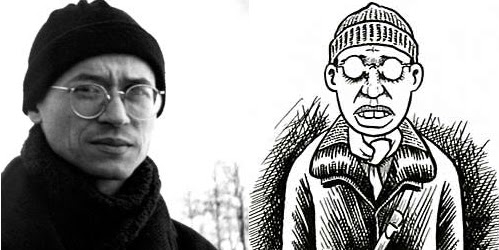
Photo Sources- 1, 2, 3, 4, 5


REVIEW: Stamps Speaker Series- Joe Sacco

I had heard rumblings that the night’s guest would draw a larger crowd than usual but I wasn’t prepared for how large the crowd might be.  As we filed into the theater from the packed lobby area, it was difficult to find an ideal seating spot. This presentation was co-presented with the University of Michigan International Institute’s Conflict and Peace initiative, and the official Stamps website contains a full list of the sponsors for the night.

Tonight’s event was not a formal speech, but more of an open discussion between the guest Joe Sacco and a host from the International Institute’s Conflict and Peace Initiative.  As the discussion proceeded different images of Sacco’s work were projected onto the screen behind them, and while switching from photo to photo could be highly distracting it was a nice visual supplement to the presentation, and often was used as a conversation point.

Joe Sacco, as we gradually came to know throughout the course of the talk, had originally received a degree in journalism at the University of Oregon, before finding that creating comics was both a way to indulge in his passion for art and to reach a wider audience that are put off by long history books and dense articles.  He approaches his subject matter in the same way a war correspondent might.  He traveled the world, and his very first comic, Palestine, was directly based off of his personal travels through Israel and the West Bank.  Some of his award-winning works include Footnotes in Gaza, Days of Destruction, Days of Revolt and Safe Area Gorazde.  He is highly regarded by comic lovers and news junkies alike for his careful research and thoughtful approach to delicate and politically charged subjects.

When asked what inspired his work and the topics he chooses to work on, Joe Sacco responded quite succinctly that anger above all else was the driving force behind his comics.  He looked for topics that created a sense of frustration or injustice in him, and just as importantly ones that he would maintain a passion for the many years that it takes to finish a single piece.  He also discussed his dislike of the word “graphic novels,” because of how his works are not novels despite fitting under that subcategory.  He admits, however, that the word is here to stay and will use it himself when describing his occupation to others.

One of the very first panels from “The Great Wall”

One piece that was discussed quite thoroughly was Sacco’s 24-foot-long graphic tableau “The Great War.”  Sacco spoke briefly about how fascinated he was with World War I while growing up in Australia, where that war takes up a large part of their cultural identity.  His inspiration for this specific piece was The Bayeux Tapestry, and he wanted to create a similar narrative scroll that told a story when read from left to right.

middle segment of “The Great War”

As an artist, I also found the discussion of the artistic styles to be quite interesting.  Sacco talked briefly about his upcoming project and how he will be turning traditional comic styles on their head in order to better convey the meaning and message that he wants to.  He’s working on a project about the indigenous peoples of Canada, and as such is experimenting with creating comics with no borders and an aesthetic style that focuses heavily on nature and natural forms.  He believes this will better fit the ideology and tone of the work itself, as the groups he will be focusing on have a specific way of thinking about nature.

Panel from his book “Days of Destruction, Days of Revolt”

As the crowds streamed out of the theater and into the brisk night air, we were once again greeted with live music.  A long line of people waiting for autographs trailed up the staircase to the second balcony, further proving the popularity of tonight’s speaker.

If you would like to check out more of Joe Sacco’s work you can purchase many of his books from amazon here.  The STAMPS speaker series is free to the public and is free to the public and is offered every Thursday at 5:10 at the Michigan Theater.  You can find a full list of the upcoming speakers here.


pictures from- 1, 2, 3 


REVIEW: Tracy K. Smith Poetry Reading

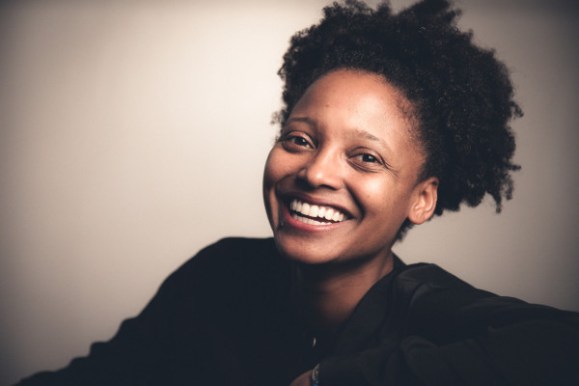
The woman introducing Tracy K. Smith immediately piqued my interest regarding the poet.  Quotes along the lines of “she changed my life,” “she has finally made sense of being a human being,” and she can “write about anything and turn it into unforgettable art” were prominent in the speech.  At the end of it, I was on the edge of my seat waiting for Smith to begin her reading.

Tracy Smith read nine of her poems.  In the few poetry readings I’ve attended in my life, I’ve noticed that all of the poets seem to read their work in the same mellow, soothing voice.  In fact, the only time I’ve ever heard someone read with emotion was at a poetry slam event I attended last year.  These vocal inflections are, as I have come to understand them, necessary to a poetry reading… but honestly, it took away from my experience at Smith’s reading.  She had very powerful language in her poetry but the way she was performing them made them seem almost dull.

Not to say that her voice wasn’t a good reading voice.  It was.  She has an almost melodic method of intonation that added resonance and ambiance to her poems.  For instance, the first poem Smith read was called “Unrest in Baton Rouge” after the photo by Jonathan Bachman.  A prominent quote from this poem was “love is a language we all speak.”  Smith’s calm intonation added to the image her language was trying to paint.  Phrases such as “ink dark blood” really caught my attention.

In another of her poems, Smith referred to a sky that was a “dry, pitiless white.”  If you were outside earlier today, this was a perfect method to describe our weather.  Today wasn’t the dull, monochromatic gray associated with January skies in Michigan, but lively and unforgiving.  I thought that was a beautiful part of the reading.

The third poem Smith read was an assignment from the National Portrait Gallery on an exhibition of photos coming out of the Civil War.  She claimed she wanted to immerse herself in the lesser heard voices from that history.  The poem was called “I Will Tell You the Truth About This, I Will Tell You All About It.”  It was a long, found poem that she only read excerpts from.  All of the poem was supposedly a letter addressed to President Lincoln regarding the struggle, among other things, of one not knowing one’s own age after having been freed from slavery.

Later on in the reading, Smith discussed how she was captivated by her seven-year-old daughter’s “fierce, wonderful will.”  Her fifth poem talked about the particular things her daughter enjoyed (for example, cereal… but not the crunchy kind) and was overall a very sweet declaration of love.  Her seventh poem was also about parenthood.  Prominent quotes from that poem were that you “give all you can spare and then give more” and “we are shaped…by what we love.”

Smith was joking by the end of her reading, trying to find “something less depressing” to read.  She settled on a poem about the “roiling infinity of space” that I thought was beautifully written.  The language in the piece conveyed the vastness of the universe in a way I was able to comprehend (which, according to my astrobiology professor, is very difficult to do).

She closed with a political poem, as she referred to it.  She had originally dreamed up the poem, saying that in the dream she was consciously trying to remember the poem to write down when she woke up.  The original title was changed after this recent election as Smith attempted to acknowledge the anxiety the results of this November have brought to the world.

Review: University Symphony Orchestra Concert

It was a wonderful concert. It goes without saying that the University Symphony Orchestra performed beautifully last night, and I loved both sets of music. They began with Mozart’s “Jupiter” symphony, and the first thing I noticed was that when they began playing, the bows of the violin section all moved in unison. I don’t think I’ve often seen movements so crisp, which is a symbol of the orchestra’s caliber. I heard the same thing when in the same movement there occurred a series of grace notes, which due to their rapidity can be easy to miss or blur. Instead, the unity I heard was stellar. I’ve heard much of Mozart’s work, but “Jupiter” was something entirely different. In most of his other work I find a certain delicacy in his melodies, even in his more intense pieces. While that’s still true here, the balance in “Jupiter” is definitely tipped towards grandeur and not daintiness.

After the intermission, they played Holst’s “The Planets”. It was a fantastic performance. I’ve never heard such overwhelmingly powerful music before. Nor have I seen such instrumentation (this was the first time, I think, that I recall seeing an alto flute played in concert, and that wasn’t the only unusual instrument there). This was the highlight of the programme, as the entire suite has been set to a visual accompaniment by José Francisco Salgado, a UM alum, who came onstage to introduce the piece. The visuals were a montage of photographs, renderings, and videos, set to move as one with the music. I was not quite sure what to think of the film. Sometimes it seemed like just a montage of images, which I realize is a result of our limited capability to document these planets. I thought Mars was the most polished piece, and I believe that’s because there was more of a thread to follow there. We’ve also done the most research on Mars and therefore have plenty of videos and time-lapse imagery, which Salgado was able to time wonderfully with the music. On the other hand, the other movements were mostly photographs and artists’ renderings. The “Neptune” movement contained, I thought, less footage of Neptune than it did of the stars, which, while intentional and beautiful, eclipsed Neptune.

I also had some difficulty identifying the scientific concepts that Salgado intended to convey through the film. I wish I had been able to attend the panel discussion beforehand, because I think they would have discussed the science present in the footage and given me some things to look for. However, the programme made a close substitute, because for both “Jupiter” and “The Planets” there were detailed musical descriptions of each movement. I really appreciated the historical and musical context they provided. That said, I’m glad the film was there as an accompaniment. The film added color, which was valuable because, thanks to photography and digital renderings, we’ve always seen astronomical pictures in bright colors. Furthermore, the timing was done very well, which, in a musical piece, is an essential element. This combined with the forceful nature of Holst’s music made the entire thing simply awe-inspiring.

REVIEW: Patriot’s Day

I was sitting at my dining room table doing homework when I heard. I had taken a break to check Facebook when I saw that 2 explosions had gone off near the finish line of the Boston Marathon. At the time I was very saddened and scared as I watched the television coverage of the bombing, the injured, and the dead. However, unlike most people, who slowly forgot as time passed, this particular bombing stayed with me and affected me more as time went on.

At the time of the bombing I had recently received my 3rd knee surgery and the doctors had told me I would never run again. Fast forward to today, and I have run 2 marathons and am very passionate about running. One of the things that effects me the most is that the Boston Marathon is the only public marathon that you have to qualify for. I would consider myself a fast marathon runner, but the Boston Marathon is a race that I may only be able to dream about racing. That is what I think is lost on some of the general public. The runners on this day are elite runners for their age group. The bomb wasn’t set off at a regular marathon, which still would have been catastrophic, but it was set off at the Boston Marathon, targeting not only the innocent bystanders but also runners who had spent months training not only to run this race but also months of hard training for the race where they qualified. For someone who is a runner, Boston is a dream, and on that day many dreams were shattered for families, spectators, and racers.


Patriot’s Day is about the 2013 bombing at the Boston Marathon. We see much of the tragic event through the eyes of Tommy Saunders, a fictional policeman created specifically for the film. Specifically we see the events of that infamous day as well as the long manhunt and investigation of the bombers.

patriots-day-san-francisco-movie-review-2

This movie does an excellent job with pace. From the time of the bombing till the last bomber is caught, a span of 3 days is covered. In those three days a lot happens strictly with research and the processing of information within an office; yet, Patriot’s Day does an excellent job at keeping these times suspenseful and full of emotion. Furthermore, the cinematography plays well into the events being shown. The portrayal of the bombing is permeated with shaky shots including a shot where the camera falls to the ground. The chaos is visually apparent as the camera is jolted around and splattered with blood. This same style is apparent again in the shootout later in the movie. The camera work brilliantly and unapologetically shows the fear and the gore associated with the event.

Even for someone who was very familiar with the events that happened back in 2013, I was still surprised multiple times while watching the movie. So much is shown from behind the scenes of the investigation that I had no idea was going on. Patriots Day will undoubtedly give you a new important perspective on the bombings, no matter your previous knowledge of the event.

040616_PATRIOTSDAY_KB_462.CR2

Even while cringing and letting tears fill your eyes you will not want to look away from the dramatic investigation. Patriots Day works so well as an intense, climactic piece that you will forget you are watching true events unfold. The mixture of real and recreated footage serves as tough reminder that real people lived through this horror. Overall the strong acting and unique camera work makes this movie an important must-see.

PREVIEW: Tracy K. Smith Poetry Reading

The Hopwood Underclassmen Award Ceremony will be tomorrow from 3:30-5:30pm.  It is free and open to the public!

Tracy K. Smith, the author of three collections of poetry, The Body’s Question, Duende, and Life on Mars (winner of the Pulitzer Prize for Poetry in 2012), and a memoir, Ordinary Light (a finalist for the 2015 National Book Award in Nonfiction), will give a reading after the awards have been announced.  She also was the 2014 recipient of the Academy of American Poets Fellowship.  Chancellor Toi Derricotte noted that, “The surfaces of a Tracy K. Smith poem are beautiful and serene, but underneath, there is always a sense of an unknown vastness. Her poems take the risk of inviting us to imagine, as the poet does, what it is to travel in another person’s shoes” (poets.org).

I’ve never read or heard any of Smith’s work before and am looking forward to doing so tomorrow!